How to Evaluate B2B Data Vendors for Accuracy and Compliance
Written by:

Junaid Hussain Khan
Best B2B Leads Databases in 2026: Verified and Compared
> Best B2B Leads

TL;DR
- A reliable b2b leads database should verify emails and phone numbers on a regular cycle, not just at the point of collection.
- Accuracy claims mean little without a published verification methodology. Ask every vendor how they test deliverability.
- Company size, job title, and technographic filters matter more than raw record count when you are trying to reach real decision makers.
- Most B2B teams lose pipeline to bounced emails and disconnected numbers long before they lose it to bad messaging.
- Built-in email verification, Chrome extension access, and CRM sync are now baseline expectations, not premium add-ons.
- ReachStream Prospect combines verified B2B contacts with a built-in verifier so sales teams do not need two separate subscriptions.
- Compliance (GDPR, CCPA) is not optional. Confirm how a provider sources and refreshes its data before you sign a contract.
- The best B2B database for you depends on your target market, your outbound volume, and how often your ICP changes.
Introduction
Every sales team has felt this pain at some point. You pull a list of 500 contacts, load them into your outreach tool, and by the end of the week half the emails have bounced and a third of the phone numbers ring dead. The problem usually is not your messaging. It is the b2b leads database you built the list from.
Choosing the right source for B2B contact data is one of the highest-leverage decisions a revenue team makes, and it is also one of the most overlooked. Sales leaders spend weeks refining cold email copy and call scripts, then run all of that effort through a list nobody actually verified.
In this guide, we will walk through what separates a dependable B2B leads database from a bloated one, how to evaluate providers with a clear framework, and where ReachStream Prospect fits if you are trying to consolidate your prospecting stack. By the end, you will know exactly what to check before you commit budget to any B2B database provider, and you will have a repeatable way to test data quality instead of taking a vendor’s word for it.
Why Your B2B Leads Database Choice Actually Matters
Outbound sales runs on trust in the data. If your SDRs cannot trust that a contact’s email address and phone number are current, every other part of the process breaks down.
Common Mistake
Many teams treat B2B leads data as a one-time purchase instead of an ongoing resource. Contact information decays fast. People change jobs, companies get acquired, phone numbers get reassigned. A list that was 95% accurate six months ago may have significantly lower accuracy today.
Here is what a weak B2B sales lead database actually costs a team:
- Wasted SDR hours: Reps spend time manually re-verifying contacts that should have been clean on delivery.
- Damaged sender reputation: High bounce rates on cold email outreach get domains flagged or blacklisted.
- Missed quota: Every bounced email or disconnected call is a lead that never had a chance to convert.
- Bad reporting: Leadership sees low reply rates and assumes it is a messaging problem, when it is actually a data problem.
Industry Insight
Poor data quality is often identified by sales operations teams as one of the top reasons pipeline forecasts miss their targets. It is rarely the flashy reason, but it is one of the most common ones
This is exactly why the selection process for a B2B contact database deserves the same rigor you would apply to choosing a CRM.
What Makes a B2B Contact Database Reliable
Not all B2B databases are built the same way, and the differences show up the moment you start sending outreach.
Verification Frequency
A verified contact is only as good as the last time it was checked. Look for providers who verify emails on a rolling basis rather than a one-time scrape. Real-time or near-real-time verification, ideally through a built-in email verifier, catches role changes and defunct addresses before they hit your sequence.
Depth of Filtering
A large record count is meaningless if you cannot narrow it down to your actual buyer. The filters that matter most for B2B lead prospecting include:
- Job title and seniority level
- Company size (headcount and revenue band)
- Industry and sub-industry
- Geographic location
- Technographics (what software stack a company already uses)
- Department and functional area
Multi-Channel Contact Data
Email addresses alone are not enough anymore. The strongest B2B contact and company data providers also surface direct-dial phone numbers and mobile numbers, so reps can build multi-touch sequences instead of relying on email as the only channel.
Tip
If a provider only offers email addresses with no phone data, ask directly how they source mobile numbers for other plans. A database with only one contact channel per record limits your outreach options significantly.
Compliance and Sourcing Transparency
Any B2B database provider you consider should be able to explain, in plain language, where their data comes from and how they stay compliant with regulations like GDPR and CCPA. If a vendor cannot answer this clearly, treat that as a warning sign.
How to Evaluate a B2B Sales Leads Database Before You Buy
Here is a practical framework we recommend to teams evaluating their next B2B leads database.
Step 1: Request a Sample Export
Before committing to a contract, ask for a sample of 100 to 200 records that match your actual ICP, not a generic sample. Run these through your own outreach sequence for a week and track bounce rates.
Step 2: Check the Refresh Cadence
Ask how often the database is updated. Monthly refresh cycles are common. Anything longer than a quarter is a red flag for fast-moving industries like tech and healthcare.
Step 3: Test the Filters You Actually Need
Log in to a demo or trial account and search using your real targeting criteria: job title, company size, industry, and location together. A database can look impressive in marketing screenshots and still fall apart when you apply real-world filter combinations.
Step 4: Evaluate Integration Options
Your B2B sales lead database should fit into your existing workflow, whether that is a CRM, an outreach sequencer, or a Chrome extension for prospecting directly from LinkedIn.
Quick Checklist: Vendor Evaluation
- Sample export matches your actual ICP
- Bounce rate on sample list is consistently low
- Refresh cadence is documented and reasonable
- Filters support job title, company size, and industry together
- Phone numbers are available, not just email addresses
- Built-in or connected email verification is available
- Compliance sourcing is documented (GDPR, CCPA)
- Pricing scales with your actual usage, not inflated tiers
Step 5: Compare Cost Per Verified Contact, Not Cost Per Record
A cheaper database with a high bounce rate can end up costing more per usable lead than a slightly pricier one with strong verification. Do the math on cost per *working* contact, not cost per row in a spreadsheet.
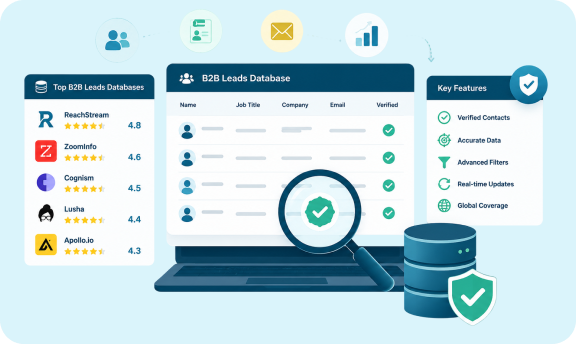
Top B2B Database Providers Compared
There are several established names in the B2B prospecting platforms space, each with a different focus. Some position themselves primarily as B2B Sales Lead Databases for outbound teams, while others focus more on marketing-driven B2B lead data for account-based campaigns. Here is a general comparison of what buyers typically weigh when evaluating options.
| Factor | What to Look For | Why It Matters |
|---|---|---|
|
Data verification |
Built-in verifier vs. third-party add-on |
Reduces bounce rates without extra tools |
|
Filter depth |
Title, seniority, company size, technographics |
Helps you reach true decision makers |
|
Contact channels |
Email, direct dial, mobile |
Enables multi-touch outreach |
|
Compliance |
GDPR, CCPA sourcing documentation |
Protects your company legally |
|
Pricing model |
Credit-based vs. seat-based |
Should match your team’s actual usage pattern |
|
Integrations |
CRM sync, Chrome extension, API access |
Keeps data inside your existing workflow |
Stop Guessing, Start Verifying
Tired of cleaning up bad lists after the fact? See what a verified B2B contact database looks like before you commit budget.
Where ReachStream Prospect Fits In
ReachStream Prospect is built around a straightforward idea: a B2B contact database should not require a second tool just to confirm the data is usable.
The platform brings together verified B2B contacts, company-level data, and advanced search filters in one place, which helps sales and marketing teams cut down the time spent stitching together multiple point solutions. A few areas where this shows up in day-to-day prospecting work:
- Built-in email verification as part of the core workflow, so reps are not exporting lists to a separate verifier before sending outreach.
- A Chrome extension for finding contact and company data directly while browsing LinkedIn or a company website.
- Advanced search filters, including job title, company size, industry, and technographics, to narrow a broad market down to a working target list.
- Mobile numbers and direct-dial data alongside email addresses, supporting multi-channel outreach rather than email-only sequences.
- Data enrichment, which fills in missing fields on existing CRM records instead of requiring a full re-import.
This does not mean every use case fits ReachStream Prospect over other B2B database providers. Teams with highly specialized niche verticals or very small target lists may find a boutique data provider better suited to their needs. But for teams that want a B2B sales leads database with verification built into the workflow, ReachStream Prospect is designed to reduce the number of tools in the stack rather than add to it.
Best Practice
Whichever platform you choose, treat the first 30 days as a data quality audit. Track bounce rates, reply rates, and connect rates on calls. Real usage data will tell you more than any vendor pitch.
Common Mistakes Teams Make When Choosing a B2B Database
Even experienced sales and marketing teams fall into a few predictable traps when selecting a B2B leads database.
Mistake 1: Prioritizing Record Count Over Accuracy
A database advertising 200 million contacts sounds impressive, but if a large percentage of those records are stale, you are paying for volume you cannot actually use. A smaller, well-maintained b2b database will consistently outperform a bloated one.
Mistake 2: Ignoring Job Title Normalization
Titles vary wildly across companies. “VP of Growth” at one company might be doing the same job as “Head of Marketing” at another. A strong B2B contact database should normalize titles so your filters actually catch the right decision makers, not just an exact string match.
Mistake 3: Skipping the Trial Period
It is tempting to sign an annual contract for a lower rate, but skipping a trial or sample export means you are trusting marketing copy over real performance. Always test before committing to a long-term plan.
Mistake 4: Treating Data Purchase as a One-Time Event
B2B contact information changes constantly. A b2b leads database subscription should include ongoing updates, not a static export that grows staler every month.
COMMON MISTAKE
Some teams also overlook internal list hygiene. Even great source data degrades if your CRM never syncs bounced contacts back and flags them for removal. Data quality is a two-way responsibility between the provider and your own systems.
How to Build a Repeatable B2B Lead Prospecting Workflow
Having access to a solid b2b leads database is only half the equation. The other half is a repeatable process for turning raw data into pipeline.
1. Define Your Ideal Customer Profile First
Before you open any database, document your ICP: industry, company size, geography, and the specific job titles who hold buying power or influence. This step prevents wasted credits on broad, unfocused searches.
2. Pull a Focused List, Not a Massive One
Resist the urge to export thousands of contacts at once. Small, targeted B2B Lead Lists of 200 to 300 highly relevant contacts will consistently outperform a generic list of 5,000.
3. Verify Before You Send
Even with a reputable B2B contact database, run a verification pass immediately before a campaign, especially if the list has been sitting for a few weeks. Emails go stale fast.
4. Layer Your Outreach Channels
Combine email outreach with phone follow-up and LinkedIn touches. Multi-channel sequences using verified email addresses and phone numbers consistently see higher reply rates than single-channel campaigns.
5. Feed Results Back Into Your Targeting
Track which segments (by title, industry, or company size) convert best, and refine your next database pull accordingly. This turns your B2B sales strategy into a feedback loop instead of a one-time list purchase.
Build Your Next List in Minutes
Search verified contacts by job title, company size, and industry, then export straight to your outreach tool.
Buying Considerations: Questions to Ask Every Vendor
Before signing with any B2B database provider, get clear answers to these questions:
- How often is the data refreshed, and what does that refresh actually check?
- What is your average email match and deliverability rate for mid-market companies?
- Do you offer phone numbers and mobile numbers, or only email addresses?
- Is email verification built in, or will we need a separate tool?
- How is the data sourced, and is it GDPR and CCPA compliant?
- What does pricing look like as our usage scales up?
- Can we export a genuine sample list that matches our ICP before purchasing?
- What integrations are available for our CRM and outreach tools?
EXPERT INSIGHT
Teams that ask these questions upfront rarely end up switching providers within the first year. Teams that skip this step tend to churn through two or three B2B database providers before finding one that fits.
See the Difference Verified Data Makes
Book a walkthrough and see how ReachStream Prospect handles verification, filtering, and enrichment in one platform.
Conclusion
The right b2b leads database is not the one with the biggest number on its homepage. It is the one that gives your team verified contacts, meaningful filters, and multiple ways to reach a decision maker, all without requiring three extra tools to make the data usable.
If you take one thing away from this guide, let it be this: test before you buy. Pull a sample, run it through your own outreach process, and measure bounce and reply rates yourself. Marketing claims are a starting point, not proof.
ReachStream Prospect was built to remove the guesswork from that process, combining verified B2B contacts, built-in email verification, and advanced filtering in a single platform designed for modern B2B lead prospecting.
95% Accurate. 100% Yours to Prove.
Join 1,000+ companies who ditched guesswork for verified B2B contacts.
Frequently Asked Questions
What is a B2B leads database?
A B2B leads database is a searchable collection of business contact and company data, typically including names, job titles, email addresses, phone numbers, and firmographic details like company size and industry. Sales and marketing teams often use this database to identify and reach decision makers for outbound campaigns.
How to know if a B2B contact database is accurate?
Request a sample export that matches your actual target audience and runs it through your outreach sequence. Track the bounce rate on emails and the connect rate on phone numbers. Anything above a 5 to 10 percent bounce rate signals a data quality problem.
B2B Database vs Email List: What's the Difference?
A B2B email list typically contains only email addresses, often gathered without ongoing verification. A full B2B contact database includes richer data such as job title, company size, phone numbers, and technographics, along with regular data refreshes.
How often should a B2B database be updated?
Look for providers who refresh their data monthly at minimum. Fast-moving industries like technology and healthcare see especially high turnover in job titles and contact details, so more frequent updates directly improve deliverability.
Do I need a separate email verification tool?
Not if your B2B leads database includes built-in verification. Platforms like ReachStream Prospect combine contact data with a built-in email verifier, which removes the need to export lists to a separate verification tool before sending outreach.
What filters matter most when searching a B2B database?
Job title, seniority level, company size, industry, and geographic location are the core filters most sales teams rely on. Technographic filters, which show what software a company already uses, add another useful layer for targeted outbound.
Is B2B Contact Data Legal for Cold Outreach?
Legality depends on your jurisdiction and how the data was sourced. Choose providers who are transparent about GDPR and CCPA compliance, and always follow applicable regulations for commercial email outreach in your target regions.
Can I use a B2B database for both sales and marketing?
Yes. Sales teams typically use B2B contact data for direct outreach and prospecting, while marketing teams use similar data for account-based marketing, targeted advertising, and building segmented email campaigns.
What is the ideal list size for a cold outreach campaign?
Smaller, highly targeted lists of 200 to 300 verified contacts generally outperform large, generic lists of several thousand. Focus on relevance and data accuracy over sheer volume.
How does ReachStream Prospect verify contact data?
ReachStream Prospect includes a built-in email verifier as part of its core platform, allowing users to check deliverability without exporting data to a separate tool. This is paired with regular data refreshes to keep contact and company information current.
What Is Data Enrichment and Why Does It Matter?
Data enrichment fills in missing fields on existing records, such as job title, company size, or phone number, using additional verified sources. It helps sales teams complete partial CRM records without a full data re-import.
Should I choose a database based on price or data quality?
Price matters, but cost per usable contact is the more important metric. A cheaper database with a high bounce rate often costs more per working lead than a slightly higher-priced option with strong verification and refresh cycles.
Junaid Hussain Khan
Author
Junaid Hussain Khan

Brand Growth & Strategy at ReachStream, where he drives content, SEO, and growth strategy for B2B sales and marketing teams.
Share
Table of Contents
Access 200M+ verified business emails and grow your sales pipeline effortlessly.
Power Your Sales
with Targeted Data
Junaid Hussain Khan is the Business Development Manager at ReachStream, adept at forging strategic partnerships and identifying new market opportunities to propel ReachStream's growth and strengthen its position in the B2B ecosystem.
Don't forget to share this post!















Check out our other blogs!
How to Build a Targeted Prospect List Using Filters
October 21, 2026

B2B Data for Ed-Tech Companies: Reaching School Decision-Makers
October 21, 2026

Direct Dial Numbers Explained: A Guide for Sales Reps
October 19, 2026