


> How to Know
How to Evaluate B2B Data Vendors for Accuracy and Compliance
In B2B sales, having the right prospect is half of the battle. Your team needs accurate, up-to-date information, who to contact, how to reach them, and when to start the conversation. When that data is outdated or incomplete, even the best sales strategy can lose opportunities.
This is why having a contact database is becoming increasingly important for modern B2B organizations. We often find ourselves wondering, “Where did we go wrong?” or “Why haven’t our metrics reached our expectations?” But how do you know when your existing database is no longer good enough?
If you’ve ever scrambled to remember whether Jack from XYZ Solutions needed a follow-up last week or struggled to find the phone number of Amy, the event lead you met at a conference, you already know how chaotic contact management can get.
B2B contact data is a structured collection of verified information about professionals and companies, used by businesses to identify, reach, and engage decision-makers for sales, marketing, and partnership activities.
An accurate sales contact database helps B2B sales teams work smarter by reducing research time and making prospecting more efficient. Instead of spending hours searching for the right contacts, sales professionals can focus on connecting with qualified decision-makers who are more likely to be interested in their products or services.
In 2026, B2B growth is increasingly driven by precision rather than volume. Sales teams and marketers no longer succeed by casting wide nets; they succeed by reaching the right decision-makers at the right time with relevant messaging. At the center of this shift is B2B contact data.
B2B contact data enables businesses to identify, reach, and engage professionals who influence purchasing decisions across industries.
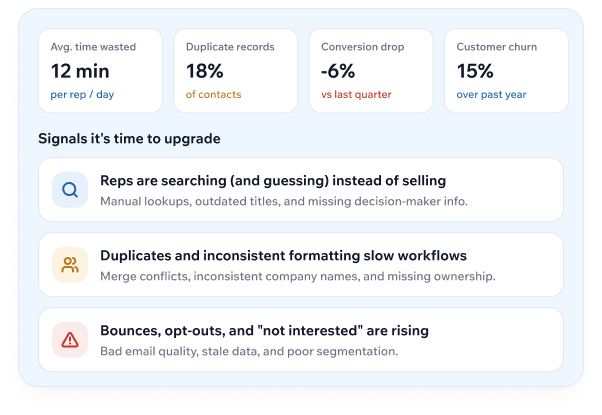
Outdated or incomplete data impacts businesses in several ways. Before we look at the signs, let’s understand the impact. Outdated CRM data doesn’t just look messy. It costs you money and time. Here are few steps one can take
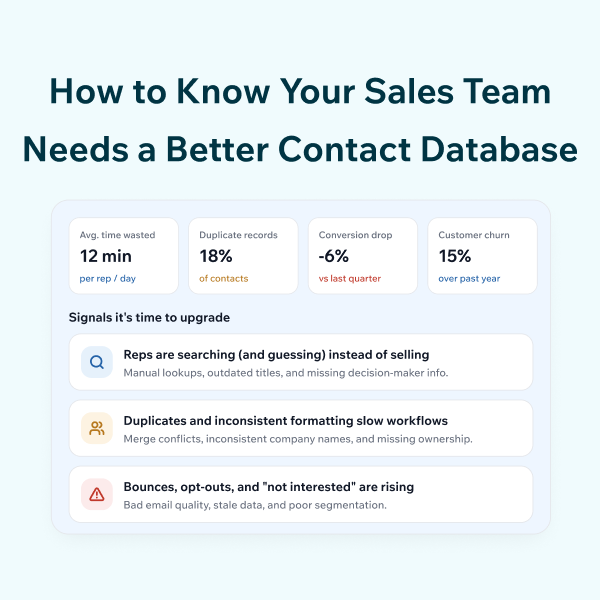
One of the clearest signs of Outdated CRM data is duplication. If you see the same contact appear two or three times, that’s a problem. Duplicates usually happen because of manual entry errors or multiple lead sources feeding into the same CRM.
Additionally, duplicates confuse your sales team. Two reps might contact the same lead without knowing it. This looks unprofessional to your prospects. So, if duplicates are common in your system, it’s time for a cleanup.
Another strong sign of Outdated CRM data is a rising bounce rate. If your open rates are dropping and bounces are climbing, your contact list likely has outdated or fake emails.
Furthermore, high bounce rates can hurt your domain reputation. Once your reputation drops, even your good emails start landing in spam folders. Therefore, monitoring bounce rates regularly helps you catch Outdated CRM data before it causes further damage.
Next, look at how many fields are empty in your CRM. Missing job titles, phone numbers, or company names are a sign of Outdated CRM data. Incomplete records make segmentation nearly impossible.
For example, if you want to target “marketing managers in Mumbai,” but half your records are missing job titles or locations, your campaign will fail. So, incomplete data limits your ability to run precise, targeted outreach.
Formatting issues are another common symptom of Outdated CRM data. For instance, some phone numbers might include country codes, while others don’t. Some names might be in all caps, while others are in lowercase.
This might sound minor, but it isn’t. Inconsistent formatting breaks automation rules and personalization tags. As a result, your emails might say, “Hi JOHN” instead of “Hi John.” Small issues like this add up and hurt your brand’s professionalism.
People change jobs often. Companies merge, rebrand, or shut down. If your CRM still shows old job titles or old company names, that’s a clear sign of an outdated contact database signs.
Consequently, your sales pitch might target the wrong decision-maker. Imagine calling someone who left the company two years ago. This wastes your team’s time and creates a poor first impression with whoever answers instead.
B2B contact data should be reviewed and updated regularly because information such as job titles, company affiliations, email addresses, and phone numbers can change frequently. The ideal update frequency depends on your industry, sales cycle, and database size, but sales teams should always verify important contact information rather than relying on occasional checkups.
Using data verification and high-quality, verified B2B contact lists can help maintain CRM data accuracy in 2026. Data enrichment tools can help identify outdated records, new decision-makers, and changes in company information. Regular updates also support better contact database management, CRM hygiene, improve efficiency, and reduce issues such as high bounce rates and duplicate records.
A better contact database isn’t simply about having more contacts. It’s about having reliable, relevant, and actionable information that helps your sales team reach the right people at the right time.
If your sales team is spending too much time researching prospects, experiencing high bounce rates, cleaning duplicate CRM records, struggling to map accounts, or missing opportunities because contact information is outdated, it may be time to reconsider current database strategy.
The right, better contact database should do more than give your team more names. It should help provide high-quality B2B data that sales representatives can use.
In a sales environment where productivity, personalization, and accurate information directly influence revenue, maintaining reliable contact data is no longer simply a data-management task.
Author

Access 200M+ verified business emails and grow your sales pipeline effortlessly.
Don't forget to share this post!















Check out our other blogs!
Email Verification Tools: 15 Ways to Check Business Emails
B2B Data Providers: How to Compare Contact Data Platforms
CRM Data Enrichment: How to Improve Incomplete Contact Records
How to Know Your Sales Team Needs a Better Contact Database