Written by:

Manohar Devadiga
How Software Development Companies Can Use Verified B2B Data to Reach Decision-Makers
Compare Apollo vs. ZoomInfo on pricing, contact data, sales intelligence, email finding, and prospecting features to choose the right platform for your team.

TL;DR
- Verified B2B data helps software development companies identify businesses that are more likely to need their services, making prospecting more targeted and efficient.
- Define an ideal customer profile (ICP) based on industry, company size, geography, technology requirements, and business growth stage.
- Identify key decision-makers, such as CTOs, CIOs, VPs of Engineering, and IT Directors, to reach professionals involved in purchasing decisions.
- Verify email addresses, job titles, and company information to reduce bounced emails, outdated contacts, and ineffective outreach.
- Segment prospects based on their business requirements and personalize outreach to highlight relevant software development or staff augmentation solutions.
- Track key metrics such as email bounce rates, positive reply rates, meeting bookings, and conversion rates to improve prospecting performance.
- Platforms like ReachStream can help businesses discover verified B2B contacts and company information to build a more focused and consistent sales pipeline.
Finding the right clients is one of the biggest challenges for software development companies. While businesses may offer excellent development services, technical expertise alone does not guarantee a steady flow of projects. Companies also need an effective way to identify potential customers, connect with the right decision-makers, and build meaningful business relationships.
This is where verified B2B data becomes valuable. Instead of relying on random outreach or outdated contact lists, software development companies can use accurate business information to identify organizations that are more likely to need their services.
Whether a business specializes in custom software development, IT consulting, or operates as a nearshore staff augmentation company, having access to reliable B2B data can make its sales and prospecting efforts more focused.
1. Identify the Right Target Audience
Not every business is a potential customer for a software development company. Some organizations have established in-house engineering teams, while others may lack the technical resources required to execute their projects.
The first step is to define an ideal customer profile (ICP). This involves identifying the types of businesses that are most likely to benefit from the company’s services.
Useful criteria include:
- Industry: SaaS, healthcare, fintech, e-commerce, logistics, and other technology-driven sectors.
- Company size: Startups, small businesses, mid-sized companies, or large enterprises.
- Geography: Countries and regions where the company can realistically provide services.
- Technology requirements: Businesses using specific platforms, frameworks, or software infrastructure.
- Growth stage: Companies expanding their operations, launching new products, or increasing their engineering capacity.
For example, a software development company specializing in SaaS solutions might target technology startups that recently secured funding and are preparing to expand their product teams.
A well-defined ICP helps sales teams avoid spending time on businesses that are unlikely to become customers.
2. Find the Actual Decision-Makers
One common mistake in B2B prospecting is contacting the wrong people. Sending a software development proposal to a general company email address may not produce meaningful results because the recipient might not have the authority to evaluate or approve the service.
Instead, companies should identify professionals directly involved in technology purchasing decisions.
Depending on the organization and project requirements, relevant decision-makers may include:
- Chief Technology Officers (CTOs)
- Chief Information Officers (CIOs)
- Vice Presidents of Engineering
- Heads of Product
- IT Directors
- Technical Co-founders
- Engineering Managers
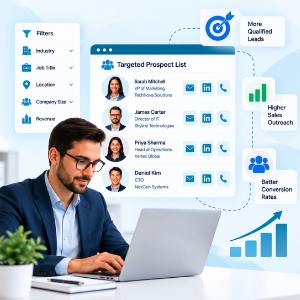
Verified B2B databases can help businesses discover professional contact information, job titles, company details, and other relevant attributes.
For instance, a company offering dedicated development teams might prioritize CTOs and engineering leaders, while a business selling enterprise software solutions may focus on CIOs and IT directors.
Reaching the right person increases the likelihood of starting a relevant business conversation.
3. Use Verified Contact Information to Improve Outreach
Even when a company identifies the right prospect, inaccurate contact information can create another obstacle.
Outdated email addresses, incorrect job titles, and incomplete company records can waste valuable sales resources. They may also contribute to email delivery problems when outreach campaigns are sent to invalid addresses.
Verified B2B data helps reduce these challenges by providing more reliable contact information.
Before launching an outreach campaign, sales teams should:
- Verify professional email addresses using an email verification service.
- Check whether the prospect still holds the listed position.
- Confirm that the company matches the intended target profile.
- Remove duplicate and outdated contacts.
- Segment prospects based on industry, role, company size, and location.
Platforms such as ReachStream can help businesses discover B2B contacts and company information for targeted prospecting.
Combining contact discovery with email verification creates a more organized foundation for outbound sales campaigns.
4. Segment Prospects Based on Their Business Requirements
A generic sales message rarely addresses the specific challenges faced by different businesses.
For example, a startup looking to launch its first software product has different requirements from an established enterprise modernizing its existing technology infrastructure.
This is why prospect segmentation is important.
Software development companies can create separate prospect lists based on business needs.
Startups and early-stage businesses
These companies may need help building minimum viable products (MVPs), developing applications, or establishing their initial engineering teams.
Growing SaaS companies
Businesses experiencing customer growth may need additional developers to accelerate product development, improve existing features, or handle technical backlogs.
Established enterprises
Larger organizations may require custom software integrations, legacy system modernization, cloud migration, or specialized development expertise.
Companies expanding engineering teams
Organizations facing hiring delays or talent shortages may consider external development partners or staff augmentation services.
A nearshore staff augmentation company, for example, can target businesses looking to expand their engineering capacity by working with developers in nearby geographical regions.
Segmenting prospects according to their likely requirements allows sales teams to create more relevant outreach messages.
Find the Right Prospects. Build Better Connections.
5. Personalize Outreach Using Company-Level Insights
Having verified contact information is only the beginning. The next challenge is using that information to create meaningful conversations.
Personalization should go beyond inserting a prospect’s first name into an email. Sales teams should understand the company’s business model, recent developments, technology requirements, and potential challenges.
Consider a few examples:
- A recently funded startup may be interested in accelerating product development.
- A SaaS company hiring multiple software engineers may need additional development capacity.
- An enterprise adopting cloud technologies may require external technical expertise.
- A business expanding into new markets may need help adapting its software infrastructure.
These observations can help sales representatives explain why their services are relevant to a particular prospect.
A personalized outreach email should generally include a relevant opening, a clear explanation of the value being offered, and a simple call to action.
The objective is not to immediately sell a service but to establish a conversation around a business problem the prospect may be experiencing.
6. Build a Consistent B2B Prospecting Pipeline
Relying entirely on referrals or occasional inbound inquiries can make sales unpredictable.
Verified B2B data allows software development companies to build structured prospecting pipelines and maintain a consistent approach to finding potential customers.
A simple pipeline can include the following stages:
- Lead discovery: Identify companies that match the ideal customer profile.
- Contact identification: Find relevant decision-makers within those organizations.
- Data verification: Validate email addresses and review company information.
- Lead segmentation: Organize prospects based on industry, business size, geography, and requirements.
- Outreach: Contact prospects through personalized emails or other appropriate channels.
- Follow-up: Maintain communication with prospects who have not yet responded.
- Qualification: Determine whether the prospect has a genuine requirement, budget, and purchasing timeline.
Tracking these stages helps sales teams understand where prospects are dropping off and which activities are generating meaningful opportunities.
It also makes it easier to evaluate the quality of different prospecting campaigns.
7. Measure the Effectiveness of B2B Data and Outreach
Purchasing or accessing a B2B database does not automatically generate customers. The real value comes from how effectively a company uses the information.
Software development businesses should track key performance indicators (KPIs) to understand whether their prospecting efforts are working.
Some useful metrics include:
- Email bounce rate: Measures how many emails fail to reach their intended recipients.
- Positive reply rate: Tracks the percentage of prospects responding with genuine interest.
- Meeting booking rate: Measures how many prospects agree to a sales conversation.
- Lead qualification rate: Evaluates how many discovered prospects meet the company’s requirements.
- Conversion rate: Tracks how many prospects eventually become paying customers.
- Cost per qualified lead: Helps assess the efficiency of prospecting activities.
These metrics can reveal whether a company needs better targeting, more accurate contact information, improved messaging, or a different outreach strategy.
Regularly reviewing campaign performance also helps businesses refine their ideal customer profiles over time.
Better B2B Data Starts With a Smarter Search.
Conclusion
For software development companies, reaching potential customers is not simply about sending more emails or building larger contact lists. It is about identifying the right organizations, finding the professionals responsible for purchasing decisions, and communicating relevant business value.
Verified B2B data makes this process more structured by helping sales teams discover potential customers, access professional contact information, and organize prospects according to their requirements.
When combined with thoughtful segmentation, personalized outreach, and consistent performance tracking, reliable B2B data can become an important part of a company’s customer acquisition strategy.
Whether a business provides custom software development, enterprise IT solutions, or operates as a nearshore staff augmentation company, a focused B2B prospecting strategy can help it connect with relevant decision-makers and build stronger sales opportunities.
Manohar Devadiga
Author
Manohar Devadiga

Marketing professional, specializing in SEO, content strategy, social media, performance marketing, prospecting, and demand generation.
Share
Table of Contents
Access 500M+ verified business emails and grow your sales pipeline effortlessly.
Power Your Sales
with Targeted Data
Don't forget to share this post!















Check out our other blogs!