Written by:

Mohammed Younus
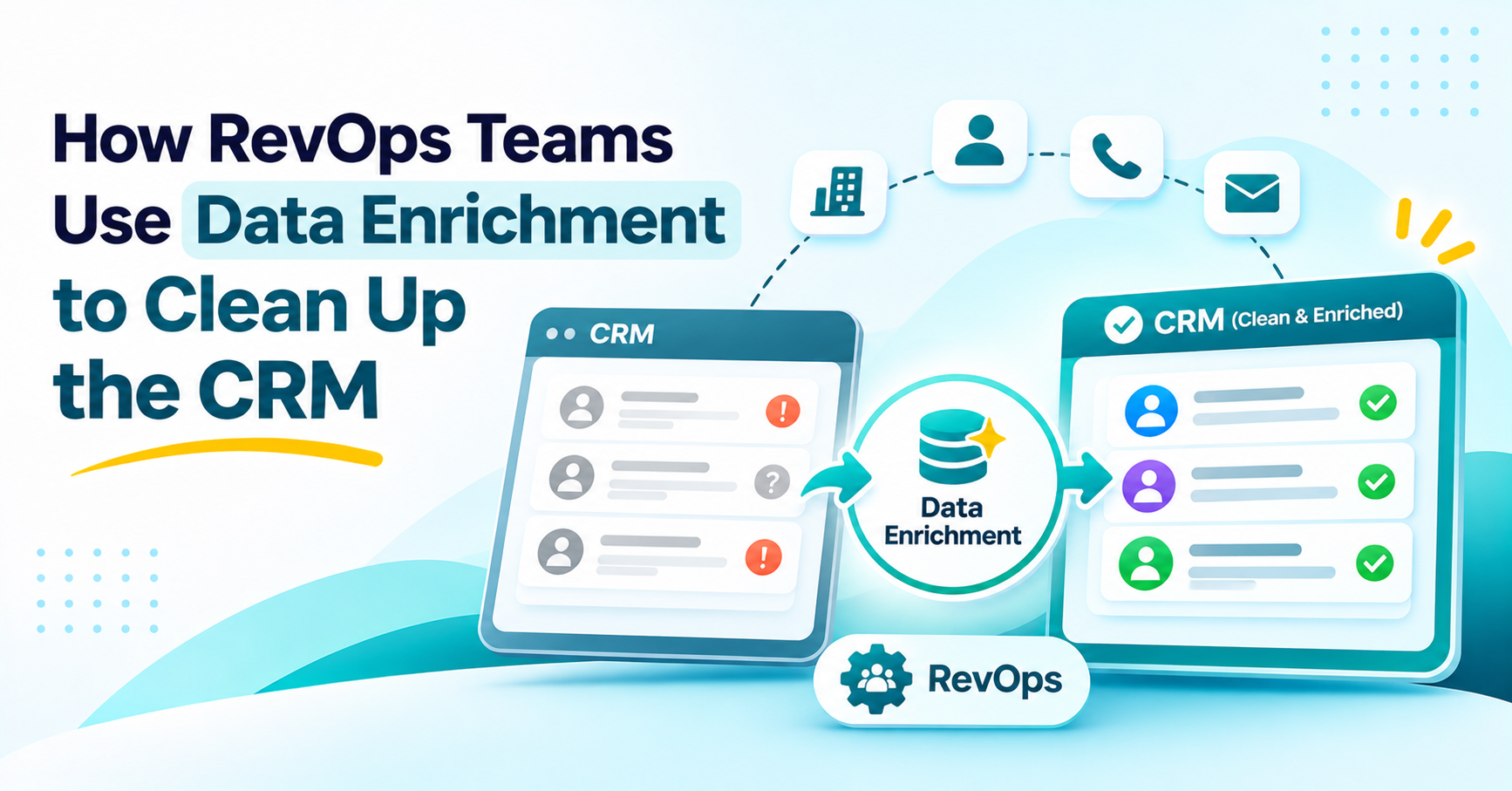
How RevOps Teams Use Data Enrichment to Clean Up the CRM
How to Evaluate B2B Data Vendors for Accuracy and Compliance

TL;DR
- RevOps teams use data enrichment to fill missing or outdated CRM fields: firmographic, technographic and contact-level.
- Enrichment alone is not enough. Verifying that a contact is still reachable is the step most teams skip.
- Data cleansing and data enrichment are different jobs and need to run on the same schedule, not instead of each other.
- Enrich in order: firmographic fit first, then technographic fit, then contact-level reachability.
- Clean, enriched data closes the gap between forecast confidence and the data quality behind it.
- Marketing and sales should enrich the same shared CRM fields instead of keeping separate copies.
- ReachStream Prospect enriches and verifies in the same pass, then writes the result back into Salesforce or HubSpot
Why One CRM Can Show Five Versions of the Truth
A CRM fed by five systems ends up with five versions of the truth. One tool has the right job title. Another has a dead phone number. A third has no industry field at all.
RevOps gets blamed for this, even when the data came in broken from somewhere else. Filling in missing or outdated fields with verified company and contact data is how RevOps fixes it, on a recurring basis, not as a one-time project.
This guide covers what to enrich first and why it changes forecasting and sales-and-marketing alignment. It also covers the step most teams skip: enriched data still fails if it is not also verified as reachable.
Quick Answer
RevOps teams use data enrichment to fill in missing or outdated CRM fields: firmographic, technographic and contact-level data. The data comes from an external source and is matched back to existing records.
This keeps forecasting, segmentation and sales-and-marketing alignment accurate. On its own, enrichment is not enough: records also need their contact details verified as reachable.
What Is RevOps Data Enrichment (and Why the CRM Needs It)
RevOps data enrichment is the practice of adding missing or outdated company and contact details to CRM records. Instead of leaving a gap for a rep to guess at, it pulls from an external data source and writes the result back into the record the CRM already has.
The CRM needs this because no single tool feeds it. Marketing automation writes to it. So does a web form and a cold outbound tool. Each one knows a different slice of the truth.
A Record Isn't Clean Until It's Reachable
A record is not clean just because every field has something in it. It is clean when the data is current and the contact can actually be reached. That second part is where most data enrichment efforts stop short, and it is the thread that runs through the rest of this guide.
Data Enrichment vs. Data Cleansing: Two Different Jobs
Data cleansing removes or fixes what is wrong: duplicate records, formatting mismatches, contacts who left the company years ago. It subtracts or corrects.
Enriching a record adds what is missing instead: a verified email, a direct phone number, a company’s revenue band, its technology stack. It builds on top of a record rather than fixing it.
RevOps data management needs both running side by side, on the same schedule. Cleansing without enrichment leaves accurate but empty records. Enrichment without cleansing fills in detail that sits behind a duplicate record that should not exist in the first place.
Firmographic Data: Confirming the Account Fits
Revenue operations data enrichment follows a set order. Firmographic data, industry, company size, revenue and location, confirms whether the account fits the target market at all.
B2B data enrichment at this scale depends on the size of the source database behind it. ReachStream Prospect enriches against a pool of 450M+ contacts and 25M+ companies. A thin CRM record has somewhere real to pull from.
Technographic and Contact-Level Data: Confirming the Person
Technographic data, which platforms a company already runs, narrows that further to accounts likely to need what you sell. Contact-level data, a verified email, direct phone, title and seniority, confirms there is a reachable person behind the account.
B2B contact data enrichment should run before technographic enrichment when the goal is reaching a specific title. A confirmed decision-maker is worth more than a confirmed tech stack with no named contact behind it.
SEQUENCING NOTE
Contact-level enrichment should run before technographic enrichment when the goal is reaching a specific title. A confirmed decision-maker with a verified email is worth more than a confirmed tech stack with no named contact behind it.
See ReachStream Prospect's Enrichment Layer in Action
See how firmographic, technographic and contact-level enrichment work together on your own CRM data.
How Clean, Enriched Data Improves Revenue Forecasting
A forecast is only as good as the fields it is built on. A deal missing company size, industry or a confirmed contact is a guess wearing a dollar figure.
That gap between confidence and actual data quality is exactly what revenue operations data quality work is meant to close. Enrichment closes part of that gap before a forecast is built, not after it slips.
What the Confidence Gap Looks Like
Gartner’s State of Sales Operations Survey asked sales leaders and sellers about their confidence in forecasting accuracy. Only 45 percent said they had high confidence. Only 47 percent believed their company’s data was high quality, which left 13 percent calling it poor, as reported by Gartner (as of February 2020). The survey predates current RevOps tooling, but the gap has not closed.
| Approach | Best for | Time per verified contact | Scalability | Data freshness risk |
|---|---|---|---|---|
|
No enrichment |
Nothing, just the original raw CRM record |
None, no check has run |
N/A, no process to scale |
High, fields go stale with no refresh |
|
Enrichment only |
Filling missing firmographic and technographic fields |
Minutes, automated against an external source |
High, runs across the whole CRM at once |
Medium, fields are current but reachability is unchecked |
|
Enrichment + verification |
Records a rep can act on immediately |
Minutes, plus real-time email verification |
High, same automated process end to end |
Low, confirmed current and reachable before use |
Common CRM Data Quality Problems RevOps Teams Face
Multiple data sources feeding one CRM with no single source of truth is the root problem behind most others. Each tool updates its own copy. Nothing reconciles them. Small differences pile up unnoticed.
Poor match rates between the CRM and other systems compound this: one account can end up split across three records. Duplicate and stale contacts add a third layer. A person changes jobs, and the old title sits in the CRM for months, quietly skewing reports.
Solving this is what revenue operations data enrichment is for. It answers one question on repeat: which version is current, and is the contact still reachable.
DATA QUALITY SNAPSHOT
A more recent industry survey found that just 76 percent of CRM users say less than half of their company’s CRM data is accurate and complete. That figure comes from Validity’s State of CRM Data Management in 2025 report, checked November 2026.
How Data Enrichment Improves Sales and Marketing Alignment
Sales data enrichment and marketing data enrichment usually happen in separate tools, which is exactly the problem. Marketing enriches a lead with firmographic fit. Sales re-enriches the same account later with its own fields. Neither trusts the other’s version.
Data enrichment for marketing operations and data enrichment for sales teams should write to the same shared fields instead. A lead that reaches sales then already carries the context marketing confirmed. Nobody starts the research over, and nobody argues about whose number is right.
Questions to Ask Before You Trust a CRM Field
- Does this field come from one source of truth, or five systems that never reconcile with each other
- Has it been refreshed in the most recent enrichment cycle, or is it quietly going stale
- Is the contact verified as reachable, not just filled in with a plausible-looking value
- Would sales and marketing both recognize this as the same record, or does each team keep its own version
BEST PRACTICE
ReachStream user John W., Head of Marketing, put it this way: “It helps me find valid leads fast and ensures emails reach them.” That is the alignment point in one line. A lead marketing hands off is only useful to sales if the contact detail on it still works.
Enrich and Verify: Why Reachable Data Is the Real Finish Line
A record is not clean until the data in it is both current and reachable, not just filled in. Enrichment fills the field. Verification confirms the person can still be reached. A CRM full of enriched but unreachable contacts just looks finished.
Data Enrichment fills incomplete or outdated records with verified emails, phone numbers, company attributes and technographic data. Its built-in Email Verifier checks every email in real time before export, so credits go toward contacts you can actually reach.
What Customers Say
“It helps me find valid leads fast and ensures emails reach them.”
John W., Head of Marketing
Where ReachStream Prospect Fits In
List Builder keeps enriched records current on its own, instead of going stale the week after a one-time cleanup. Native Salesforce and HubSpot integrations write the enriched, verified data straight back into the CRM the team already uses. RevOps is not left maintaining a second system of record.
See Enrichment and Verification Working Together
Book a demo to see enrichment and verification working on the same record.
Conclusion
A clean CRM is not a project with an end date. It is enrichment and verification running on a recurring schedule, not an annual cleanup sprint.
Start with the three layers in order: firmographic, technographic, contact-level. Keep cleansing running alongside enrichment. Then check the step most teams skip, whether each contact is still reachable. That step turns a full CRM into a usable one, built on data the whole revenue team can trust.
This matters across the whole go-to-market motion, not just RevOps. For more, see why data enrichment is the backbone of modern GTM teams.
See What a Fully Enriched, Fully Verified Record Looks Like
Book a demo with ReachStream Prospect and see what a fully enriched, fully verified record looks like.
Frequently Asked Questions
What is RevOps data enrichment?
It is the practice of filling in missing or outdated CRM fields: firmographic, technographic and contact-level. The data comes verified, from an external source. RevOps owns it as a recurring schedule, not as a one-off list purchase or an annual cleanup project.
How does data enrichment support revenue operations?
It gives every team pulling from the CRM the same current, verified record instead of a partial, different version in each system. That supports more accurate forecasting and gives revenue operations a single source of truth rather than five conflicting ones.
Why is CRM data enrichment important for RevOps teams?
Bad CRM data wastes rep time, breaks segmentation and skews attribution. Enrichment addresses the root cause: missing or outdated fields. The alternative is leaving RevOps to patch the symptoms deal by deal, record by record, every quarter, with no lasting fix.
What types of data should revenue operations teams enrich?
Three layers matter. Firmographic data confirms company fit. Technographic data confirms product fit. Contact-level data, a verified email and phone number, confirms there is a reachable person behind the account. Enrich them in that order, since each layer narrows the next one.
What is the difference between data enrichment and data cleansing?
Cleansing fixes or removes what is wrong: duplicates, dead contacts, formatting errors. Enrichment adds what is missing instead. Both need to run together on the same schedule. Cleansing alone leaves accurate but empty records. Enrichment alone can fill in detail behind a record that should not exist.
How does data quality affect revenue forecasting?
A forecast built on deals missing company size, industry, or a confirmed contact is a guess with a dollar figure attached. Gartner’s own survey found fewer than half of sales leaders and sellers had high confidence in their forecasts. The same gap showed up in the data behind them.
How does data enrichment improve sales and marketing alignment?
When marketing and sales enrich the same shared CRM fields instead of separate copies, the handoff changes. A lead handed to sales already carries the context marketing confirmed. Neither team starts the research over, and neither distrusts the other’s version of the account.
What are the common data quality problems in RevOps?
Multiple systems feeding one CRM with no single source of truth is the most common problem. Add poor match rates between those systems, records split across tools instead of living as one confirmed version, and stale contact details that go out of date quietly between refresh cycles.
How often should CRM data be re-enriched?
There is no universal interval, but enrichment should run on a recurring schedule rather than as an annual project. Contacts change roles, companies get acquired, and technology stacks change continually, so a CRM enriched once and left alone starts drifting out of date within a quarter.
Mohammed Younus
Author
Mohammed Younus

Mohammed Younus is the Senior Manager of Business Operations with a keen insight into the B2B landscape. Through his contributions to this blog, he aims to share cutting-edge tactics and insights that empower sales and marketing professionals to achieve unparalleled success.
Share
Table of Contents
Access 500M+ verified business emails and grow your sales pipeline effortlessly.
Power Your Sales
with Targeted Data
Mohammed Younus is the Senior Manager of Business Operations with a keen insight into the B2B landscape. Through his contributions to this blog, he aims to share cutting-edge tactics and insights that empower sales and marketing professionals to achieve unparalleled success.
Don't forget to share this post!















Check out our other blogs!