

Q3 Limited-Time Deal. Find verified B2B leads at half the cost. Get 50% Off with Coupon Code PROSPECT50. First 200 Users Only.
How to Check if an Email Address Is Valid: 5 Easy Methods
Written by:
Mohammed Younus

How to Check if an Email Is Valid: 5 Proven Methods 

>How to Check

How to Evaluate B2B Data Vendors for Accuracy and Compliance

TL;DR

You found the right prospect, wrote a sharp message, and hit send. It bounced. Every outbound team knows that moment. Bad addresses drain outreach budgets, distort reporting, and chip away at deliverability until entire email campaigns start landing in spam.

The fix is simpler than most teams expect, but it needs a system. This guide covers how to check if an email is valid using five proven methods, from manual checks that take seconds to workflows that verify thousands of contacts at once, plus the mistakes that quietly wreck sender reputations. 

Why Email Validity Matters More Than You Think 

Email lists age faster than teams expect. People change jobs, companies rebrand, and inboxes get abandoned. Industry estimates put email list decay between 22 and 26 percent per year, so a quarter of last summer’s list may already be dead weight. 

That decay has three costs. Money: most platforms charge by contact or send volume, so dead addresses inflate the bill. Data: when part of a list cannot receive mail, engagement rates are measured against ghosts, and your email marketing strategy gets built on distorted numbers. 

Deliverability is the big one. Mailbox providers watch bounces closely, and sending emails to invalid addresses tells them you do not know your audience. Hard bounce rates above roughly 2% erode trust; once that slips, even your valid emails struggle to reach the inbox. Protecting your sender reputation is the real reason validity checks exist.

INDUSTRY INSIGHT 
Google and Yahoo tightened bulk sender requirements in 2024: SPF, DKIM, and DMARC authentication, one-click unsubscribe, and spam complaint rates under 0.3 percent. Verified lists make those thresholds far easier to hold.
Stop Paying to Email Dead Inboxes 
ReachStream Email Verifier is designed to catch invalid, risky, and undeliverable addresses before they touch your campaigns. Your first 100 credits are free. 

Key Components of a Valid Email Address

It helps to know what you are testing. A deliverable address clears three layers: 
  1. Correct syntax: A local part, an @ symbol, and a domain, with no illegal characters or stray spaces. 
  2. A working domain: The domain exists and is configured to receive mail, which its MX records confirm. 
  3. A live mailbox: The mail server will accept messages for that specific address. 
Most quick checks cover the first layer and sometimes the second. Only full verification covers all three. Syntax says an address could exist. Verification says the email address exists and can receive mail. 

How to Check if an Email Is Valid: 5 Methods

There is no single answer to how to check if an email is valid. The right method depends on volume, stakes, and time. Here are the five professionals actually use: 

Method 1: Use an Email Verification Tool

Purpose-built email verification tools help you verify email addresses accurately and at scale without sending a single message. A dedicated email validator runs every check above, plus several you cannot do manually, in seconds per address. 

This is where ReachStream Email Verifier fits. Its engine was built and used internally to verify more than 200 million contacts before becoming a standalone product. It is designed to verify any email address across multiple layers, from syntax and MX health down to a mailbox-level check, and it returns results with 99.8 percent accuracy. Instead of a flat yes or no, every address comes back as one of five statuses: Valid, Invalid, Risky, Unknown, or Do Not Mail, because the right move for a risky address differs from the right move for an invalid one. Signup includes 100 free credits to test it on a real slice of your list. 

Check Your First 100 Addresses Free
Paste in one email or upload a full list. ReachStream Email Verifier returns a clear status for every address, with 100 free credits at signup. 

Method 2: Look Up the Domain's MX Records

MX (mail exchange) records tell the internet which mail server accepts messages for a domain; no MX records usually means no inboxes at all. 

Checking takes seconds with any free MX lookup tool, or run dig MX company.com (Mac and Linux) or nslookup -type=mx company.com (Windows). Mail servers in the result mean the domain can receive email; nothing means every address there is undeliverable. 

This filter weeds out dead domains and made-up entries. What it cannot do is confirm a specific mailbox: a domain with healthy MX records will still reject a name that never worked there. 

Method 3: Send a Test Email (With Caution)

The most direct test is also the riskiest at scale. Send a short, genuine message and watch what happens: a hard bounce means invalid, while a reply or an out-of-office suggests a live inbox. 

For one or two addresses, fine. As a list strategy, it is a trap: every hard bounce is logged against your domain, and a burst of them increases the likelihood that future messages are filtered as spam. If you must test, send a real message with a real reason, and never a blank one. 

Method 4: Search the Address Online

For high-value prospects, a few minutes of research can confirm the person and the address: search the exact address in quotes on Google, check the company’s team pages, and confirm on LinkedIn that the person still holds the role. 

You can also infer the company’s email pattern: if press releases show jane.doe@company.com, colleagues probably follow first.last too. Pattern guessing alone is risky; pattern plus confirmed employment gets close. It shines in account-based outreach, but collapses past a dozen addresses and never proves the mailbox will accept mail. 

Expert Insight
Experienced SDR teams treat research and verification as two halves of one step: find the likely address through patterns and LinkedIn, then verify it before it enters a sequence.

Method 5: Check the Syntax and Format

Start with what your eyes can catch: 
Manual review works for addresses collected from business cards, events, or reply threads, and a quick email checker or a simple regex can automate the same pass for larger sets. The limit: perfect formatting proves nothing about the mailbox. A flawless address still bounces if its owner left the company last quarter. 
Pro Tip
Never treat verification output as keep-or-delete. Send to valid addresses, drop invalid and do-not-mail results, and route catch-all and risky contacts into a small, watched segment.

How Email Verifiers Work

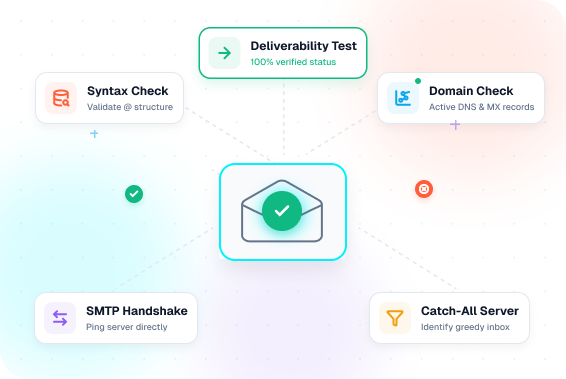
Modern email verification technology runs a pipeline of checks, stopping the moment an address fails one: 
Catch-all domains are the honest exception: some companies accept mail for any address at their domain, so individual mailboxes cannot be fully confirmed. An accurate email checker says so plainly with a Catch-All status instead of pretending certainty. 

Which Method Should You Use?

Side by side, the trade-offs: 
Method  Best for  Confirms mailbox?  Scale  Reputation risk 
Syntax check 
Quick screening 
No 
Low 
None 
MX record lookup 
Filtering dead domains 
None 
Medium 
No 
Test email 
High-touch one-offs 
Eventually 
Very low 
High at volume 
Manual research 
High-value prospects 
No 
Very low 
None 
Verification tool 
Lists of any size 
Yes, without sending 
High 
None 
 A simple way to decide: 

How to Clean an Entire Email List

Single-address checks keep new contacts clean. Email list cleaning rescues the database you already have: 
Email list decay never stops, so most teams settle on a quarterly cycle with an extra pass before major campaigns. 
QUICK CHECKLIST
Before your next send:
BEST PRACTICE 
 Verify at the moment of capture, not just at campaign time. Real-time checks on signup forms can help stop mistyped and fake addresses from entering your database at all.

Common Mistakes When Verifying Email Addresses

Even teams that verify regularly hit a few traps. 
  1. Checking syntax and stopping: A well-formatted address that bounces hurts exactly as much as an obviously fake one. 
  2. Treating catch-all as valid: A catch-all domain accepts everything at the server level, so a pass there is not proof of a mailbox. Send emails to these in small, monitored batches. 
  3. Verifying once and moving on: A list verified in January is not a verified list in July. The process has to be as continuous as the decay.
  4. Purging every non-valid result: Risky and unknown are not invalid. Aggressive deletion throws away reachable prospects that segmentation would keep in play. 
  5. Ignoring engagement: Validity is the floor, not the ceiling. A mailbox can be deliverable while its owner ignores everything, so pair verification data with email engagement data when deciding who stays in active email campaigns. 
Clean Your List Before the Next Campaign 
Upload up to 25,000 addresses in one batch and see which contacts are dragging your deliverability down. 

Final Thoughts

Every method has a place: manual checks and MX lookups answer quick questions, research earns its keep on high-value accounts, and tools do the heavy lifting everywhere else. 

The bigger shift is treating validity as a discipline rather than a cleanup. Teams that learn how to check if an email is valid, then build verification into capture forms, prospecting workflows, and a quarterly routine, spend less, measure honestly, and land in more inboxes. A short list of confirmed contacts beats a long list of guesses every time. 

Your list is decaying quietly right now. The best time to verify it was last quarter; the second best is today. 

Improve Deliverability with Smarter Email Verification 
Discover smarter email verification and cleaner contact lists. Schedule a demo to see ReachStream Email Verifier in action.  

Frequently Asked Questions

1. What does it mean for an email to be valid?

It has correct syntax, a domain with active MX records, and a live mailbox that accepts messages. All three layers must pass; an address can look perfect and still bounce.
Check the syntax by eye, run a free MX lookup on the domain, and search the address online. For mailbox-level certainty, a free email address validator covers one-off checks, and ReachStream Email Verifier includes 100 free credits at signup.
Yes. Verifiers use an SMTP handshake that asks the recipient’s mail server whether it would accept mail for that address, then disconnects. The mailbox is confirmed without any message being delivered.
Quarterly suits most B2B teams, with an extra pass before major campaigns. Lists decay continuously as people change roles, so annual cleaning almost always leaves dead addresses in play.
Under 2 percent is the widely accepted ceiling, and strong senders stay below 1 percent. Sustained rates above that signal poor list hygiene to mailbox providers and hurt inbox placement.
No. Inbox placement also depends on content, authentication, and sending behavior. Verification removes the addresses guaranteed to fail and clears the way for everything else.
Quality varies by tool. ReachStream Email Verifier checks addresses with 99.8 percent accuracy across five status categories. Catch-all domains remain the one source of genuine uncertainty for any verifier.
Yes, if you use a trusted provider. Choose an email verifier that follows industry security standards, complies with privacy regulations, and processes your data securely without sharing it.
Mohammed Younus

Author

Mohammed Younus
Senior Manager of Business Operations specializing in B2B Marketing, Business Development, and Process Optimization, driving operational efficiency and growth at ReachStream.
Share
Table of Contents

Access 200M+ verified business emails and grow your sales pipeline effortlessly.

Power Your Sales with Targeted Data
Mohammed Younus
Mohammed YounusAuthor
Mohammed Younus is the Senior Manager of Business Operations with a keen insight into the B2B landscape. Through his contributions to this blog, he aims to share cutting-edge tactics and insights that empower sales and marketing professionals to achieve unparalleled success.

Don't forget to share this post!

Check out our other blogs!