


> Best Bulk Email Verifier
How to Evaluate B2B Data Vendors for Accuracy and Compliance

If your marketing or sales team has ever uploaded a fresh email list and sent a campaign right away, you already know the sinking feeling of watching bounce rates climb an hour later. That is usually the moment teams start searching for a bulk email verifier.
This kind of tool checks a full list at once, flagging which addresses are safe to send to and which ones will bounce, get caught by spam traps, or quietly damage your sender reputation. For any team running email marketing at volume, this step has become as routine as checking a subject line.
This guide covers how the process works, what to look for when comparing providers, the steps to clean up a list before sending, and where ReachStream Email Verifier fits into that picture.
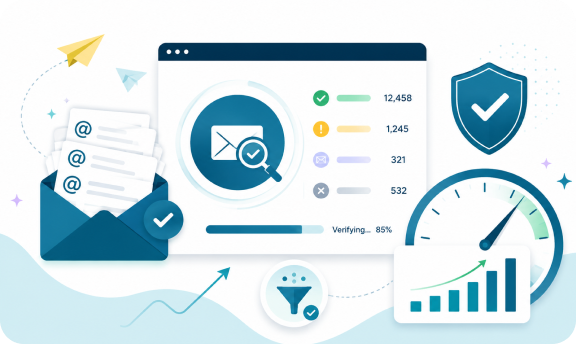
A bulk email verifier processes an entire email list at once, usually through a file upload or an API call, and returns a status for every address in the file. Instead of checking one address at a time, you get results for thousands of contacts in a single pass.
This matters for a simple reason. Sending to a list with a high share of invalid or risky addresses does not just waste effort, it puts your domain’s ability to send emails at risk. Mailbox providers track bounce rates and complaint rates closely, and one bad campaign can affect inbox placement for everything you send afterward, including transactional mail.
| Status | What It Means | What To Do |
|---|---|---|
|
Valid |
Mailbox exists and accepts mail |
Safe to send |
|
Invalid |
Mailbox does not exist or domain is dead |
Remove from list |
|
Risky |
Mailbox may exist but shows warning signs |
Send with caution or exclude |
|
Catch-All |
Domain accepts mail to any address |
Treat as unverified, monitor engagement |
|
Unknown |
Server did not respond conclusively |
Retry later or review manually |
|
Do Not Mail |
Role account, complainer, or suppression list |
Exclude |
| Email Verification | Skipping Verification |
|---|---|
|
Predictable verification costs |
Higher bounce rates and wasted email sends |
|
Cleaner contact database |
Reduced inbox placement |
|
Cleaner contact database |
Increased risk of sender reputation damage |
|
More effective campaign performance |
More time and effort spent rebuilding deliverability |
A bulk email verifier is no longer optional for teams sending any real volume of outbound or lifecycle email. Bounce rates and spam traps carry real consequences for sender reputation, and a damaged domain is slow to rebuild. Teams that build this kind of check into their sending routine, rather than treating it as a one-time cleanup project, consistently protect their deliverability better than teams that only think about it after a campaign underperforms.
Whether you need to clean up a list before a single campaign or want a recurring check built into your process. Choosing a solution that combines accurate verification, detailed status insights, and seamless integration can support stronger email performance over the
long term.
Author

Access 200M+ verified business emails and grow your sales pipeline effortlessly.
Don't forget to share this post!















Check out our other blogs!
How Many Follow-Ups Should a Cold Email Sequence Have?

How a Medical Device Company Can Reach Hospital Decision-Makers
What Data Fields Should a Healthcare Marketing Database Include?

ReachStream Prospect vs Prospeo: Who Delivers Accurate Data?