


> How Email
How to Evaluate B2B Data Vendors for Accuracy and Compliance
Your campaign reports a successful send, but the campaign performance data tell another story. Open rates are lower, responses are fewer, and bounced emails are much higher than your team expected. These are common signs of poor email deliverability.
When emails stop reaching inboxes, the first instinct is often to blame technical configurations. In reality, email deliverability isn’t something you do once and forget. Because it’s an ongoing measure of your sender reputation, list quality, engagement levels, and compliance with the evolving standards used by mailbox providers to decide what reaches the inbox.
This guide gets into what actually drives strong delivery, why bounce rates deserve more attention, and where verification fits into campaign strategy.
Email deliverability measures how successfully your emails reach recipients’ inboxes instead of getting rejected, bouncing, or landing in spam.
People mix up email delivery and email deliverability more often than you’d expect, but they are not interchangeable. Delivery just means the receiving mail server accepted your message somewhere. Deliverability is the tighter, more useful measure: whether that message actually reaches the inbox, where someone can open it, read it, and act on it. Email placement, in other words, is the real scoreboard, not just whether a server said yes.
Poor delivery quietly touches every stage of your marketing and sales work, and the damage rarely shows up right away. It builds. If your emails aren’t landing in the inbox, here’s what that tends to look like on the ground.
An SDR working a list that never reaches its targets is burning hours on accounts that were never reachable in the first place, no matter how sharp the messaging is. Marketing ends up paying for tools, lists, and headcount to run campaigns that a chunk of recipients will simply never see.
Meanwhile, a sending domain with a track record of bounces and spam complaints has a harder time with every send that follows, because mailbox providers keep score. And when open rates drop, teams often rewrite subject lines or shuffle send times, when the actual problem is that the message never made it to an inbox to be opened at all.
Improving deliverability takes more than an occasional list cleanup. A few habits worth building in:
1. Verify new contacts: Validate every address at the point of capture, before it ever enters your CRM. Catching typos and dead addresses immediately beats cleaning them up months later, and it keeps your contact database accurate from day one.
2. Recheck existing lists: Run bulk verification every 60 or 90 days to remove invalid and inactive contacts. A cleaner list leads to better outreach and stronger campaign performance.
3. Get your authentication right: Configure SPF, DKIM, and DMARC correctly. Proper email authentication gives mailbox providers a way to confirm your identity, essentially proving your emails really come from your domain. Skip it, and your messages are far more likely to get filtered into spam.
4. Write relevant content: Skip the spam-triggering language and focus on email content that is relevant and personal enough to be worth reading. When people open, read, and engage with what you send, mailbox providers take that as a signal to trust your next campaign too.
5. Keep subject lines honest: Use clear, relevant subject lines that accurately reflect your email content. Misleading headlines may attract initial opens, but they can disappoint recipients, increase spam reports, and hurt future campaign performance.
6. Make the unsubscribe link easy: A visible, working unsubscribe link cuts spam complaints and protects your sender reputation over the long run. Letting uninterested subscribers leave keeps the audience that remains engaged and your list genuinely healthy.
7. Watch your deliverability metrics regularly: Run an email deliverability audit on a set cadence so you catch trends before they dent campaign performance. Reviewing your emails deliverability rate on this cadence is one of the simplest ways to see whether your fixes are working. Track metrics such as email bounce rate, email open rate, click-through rate (ctr), inbox placement rate, and spam complaint rate.
There is no single solution for improving email deliverability. It relies on proper email authentication, a positive sender reputation, valuable content, recipient engagement, and accurate contact data. Even if everything else is in place, neglecting email verification before launching a campaign can affect the overall campaign performance.
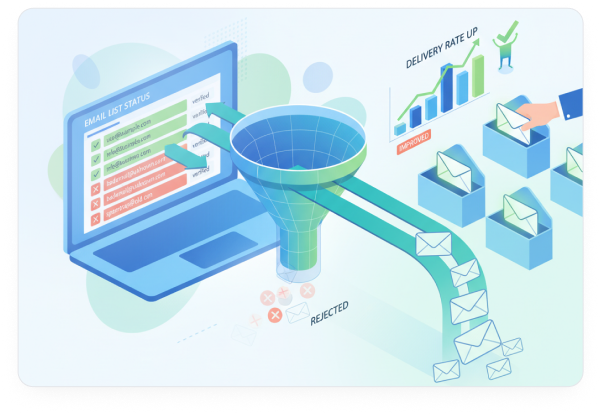
That is the piece ReachStream Email Verifier is built to handle. It targets one of the most preventable causes of poor deliverability, sending to addresses that were never going to accept the message in the first place. It flags invalid, risky, catch-all, and do-not-mail addresses before they touch your campaigns, whether you’re sending newsletters, marketing emails, or transactional messages.
Every campaign you send adds to your sender reputation, and every bad address left in a list chips away at email placement a little further. That is why keeping a list clean works better as an ongoing habit than a one-time project. Before your next send, it is worth a few minutes to see exactly where your list stands.
Author

Access 200M+ verified business emails and grow your sales pipeline effortlessly.
Don't forget to share this post!















Check out our other blogs!
Is Buying B2B Data Legal? What You Need to Know
Intent Data: What It Is and How to Use It for Campaign Targeting

What Mid-Market SaaS Teams Need in Lead Gen Tools

ReachStream Prospect for E-commerce Brands: Outbound Case Study