


> Sales
How to Evaluate B2B Data Vendors for Accuracy and Compliance

Sales teams rarely struggle because they cannot find enough names. The harder problem is finding the right companies, identifying the people who can make a decision, and trusting the contact data before outreach begins. That is where sales intelligence tools fit into the modern sales process.
These platforms combine contact data, company information, prospect research, and workflow features in one place. Used well, they help revenue teams move from a broad market to a focused list of qualified leads without spending hours searching across disconnected sources. This guide explains how sales intelligence software works, which features matter, and what to compare before choosing a platform.
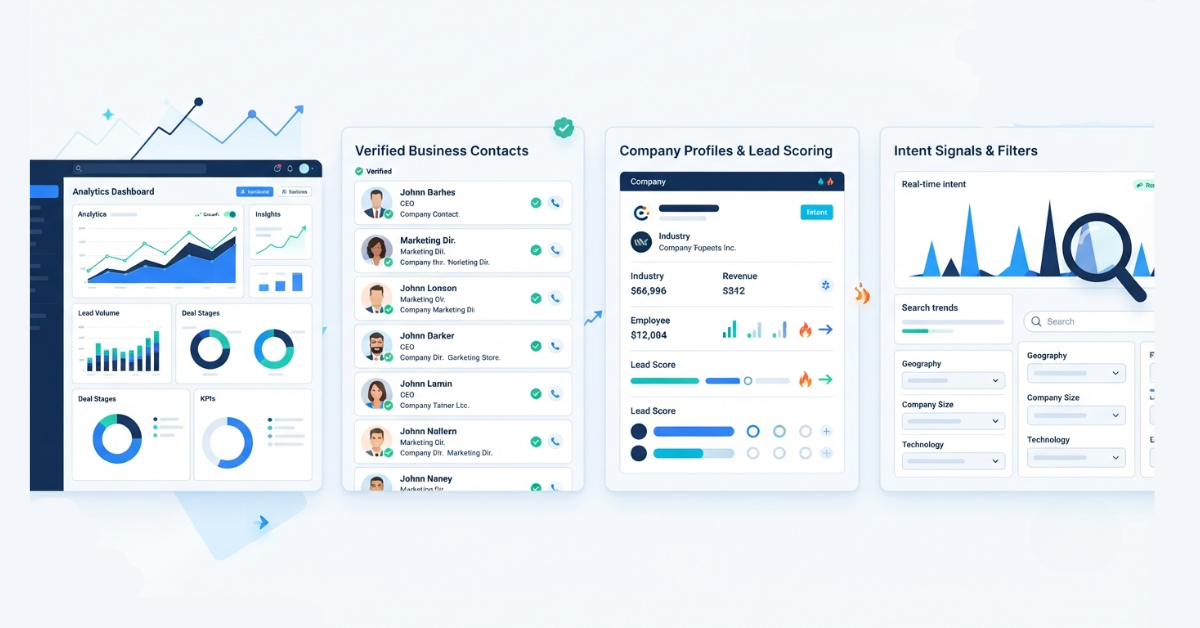
Sales intelligence tools help teams discover, understand, and prioritize potential business customers. They typically combine professional contact records with company data such as industry, location, employee count, revenue range, technology usage, and organizational role.
A basic contact database may give you a name, job title, and email address. A sales intelligence platform adds account context, qualification signals, enrichment, and a path into your sales pipeline. A B2B data platform brings those account and contact views together for prospect research.
For example, an HR software rep could filter technology companies in a target region, identify People Operations leaders, verify their details, and send suitable prospects to the CRM.
Most platforms follow a similar workflow: turn a broad market into an actionable prospect segment.
Teams with large databases can use CRM enrichment to update incomplete records before a campaign. Teams researching browser workflows can also review a Chrome prospecting guide before choosing an extension.
The right feature set depends on your sales motion and existing stack. These capabilities are the most useful starting points when comparing sales intelligence solutions. For deliverability-focused teams, a built-in email verifier may matter more than a larger database.
Feature | Why it matters | Questions to ask |
Contact and company search | Helps reps find relevant people and accounts quickly | Can you search by role, industry, location, size, and revenue? |
Verification | Reduces the risk of sending to invalid business emails | How are records checked, and when was the data last verified? |
Enrichment | Fills missing or outdated CRM fields | Can the tool update existing records in bulk? |
Intent and buying signals | Helps teams prioritize accounts showing relevant interest | Are signals understandable and connected to an action? |
CRM integrations | Reduces duplicate entry and keeps records aligned | Does it sync with your CRM and preserve field mapping? |
Automation and API access | Supports repeatable workflows at higher volume | Can the tool fit into your current sales stack? |
The practical benefit is focus: reps start with a relevant segment and spend more time deciding whom to contact and why. Teams can also compare B2B contact providers when they need broader coverage.
A sales intelligence platform can also improve ICP targeting. When teams define their ideal account using clear fields, they are less likely to fill the pipeline with companies that look attractive on paper but rarely become customers. Better targeting supports more relevant outreach and more useful conversion analysis.
Teams gain a repeatable way to build lists. Managers can standardize filters, while reps use the same definitions for title, industry, seniority, or company size. A list builder is useful when several people maintain segments.
For example, a BDR can start from a filtered account list, review enriched records, and reserve manual research for the highest-value prospects instead of repeating the same lookup for every account.
Sales intelligence tools provide the data layer for B2B lead generation. They help teams find ICP-fit companies, identify decision-makers, build contact lists, and move qualified records into the sales process.
A typical workflow begins with account selection, followed by filters for industry, company characteristics, function, and seniority. Teams can then segment prospects by territory, use case, company stage, or campaign theme.
The next step is quality control. Teams should enrich incomplete records, verify business emails, and remove contacts that do not match the target audience. Tools such as a contact database can make this work faster, but the team still needs rules for qualification and consent. A focused lead generation guide can help teams connect the data step to campaign planning.
Qualified contacts then move into the CRM or sales engagement workflow. The platform supplies information and signals; sales and marketing teams remain responsible for relevance, timing, and compliance.
The main difference is depth and workflow. A traditional database may provide a static list of contacts, while a sales intelligence tool is designed to help teams search, evaluate, update, and activate those records.
Factor | Traditional Lead Database | Sales Intelligence Tool |
Contact data | Often delivered as a static list | Searchable and often refreshable within a workflow |
Company insights | Limited firmographic context | Broader account intelligence and segmentation |
Filtering | Basic filters may be available | More detailed filters for ICP targeting |
Data enrichment | Usually separate or manual | Often built into the platform or connected by API |
Intent signals | Rarely included | May include intent or other buying signals |
CRM integration | Export may be the main option | Sync, field mapping, and workflow support may be available |
Automation | Limited | List building, enrichment, routing, or API automation may be supported |
Prospect research | Requires more manual work | Combines research inputs in one interface |
Neither option is automatically better. Occasional list buyers may prefer a simple database, while growing revenue teams may need connected prospecting and CRM hygiene.
A useful buying process starts with the problems the team needs to solve. Use this checklist during demos and trials.
For teams checking records inside existing systems, ReachAPI access may be relevant. Confirm that the technical workflow supports governance requirements. Buyers can also review data enrichment options when CRM completeness is essential.
The best sales intelligence tools vary by market, budget, and workflow. The comparison below is a starting point rather than a universal ranking. Product features, limits, and pricing can change, so confirm current details during evaluation.
Tool | Best for | Key strength | Data and prospecting features | Ideal user |
ReachStream | Targeted B2B prospecting | Contact and company data with list-building workflows | Filters, verification, enrichment, Chrome extension, exports, and API options | SMBs, agencies, and revenue teams |
Apollo | Prospecting plus engagement | Combines database access with outreach features | Contact search, sequences, enrichment, and engagement workflows | Teams wanting prospecting and outreach in one platform |
ZoomInfo | Enterprise account intelligence | Broad enterprise data and workflow depth | Company intelligence, contact data, intent, and sales workflows | Larger organizations with dedicated budgets |
Cognism | International prospecting | Global coverage and compliance-focused positioning | Contact data, phone information, and account research | Teams selling across multiple regions |
Lusha | Quick contact discovery | Simple in-context prospect lookup | Contact search, browser workflows, and CRM connections | Reps who want fast individual lookups |
RocketReach | Contact discovery | Finding professional contact details across roles | Email and phone discovery with search options | Recruiters, sales reps, and researchers |
LeadIQ | LinkedIn-oriented capture | Capturing prospects during browser research | Contact capture, enrichment, and workflow handoff | SDR teams prospecting heavily on LinkedIn |
UpLead | Verified prospect lists | Search and verification emphasis | Contact and company filters, verification, and exports | Teams that prioritize list quality |
Hunter | Email discovery and verification | Focused email workflow | Domain search, email finding, and verification | Small teams with a narrow email use case |
Seamless.AI | High-volume prospecting | Broad search and list generation workflow | Contact discovery, enrichment, and sales workflow features | Teams testing larger outbound volumes |
Each platform has trade-offs. Enterprise tools may provide breadth but require more budget and implementation effort, while focused tools may need additional systems for enrichment or sequencing.
ReachStream can fit teams that want targeted B2B contact and company data for prospecting, list building, and lead generation. Its workflow brings together search filters, contact discovery, email verification, enrichment, and prospect-list management rather than treating each task as a separate process.
The platform’s Chrome Extension is relevant for reps who research prospects on LinkedIn and want to capture contact details without changing tools. Filters and lists can organize prospects by role, industry, company size, and location.
ReachStream also offers email verification and data enrichment, which can help teams review contact quality before outreach and update incomplete records. As with any provider, buyers should test records from their own target market and compare the results with the fields and usage limits required by their process.
For teams evaluating the platform, a practical next step is to start with a small prospect segment before expanding usage. That approach keeps the evaluation grounded in real data quality, workflow fit, and team adoption.
Feature count should not decide the purchase. A small team may value accurate contact data and a simple export more than unused engagement features.
The right platform depends on team size, prospecting volume, target market, required fields, geographic coverage, CRM setup, automation, budget, and data quality expectations. Ownership matters too: an SDR tool may not fit RevOps without governance and usage visibility.
A practical comparison should answer three questions: Can it find the right accounts, provide usable contacts, and move data into the existing process? Those answers matter more than a long feature page.
A contact database guide can help teams compare vendors by coverage, filters, verification, export rules, and intended use rather than by contact count alone.
Define the ICP before opening the database. Write down the company, role, geography, and qualification criteria that separate a fit from a poor prospect.
Build focused segments instead of one oversized list. Smaller segments make personalization and conversion analysis easier.
Standardize prospecting filters across the team. Verify important contact data before outreach and keep CRM records enriched as accounts change.
Track outcomes by data source and segment, including reply quality, meetings, opportunities, and revenue. Review usage and test data quality before increasing spend.
Teams looking for additional context can browse ReachStream’s prospecting resources for related guidance on B2B sales, lead generation, and contact data workflows. A separate prospecting comparison can also help teams build a shortlist before requesting demos.
Sales intelligence tools help revenue teams turn sales prospecting from scattered research into a more consistent process. They combine contact intelligence, company data, filters, verification, enrichment, and workflow connections so teams can identify qualified leads with less manual effort.
When comparing options, focus on data coverage, accuracy, search quality, integrations, automation, credit structure, and compliance. The best sales prospecting tools are not necessarily the ones with the largest databases. They are the ones that help your team find the right accounts, trust the records, and move prospects into a measurable sales process.
ReachStream is one option to evaluate if your team needs targeted B2B data, list building, verification, enrichment, and prospecting workflows in one platform. Test a focused sample, compare the results with your ICP, and choose the solution that fits how your team actually sells.
Access 400M+ verified business emails and grow your sales pipeline effortlessly.
Sales intelligence tools are platforms that combine contact data, company information, search filters, and sales workflow features. Teams use them to find target accounts, identify decision-makers, verify contact details, enrich records, and move qualified prospects into a CRM or outreach process.
Lead generation tools focus primarily on finding or capturing potential leads. Sales intelligence tools usually add deeper company and contact context, filtering, verification, enrichment, and prioritization features. In practice, the two categories overlap, but sales intelligence supports more of the research and qualification workflow.
They reduce manual prospect research and help reps focus on accounts that match the ICP. A platform can support account discovery, contact identification, email verification, list building, CRM updates, and prioritization. The team still needs relevant messaging and a clear qualification process to convert the data into opportunities.
Core features should include contact and company search, useful filters, data verification, enrichment, CRM integrations, exports, and clear usage controls. Depending on the team’s workflow, intent signals, automation, browser extensions, and API access may also matter. The most valuable features are the ones the team will use consistently.
There is no single best option for every B2B team. ReachStream, Apollo, ZoomInfo, Cognism, Lusha, RocketReach, LeadIQ, UpLead, Hunter, and Seamless.AI serve different needs. Compare each platform’s coverage, data quality, workflow fit, integrations, pricing structure, and compliance practices against your target market.
They make prospecting more focused by letting teams search for companies and contacts that match defined criteria. Verification and enrichment improve record quality, while segmentation and CRM connections make it easier to organize follow-up. The result is a more repeatable process, not an automatic replacement for sales judgment.
Pricing varies by seats, credits, exports, contact reveals, phone data, features, integrations, and contract terms. Compare the total cost of the workflow rather than the advertised monthly price alone. During a trial, estimate how many records your team will search, verify, enrich, export, and sync each month.
Start with the ICP and the sales workflow you need to support. Shortlist platforms with relevant market coverage, test sample records, review verification and compliance practices, and confirm CRM compatibility. Then compare usage limits and total cost. A controlled pilot is usually more informative than a feature checklist.

Author
Marketing professional with a Master’s degree in Marketing, specializing in SEO, content strategy, social media, performance marketing, prospecting, and demand generation.
Access 400M+ verified business emails and grow your sales pipeline effortlessly.
Don't forget to share this post!















Check out our other blogs!
Email Verification Tools: 15 Ways to Check Business Emails
B2B Data Providers: How to Compare Contact Data Platforms
CRM Data Enrichment: How to Improve Incomplete Contact Records
How to Know Your Sales Team Needs a Better Contact Database