


> Sales
How to Evaluate B2B Data Vendors for Accuracy and Compliance

Finding the right business email can take longer than the first sales conversation. A prospect may have a public profile, but their direct work address is often missing, outdated, or buried across several sources. That creates friction for SDRs, marketers, founders, and B2B teams building a focused prospect list.
The Apollo email finder brings contact search, company research, email discovery, filtering, enrichment, and sales workflows into one platform. It is more than a simple business email lookup. This guide explains how Apollo works, what its data can include, how credits affect usage, what the Chrome extension does, and what to test before choosing a paid plan.
Apollo email finder is a prospecting feature that helps users locate professional contact information for people and companies. The Apollo.io email finder combines a searchable contact database with filters such as job title, seniority, company, industry, location, and employee range. That makes it possible to start with an ideal customer profile instead of a single name.
The Apollo contact finder can return a person’s name, role, company, location, work email, and phone information where available. It also connects contact records with company details, which helps a sales rep decide whether a prospect fits before using a credit to reveal data. Teams researching a market can use the Apollo lead finder to build a list, save records, and move selected contacts into a sales process.
That broader workflow is the main difference between Apollo and a standalone email lookup. Apollo can support account research, list management, email engagement, and sales sequences in the same workspace. Teams comparing providers can also review how a B2B data platform handles search, filters, and contact exports.
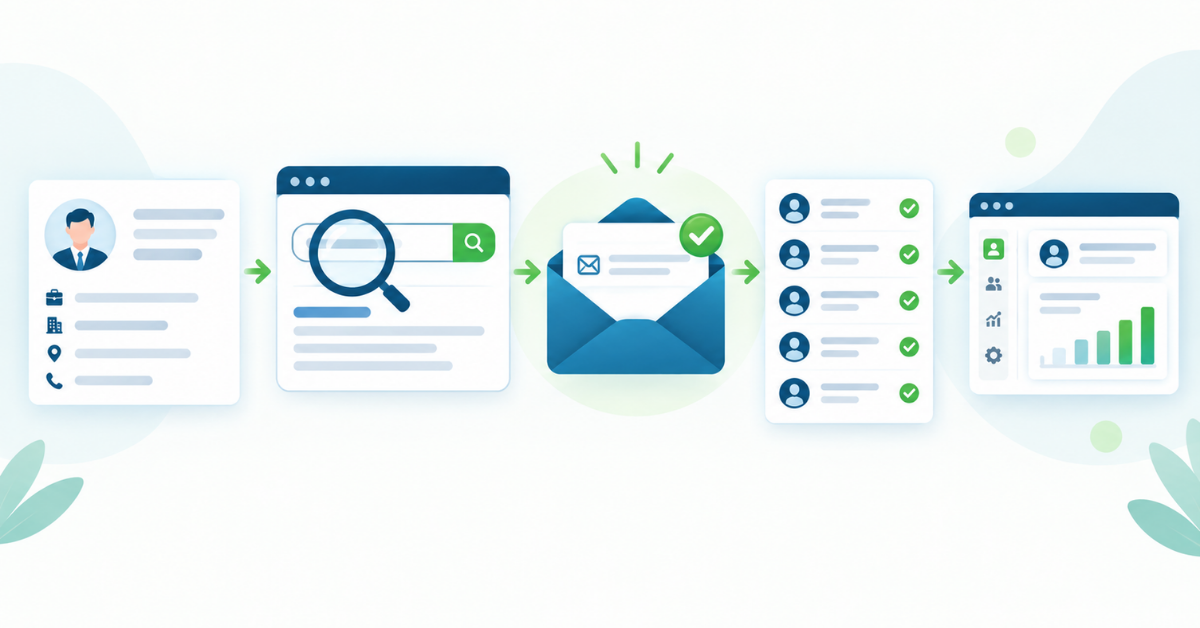
The basic Apollo email search process is straightforward, but each stage serves a different purpose:
It helps to separate four actions. Finding a contact means identifying a person who matches your criteria. Revealing an email means accessing a stored address. Verifying an email means checking whether the address appears deliverable. Sequencing means adding the person to a planned sales workflow. These actions are related, but they are not interchangeable.
Before scaling a list, compare the provider’s checking process with a practical guide to real-time email verification. A verified status can improve list quality, yet it cannot guarantee a reply or remove every delivery risk.
Depending on the record and plan, Apollo may provide:
These fields help a team move from a broad market to a practical prospect list. For example, a founder selling finance software could search for finance leaders at mid-sized technology companies in a chosen region, then review each account before revealing contact information.
The quality of the result depends on coverage, freshness, and the search filters selected. A large result set is less useful if it contains the wrong roles or companies. For a second perspective on list quality, see this comparison of B2B contact providers.
For teams evaluating browser-based prospecting, this overview of sales Chrome extensions provides a useful comparison point.
Apollo’s help documentation reports a 91% email accuracy rate and describes a multi-step verification process that uses several data sources. That number is Apollo’s own claim, not an independent guarantee. Actual results can differ by industry, country, role, domain type, and how recently a person changed jobs.
Email data changes quickly. People leave companies, domains are reconfigured, inboxes are closed, and catch-all domains can make validation harder. A record that was useful last quarter may need a fresh check before a campaign.
Use a sensible quality process:
A dedicated verifier or contact database can be useful when the main requirement is list hygiene. ReachStream’s email verifier is one option buyers may include in that comparison.
Apollo offers a free Starter plan and trial access, but “free” does not mean unlimited reveals or unlimited exports. Apollo’s pricing page says trial plans include 50 credits and 5 mobile credits, while the free plan has its own limits and feature rules. Credits can apply to contact data and other actions, so read the current account-specific terms before estimating volume.
Paid access is designed for teams that need more prospecting capacity, broader workflow features, or non-Gmail sending connections. The right question is not simply whether Apollo has a free option. Ask how several relevant records your team can search, reveal, export, and use each month without interrupting its process.
Apollo’s official pricing page uses plan comparisons, trials, credits, add-ons, and custom options. Exact rates and included limits can change by billing term, account type, feature rollout, and contract, so buyers should confirm the live price at checkout rather than use an old third-party table.
Buying area | What to check | Why it matters |
Billing term | Monthly versus annual commitment | A lower annual seat price may reduce flexibility. |
Email credits | Monthly allowance and reveal rules | It determines how far a prospecting list can go. |
Phone credits | Direct-dial cost and availability | Phone-led teams may use credits faster. |
Export credits | CSV, CRM, or API-related usage | Export volume can become a separate constraint. |
Team usage | Seats, shared pools, permissions, and limits | A plan that works for one rep may cost more at team scale. |
Automation | Sequences, workflows, and sending connections | Engagement features matter only if they fit your process. |
API access | Availability and commercial terms | Technical teams should confirm access before building around it. |
A useful alternative is to compare the subscription with a dedicated provider that focuses on list building. This guide to unlimited email views can help frame the questions around viewing limits and research volume. Buyers can also compare verified lead platforms when estimating list-building capacity.
The extension is free to download, but users need an Apollo account to use its connected features. A typical setup looks like this:
The extension reduces tab switching, which can be helpful for reps who research prospects during account review. It should still be tested on the pages and browsers your team uses. LinkedIn-side behavior can change as platform policies and browser permissions change.
Best Practice: Test the extension with a small sample from your own market. Check match quality, credit usage, page performance, and CRM behavior before installing it across the full team.
For another view of browser-based lead capture, read this guide to LinkedIn lead generation.
Pros | Cons |
Contact search and sales workflows in one system | Credit limits can restrict high-volume use |
Detailed prospect and company filters | Data availability varies by record and market |
Browser extension for in-context research | Browser workflows can change with third-party policies |
Lists, exports, and CRM connections | Team costs rise as seats and usage grow |
Free access for initial testing | Verification is not a guarantee of delivery or response |
Email and phone data where available | Some records will be incomplete |
This balance makes Apollo attractive for teams that want a broad prospecting workflow. It may be less suitable for a buyer who wants a simple, predictable contact-data subscription with minimal engagement features.
Factor | Apollo | Manual lookup |
Research time | Faster for filtered searches and repeatable lists | Slower when checking several sources |
Data availability | Depends on database coverage and record status | Depends on what is publicly visible |
Filtering | Built-in role, company, and market filters | Usually managed in spreadsheets or notes |
Verification | Apollo provides its own verification signals | Often requires a separate verifier |
Scale | Better for repeatable list building | Practical for a short list of high-value contacts |
Workflow | Can connect with lists, CRM, and sequences | Requires more manual data entry |
Cost | Subscription and usage costs | Staff time plus any separate tools |
Apollo provides an advantage when a team needs repeatable search and workflow actions. Manual research can still make sense for a small account list, unusual industries, or contacts that require detailed context before a message is sent. This comparison of manual prospecting gives buyers another way to assess the time-versus-data trade-off.
Apollo is one option among a wider group of B2B contact-data platforms. Hunter is known for domain-based email discovery and verification. Lusha, LeadIQ, and RocketReach focus on contact discovery with different browser, enrichment, and export workflows. ReachStream Prospect is worth evaluating for teams that prioritize searchable B2B contact data, filters, verified records, and list building.
The best comparison should cover database depth, email discovery, verification, bulk prospecting, filters, browser tools, pricing model, export rules, and the user experience for the actual team. No provider will have identical coverage for every market. Start with a fixed set of target companies and compare the same roles across tools.
Buyers can also review this guide to sales intelligence platforms before making a shortlist.
A practical workflow keeps data cost tied to a clear sales goal:
This approach reduces wasted credits and makes it easier to see which filters produce useful conversations. A comparison of data enrichment platforms can help if your team needs to add missing company or contact fields before activation.
Use this buyer checklist before selecting a plan:
Ask for a short trial or use the free plan to test a controlled sample. Compare the result with a dedicated provider, including the B2B email list options available for your market.
Apollo can sit between account research and sales engagement. SDR teams can use it for prospecting, account-based list building, contact enrichment, CRM workflows, and campaign preparation. Marketing teams may use the filters and company data to build audience segments, while founders can use the free tier to research an initial market.
A dedicated B2B contact database may be a better fit when the primary requirement is searching, filtering, and exporting verified contact lists at scale. ReachStream’s enterprise lead generation resources are relevant for teams comparing data-first platforms and workflow coverage. Teams with smaller budgets can also compare lead gen tools before choosing a platform.
If you want to compare a data-first workflow with Apollo’s broader prospecting platform, test ReachStream with a defined list of companies and roles. Review coverage, fields, verification signals, export steps, and total cost before making a larger commitment.
Apollo email finder is worth considering for teams that want contact discovery, filters, account research, and sales workflows in one platform. Its free access makes a controlled test possible, while paid plans can support higher-volume prospecting and connected engagement processes.
It may be less suitable for teams that need a focused contact database, predictable list-building costs, or a workflow centered on exports rather than sequences. The decision should come down to coverage in your target market, the cost of credits, verification results, CRM fit, and the amount of workflow automation your team will use.
Before buying, test a sample of real target accounts. Compare Apollo with at least one dedicated data provider, measure the quality of revealed emails, and calculate the full monthly cost at your expected volume. That process will tell you more than a feature list. Teams can also review B2B data providers as part of the shortlist
Access 400M+ verified business emails and grow your sales pipeline effortlessly.
Apollo email finder is a contact-discovery feature inside Apollo’s sales intelligence platform. It helps users search for people and companies, filter prospects, reveal available professional emails or phone details, and move suitable records into lists or sales workflows. Apollo is designed for B2B use, so its data centers on professional contact and company information rather than personal email lookup.
Apollo finds email addresses by matching search criteria with contact records in its database and then revealing available information. Users can search by name, company, role, location, and other attributes. Apollo also provides a Chrome extension for finding contact details while browsing supported pages. Email availability varies by person, company, market, and record status.
Apollo email finder has a free Starter plan and trial access, but free usage is limited by credits and feature rules. Apollo’s pricing page states that trial plans include 50 credits and 5 mobile credits. Users should check the live account terms because email reveals, phone actions, exports, and sending connections may have separate limits.
Apollo email finder pricing depends on the selected plan, billing term, seats, credits, add-ons, and workflow features. Apollo’s official pricing page should be used for the current amount because rates and plan rules can change. Calculate the cost using your expected email reveals, phone reveals, exports, and team seats rather than comparing the headline seat price alone.
Apollo reports a 91% email accuracy rate in its help documentation. That is a vendor-reported figure, not a promise that every record will deliver. Accuracy can vary with industry, geography, domain type, and job changes. Test a representative sample, monitor bounces, and recheck older records before using them in a larger campaign.
Yes, Apollo has a Chrome extension that Apollo says can provide contact and account insights across supported tools such as LinkedIn, company websites, Gmail, Salesforce, and HubSpot. Users can find available contact details, save leads, and add prospects to sequences. Install and test it in the exact browser workflow your team plans to use.

Author
Marketing professional with a Master’s degree in Marketing, specializing in SEO, content strategy, social media, performance marketing, prospecting, and demand generation.
Access 400M+ verified business emails and grow your sales pipeline effortlessly.
Don't forget to share this post!















Check out our other blogs!
Email Verification Tools: 15 Ways to Check Business Emails
B2B Data Providers: How to Compare Contact Data Platforms
CRM Data Enrichment: How to Improve Incomplete Contact Records
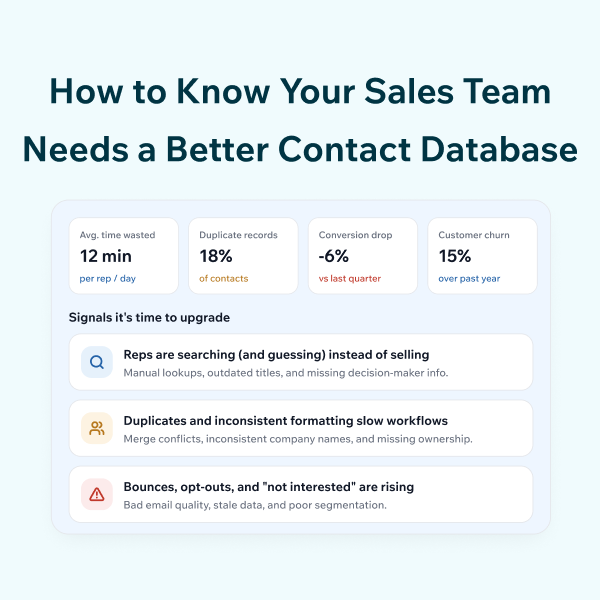
How to Know Your Sales Team Needs a Better Contact Database