
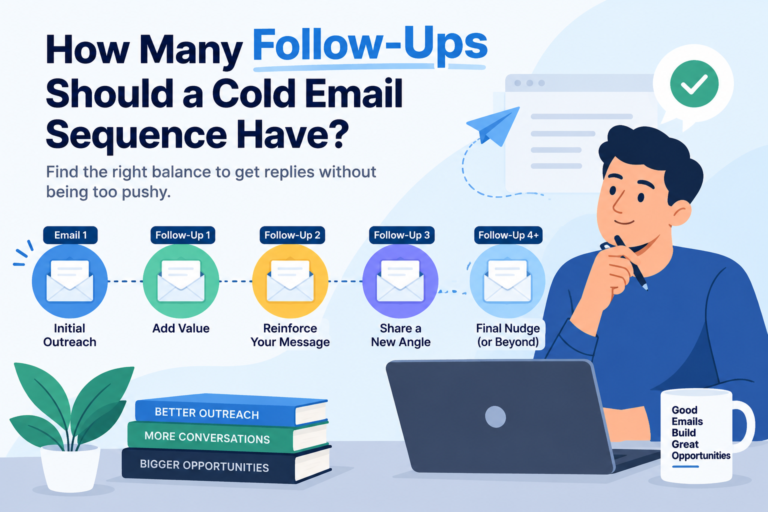


A cold email sequence is a set of emails sent to a prospect who hasn’t interacted with you before, starting with an initial message and followed by planned follow-up emails if they don’t reply. Unlike a single cold email, a sequence gives you several chances to earn a reply, since most people don’t respond to the first message they get from someone they don’t know.
A well-built cold email sequence follows a logical order: the opener introduces you and states a clear reason for reaching out, the middle follow-ups add proof or a new angle, and the final email closes the loop with a direct ask or a polite sign-off.
There is no fixed number of follow-ups that works for every cold email sequence. Report ranges vary by source and industry, with many outbound teams landing somewhere between 3 and 9 total touches.
A practical starting point for most B2B cold email sequences is 4 to 6 emails, including the first one, sent across roughly 2 to 3 weeks. From there, adjust based on your own reply and unsubscribe data: shorter sequences tend to fit simple, low-friction offers, while longer sequences make more sense for larger or enterprise accounts where the sales cycle naturally moves slower.
The right length for a cold email sequence depends on factors that differ from one campaign to the next: how targeted your list is, how relevant your offer is to the recipient, and how sensitive your industry is to unsolicited outreach.
A tightly targeted list of decision-makers who already fit your ideal customer profile may respond within the first two or three emails, while a broader or colder list often needs the full sequence to generate the same interest. Treat published benchmarks as a starting range, not a rule, and let your own reply, bounce, and unsubscribe rates guide how many follow-ups you actually send.
Cold email cadence works best when the gaps between messages widen as the sequence goes on, rather than staying on a fixed daily or weekly schedule. A common pattern is 2 to 3 days between the first email and the first follow-up, then 4 to 7 days between the next couple of emails, then a week or more before any later follow-ups. This graduated spacing mirrors how a person would naturally follow up on their own, and it also helps you avoid the rigid, evenly timed sending patterns that some spam filters flag as automated.
Beyond spacing, the day and time you send each email in a cold email sequence affects whether it gets seen at all. Tuesday through Thursday mornings, in the recipient’s own time zone, are generally a safer bet than Mondays, when inboxes are often flooded, or Fridays, when attention drops. If you have any signal that a prospect just engaged with your company, such as a website visit or a content download, sending the next follow-up soon after that signal usually works better than sticking rigidly to a preset calendar.
The biggest mistake in a cold email follow-up strategy is repeating the same message with a different subject line. Every email in the sequence should give the prospect a new reason to read it: a short case study, a relevant statistic, a resource, or a different angle on the original problem. Keep each follow-up short, plain text works better than heavily designed HTML, and always make it easy to say no, since a clear opt-out reduces spam complaints and keeps your list clean.
A cold email sequence performs better when it reaches real, working addresses in the first place. ReachStream Prospect is designed to help you build lists from verified business contacts, so fewer of your follow-ups bounce before a prospect even sees them.
Simple, specific follow-ups tend to outperform anything that sounds automated. A short first follow-up might reference the original email and add one new piece of information.
For example: “Following up on my note from Tuesday, wanted to share [specific result or resource], since it’s directly relevant to [specific situation].”
A later follow-up in the sequence can shift the angle entirely, asking a direct question like: “Is improving [specific outcome] a priority for your team this quarter, or is this the wrong time?”
The final email in a cold email sequence is often a short breakup message that gives the prospect an easy out while leaving the door open, such as: “I’ll stop reaching out for now. If this becomes relevant later, feel free to reply anytime.”
| Approach | Best for | Total span | Reply pattern | Overuse risk |
|---|---|---|---|---|
|
No follow-up (1 email only) |
Extremely narrow, one-shot outreach or a strict no-follow-up policy |
Single send |
Lowest total replies, no second chance if the first email is ignored |
Lowest, no risk of over-sending |
|
Short sequence (3 to 4 emails) |
Simple offers or a small, well-qualified list |
About 1 week |
Higher reply rate per email sent, fewer total replies overall |
Low, unlikely to trigger spam complaints |
|
Standard sequence (4 to 6 emails) |
Most B2B cold outreach and prospecting |
2 to 3 weeks |
Highest total replies, since later emails keep adding new ones |
Moderate, manageable with graduated spacing |
|
Extended sequence (7 to 9 emails) |
High-value or enterprise accounts worth extra persistence |
4 weeks or more |
Diminishing returns per additional email sent |
Higher, watch unsubscribe and spam complaint rates closely |
Stop a cold email sequence as soon as one of a few clear signals shows up: the prospect replies in any way, they explicitly ask you to stop, or you reach the last email you planned for that sequence with no response at all. Continuing to send generic “just checking in” emails past that point rarely helps and can quietly damage your sender reputation. If a prospect opens several emails but never replies, that’s a signal to change your angle or move them to a different channel, not a reason to keep sending the same message.
The most common mistake is sending too many generic “just following up” emails that add no new information and give the prospect no fresh reason to respond. Others include ignoring deliverability basics, like domain warmup and list hygiene, which quietly caps how many people ever see the sequence at all, and failing to define a clear stopping point in advance, which leads to over-sending on accounts that were never going to convert. A cold email sequence built around fewer, more relevant messages generally holds up better over time than one built purely around volume.
Keep an eye on your bounce rate and spam complaint rate as you run any cold email sequence. Industry guidance generally treats a spam complaint rate above roughly 0.1% as a warning sign, and consistently high numbers can affect whether your emails reach the inbox at all.
A well-timed cold email sequence still depends on reaching the right person at a working email address. ReachStream Prospect gives sales and marketing teams access to a large base of verified business contacts and company records, which can help reduce the bounces and dead ends that quietly undermine an otherwise well-built sequence. Pairing accurate contact data with a thoughtful cadence and relevant follow-up content is generally a stronger combination than optimizing either one on its own.
Before you plan your next cold email sequence, it can help to start from a cleaner list. ReachStream Prospect’s free plan lets you test search filters and verified contact data on a small scale before you commit to anything larger.
There is no single right number of follow-ups for every cold email sequence, but a starting point of 4 to 6 emails over 2 to 3 weeks works well for most B2B outreach. Space your follow-ups so the gaps widen as the sequence goes on, make sure every email adds something new, and stop the moment a prospect replies or opts out. Combine that cadence with accurate contact data and reasonable deliverability habits, and your cold email sequence has a much better chance of reaching an inbox and getting a reply.
See how ReachStream Prospect combines search filters, verification, and enrichment to help you build a cold email sequence around contacts who are actually reachable.
Most cold email sequences work well with 4 to 6 emails, including the first message, spread across 2 to 3 weeks. There’s no single number that fits every campaign, so treat this as a starting point and adjust based on your own reply and unsubscribe data.
A common cadence uses shorter gaps early on, around 2 to 3 days between the first email and the first follow-up, then widens to 4 to 7 days and later a week or more. Graduated spacing feels more natural to the recipient and helps avoid rigid, automated-looking send patterns.
Stop as soon as the prospect replies, explicitly opts out, or you reach the final email in your planned sequence without a response. Sending more generic follow-ups past that point rarely improves results and can hurt your sender reputation.
Each follow-up should add something the previous email didn’t, such as a short case study, a new resource, or a different angle on the original problem. A message that only says something like “just checking in” gives the prospect no new reason to respond.
Not necessarily. Many outbound teams see the biggest gains from the first one or two follow-ups, with each additional email adding a smaller benefit and a higher risk of spam complaints or unsubscribes. Results vary widely by list, offer, and industry.
A cold email sequence only works if the emails actually reach the inbox. Domain warmup, list hygiene, and a low spam complaint rate all affect deliverability, and a sequence sent from a poorly warmed-up domain can underperform even with strong copy.
Not always. Simpler offers or smaller, well-qualified lists often work with a shorter sequence, while larger or enterprise accounts can justify a longer one since those sales cycles tend to move more slowly.
Yes, if it’s overused. Too many follow-ups, especially generic ones sent on a rigid schedule, can raise spam complaint and unsubscribe rates, which affects whether your future emails land in the inbox at all.

Author

Access 450M+ verified business contacts and grow your sales pipeline efficiently.
Don't forget to share this post!















Check out our other blogs!
How Many Follow-Ups Should a Cold Email Sequence Have?

How a Medical Device Company Can Reach Hospital Decision-Makers
What Data Fields Should a Healthcare Marketing Database Include?
ReachStream Prospect vs Prospeo: Who Delivers Accurate Data?