

How to Evaluate B2B Data Vendors for Accuracy and Compliance
In modern business-to-business (B2B) commerce, sales and business development teams frequently encounter a frustrating paradox: they possess robust contact databases and powerful communication software, yet struggle to turn initial prospect interactions into meaningful, revenue-generating sales conversations. Traditional outbound tactics—characterized by high-volume, generic messaging sent indiscriminately across channels—yield diminishing returns as buyers become increasingly desensitized to generic sales pitches.
Effective B2B sales outreach requires a fundamental departure from volume-driven interruption. Success depends on precision, timing, deep contextual relevance, personalization, and disciplined, value-driven follow-up. Rather than treating prospecting as a numbers game, high-performing organizations treat it as a strategic discipline that bridges market research with buyer enablement.
B2B sales outreach differs fundamentally from business-to-consumer (B2C) marketing and transactional sales. Emotional impulses, individual preferences, and short evaluation cycles often drive consumer purchases. In contrast, B2B purchasing decisions are collective, risk-averse, and economically complex.
Enterprise and mid-market purchases rarely involve a single buyer. Modern B2B sales cycles typically engage a buying committee consisting of five to ten stakeholders, including economic buyers, technical evaluators, end-users, legal counsel, and procurement officers.
Given the complexity of buying committees, sending identical messages to thousands of generic contacts is counterproductive. High-volume, untargeted outreach triggers spam filters, damages sender reputation, and burns addressable markets. Conversely, highly targeted B2B prospecting focuses resources on accounts that match the ideal customer profile (ICP). By tailoring messages to specific corporate initiatives and industry headwinds, sales teams capture attention and build immediate credibility.
Outreach execution is only as strong as its underlying foundation. Before drafting a single message or initiating a call, sales leaders must establish rigorous targeting criteria and assemble verified data assets.
An Ideal Customer Profile (ICP) defines the exact organizational characteristics of a company that experiences maximum value from your product or service. Defining an ICP prevents wasted effort on accounts with low propensity to buy. Key parameters include:
Once target accounts are defined, sales teams must identify the specific individuals within those organizations who influence, champion, or authorize purchases. Buyer personas outline:
Identifying target accounts and buyer personas requires reliable data infrastructure. Modern sales teams leverage sophisticated B2B sales lead databases and sales intelligence platforms to map target accounts and extract verified contact coordinates. However, raw contact data is prone to decay due to job turnover, organizational restructuring, and company relocation.
Data enrichment and email verification are essential operational steps before launching campaigns. Sending outreach to defunct email addresses damages domain authority and lowers deliverability. Teams should integrate real-time verification protocols to ensure high data hygiene. For deep insights into sourcing accurate records, consult the specialized guide on B2B Sales Lead Databases.
Selecting the appropriate communication medium depends on buyer behavior, industry norms, and the complexity of the offering. Relying on a single channel often limits campaign reach, whereas an uncoordinated multi-channel approach can overwhelm prospects.
Cold email remains a cornerstone of outbound sales due to its scalability and asynchronous nature. It allows sales professionals to deliver structured, reference-rich arguments directly to executives’ inboxes. Effective email outreach requires concise subject lines, a sharp focus on prospect challenges, and transparent value propositions.
LinkedIn is the premier social network for B2B engagement. LinkedIn prospecting allows sales reps to research professional backgrounds, monitor company announcements, share industry insights, and initiate warm conversations before transitioning to email or phone calls. Social selling builds familiarity and trust long before a formal pitch occurs.
While digital channels dominate modern discourse, cold calling remains highly effective—particularly for high-value enterprise sales, urgent market disruptions, or sectors where executives rarely check email. A well-executed call cuts through digital noise, humanizes the brand, and allows for real-time objection handling and qualification.
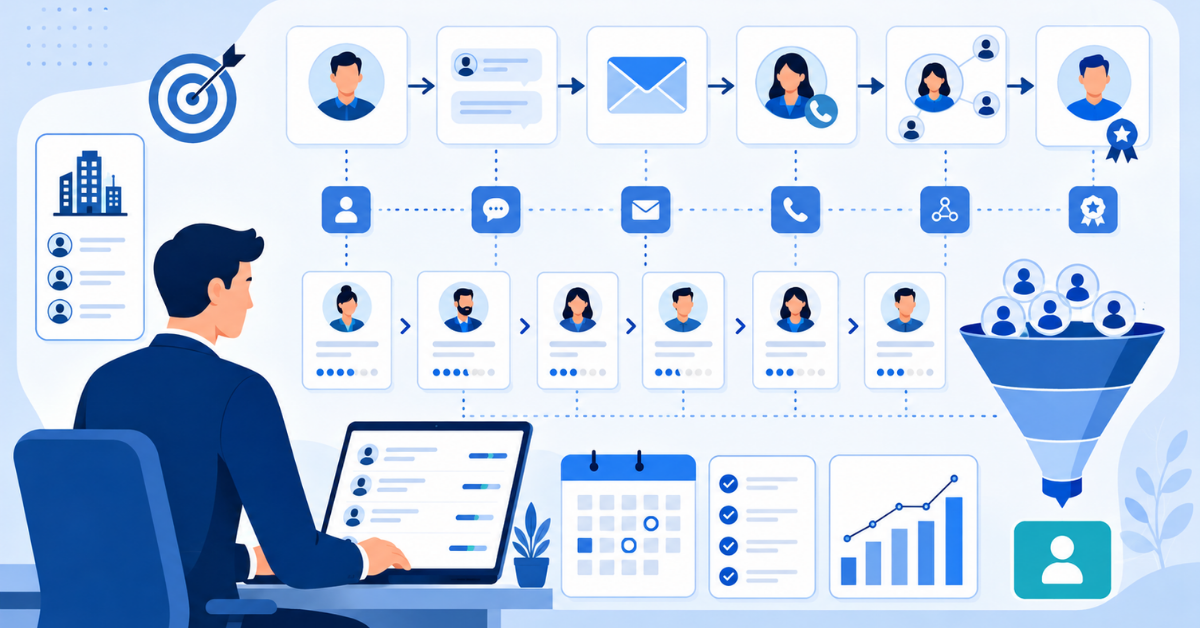
The most successful outbound strategies integrate email, LinkedIn, phone calls, and content touchpoints into a unified sequence. Multi-channel orchestration increases visibility without appearing spammy while respecting buyer preferences across different communication channels.
Channel | Best Use | Strength | Challenge |
Email Outreach | Scalable messaging, sharing detailed resources, asynchronous communication | High scalability, easy tracking, structured presentation | High competition, aggressive spam filters, lower initial response rates |
LinkedIn Prospecting | Relationship building, executive social proof, warm networking | High visibility, rich professional context, low friction | Daily connection limits, requires active profile maintenance |
Cold Calling | Immediate dialogue, complex enterprise deals, urgent qualification | Direct feedback, real-time objection handling, human connection | Gatekeeper barriers, low initial pick-up rates, high skill requirement |
Multi-Channel | Comprehensive campaign sequences across touchpoints | Maximizes contact rates, accommodates buyer preferences | Requires robust tooling, careful cadence management to avoid fatigue |
Effective outreach copywriting is customer-centric rather than product-centric. Prospects care about their own operational efficiencies and revenue growth, not the features of a vendor’s software.
Every outreach message should be anchored in a specific business challenge faced by the target industry or role. By articulating an acute pain point—such as rising customer acquisition costs or manual data reconciliation errors—reps establish immediate empathy and domain expertise.
True personalization extends beyond merging first names and company titles. Effective sales engagement relies on context derived from recent corporate events, regulatory shifts, hiring trends, technological implementations, or strategic expansion initiatives.
A common mistake in cold outreach is demanding too much commitment too early—such as requesting a 45-minute product demonstration from a cold contact. High-performing outbound messages feature low-friction, conversational calls to action (CTAs), such as asking for permission to share a relevant benchmark report or inquiring about their current approach to a specific workflow.
B2B Outreach Message Framework: Context → Problem → Relevance → Value → CTA
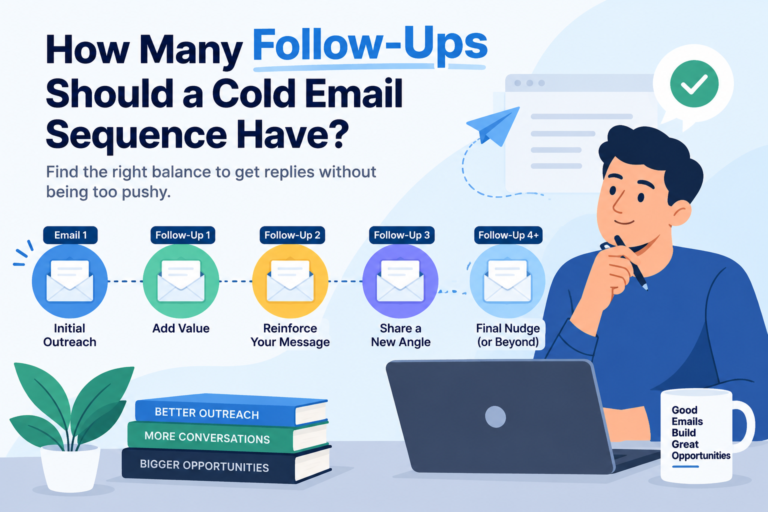
Conversion rarely occurs on the first touchpoint. Industry data consistently shows that the majority of B2B responses occur after the second, third, or fourth follow-up interaction.
Sales teams should design multi-touch cadences spanning 14 to 21 days, strategically spacing interactions across email, LinkedIn profile views, connection requests, and phone calls. A structured cadence ensures consistent coverage without appearing aggressive.
Repeatedly asking “Did you get my last email?” degrades the buyer relationship. Every follow-up interaction should introduce new value—such as sharing a recent industry case study, highlighting a regulatory compliance update, offering an original research snippet, or providing a tactical checklist relevant to their department.
Persistence must be balanced with professional respect. If a prospect explicitly opts out or communicates a lack of fit, teams must immediately suppress them from active sequences. Continuing outreach after the firm has shown disinterest harms brand equity and violates compliance standards (such as GDPR and CAN-SPAM).
Generating a reply or booking a meeting is merely the beginning of the sales cycle. An outreach response represents initial interest or curiosity, not necessarily commercial viability.
Sales development representatives (SDRs) must rigorously qualify incoming responses before routing opportunities to account executives (AEs). Evaluation criteria must assess:
To maximize operational efficiency, organizations should route prospect responses into a structured qualification matrix:
Technology acts as a powerful amplifier for outbound strategy, enabling automation and intelligence without substituting for human insight.
Customer Relationship Management (CRM) systems and specialized sales engagement platforms form the administrative backbone of modern outbound operations. They track interaction history, automate multi-channel cadence steps, and measure conversion velocity across the sales pipeline.
Sales intelligence software enables reps to filter global databases using firmographic, technographic, and intent signals to identify accounts actively researching relevant solution categories.
Data degradation requires continuous verification layers. Automated email validation tools scrub contact lists before campaign launch, preventing bounces and protecting domain reputation. To explore leading software solutions that optimize this workflow, see Top B2B Sales Software Tools to Boost Lead Gen.
Evaluating campaign efficacy requires looking beyond vanity metrics like total emails sent. True performance analysis balances engagement efficiency with downstream commercial outcomes.
Metric Category | Specific KPI | Operational Benchmark / Focus |
Deliverability | Inbox Placement Rate | Maintain >95% delivery via strict domain authentication (SPF, DKIM, DMARC) |
Engagement | Positive Reply Rate | Focus on relevance over volume; target 3–8% positive response on segmented campaigns |
Conversion | Meeting-Booked Rate | Track conversion from initial touch to confirmed discovery call (1–3% target) |
Commercial Impact | Pipeline Value Generated | Measure total closed/won revenue and active deal volume attributable to outbound |
Executing a high-performance outbound strategy requires access to pristine, verified contact data and deep company intelligence. ReachStream serves as a vital data and prospecting resource within the broader outreach workflow, providing sales teams with the infrastructure needed to identify and connect with ideal buyers.
ReachStream supports B2B sales outreach through several core capabilities:
By integrating ReachStream into the foundational research and prospecting stages, sales teams can eliminate manual data friction and focus their energy on crafting relevant, high-converting outreach conversations.
Successful outbound sales is a structured operational pipeline.
Target → Research → Personalize → Reach → Follow Up → Qualify → Measure
This outreach framework acts as a critical engine within the broader B2B sales process:
Lead Generation → Prospecting → Outreach → Qualification → Nurturing → Opportunity → Customer
Mastering B2B sales outreach requires shifting away from high-volume interruption and embracing a disciplined, research-backed methodology. By defining a precise ICP, leveraging verified intelligence tools, personalizing communications around buyer challenges, and maintaining structured follow-up cadences, sales teams can build predictable, high-value pipelines.
To explore how outbound execution fits into the broader commercial landscape, read The Ultimate B2B Lead Generation Guide (2026).
B2B sales outreach is the proactive process by which sales and business development professionals initiate contact with prospective business buyers across channels like email, LinkedIn, and phone to introduce solutions and spark commercial conversations.
The most effective channels depend on the buyer persona and the offering’s complexity, combining cold email for scalable communication, LinkedIn prospecting for relationship-building, and cold calling for high-value enterprise engagement.
A successful strategy starts with defining an Ideal Customer Profile (ICP) and buyer personas, building verified prospect lists, crafting problem-centric messaging, establishing multi-channel follow-up cadences, and measuring pipeline conversion metrics.
Sales teams should structure follow-up cadences around 3 to 5 touchpoints over a 14- to 21-day period, ensuring that each subsequent interaction adds new value rather than repeating previous requests.
An effective outreach message should include relevant context, an articulated business problem, tailored relevance to the company, a brief statement of value, and a low-friction, open-ended call to action.
Lead generation encompasses all marketing and prospecting activities designed to attract and capture prospect interest. In contrast, sales outreach is the specific outbound execution phase focused on initiating direct contact with identified prospects.
Success should be measured beyond raw activity volume by tracking positive response rates, meeting-booked rates, qualified opportunities created, pipeline value generated, and overall return on investment (ROI).
Sales teams can personalize outreach by incorporating relevant context regarding recent company milestones, industry regulatory shifts, executive hiring trends, technological stacks, and specific departmental pain points.
Marketing professional with a Master’s degree in Marketing, specializing in SEO, content strategy, social media, performance marketing, prospecting, and demand generation.
Access 200M+ verified business emails and grow your sales pipeline effortlessly.
Don't forget to share this post!















Check out our other blogs!
How Many Follow-Ups Should a Cold Email Sequence Have?

How a Medical Device Company Can Reach Hospital Decision-Makers
What Data Fields Should a Healthcare Marketing Database Include?
ReachStream Prospect vs Prospeo: Who Delivers Accurate Data?