Outbound vs Inbound Lead Generation: Which Works Best for B2B?
- Best Practice > Marketing > Sales
- > Article
- Best Practice > Marketing > Sales
- > Article
How to Evaluate B2B Data Vendors for Accuracy and Compliance
Every B2B business eventually faces the same question: should we wait for buyers to find us, or should we go find them first? Inbound and outbound lead generation represent two different answers to that question, and both have earned their place in a modern B2B strategy.
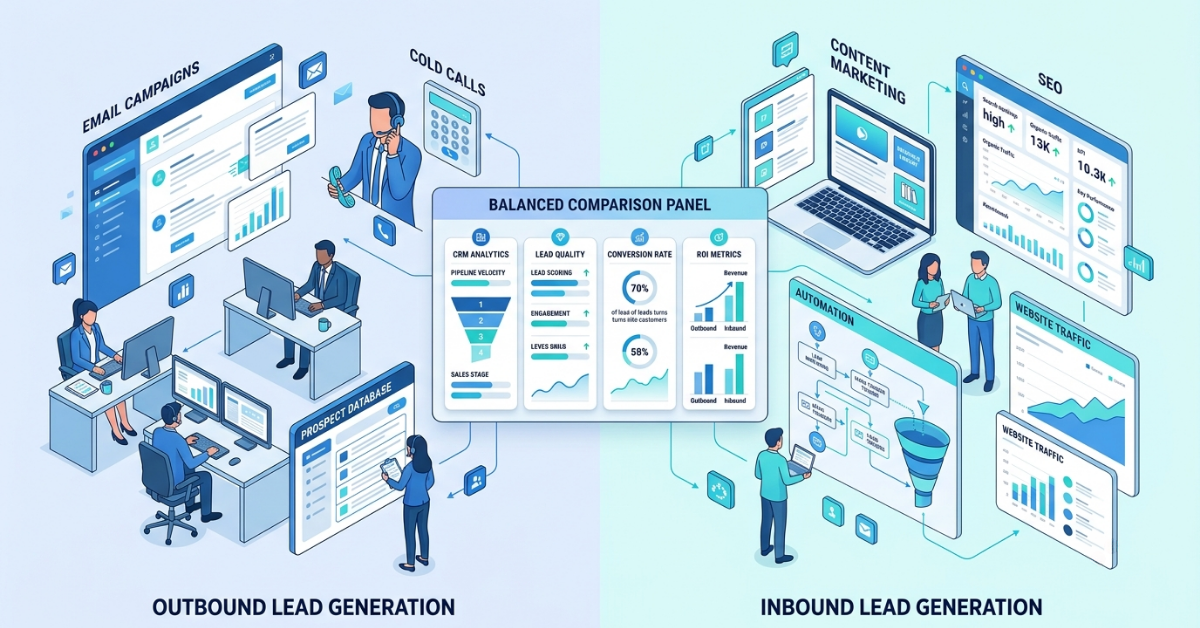
Inbound lead generation relies on content, search visibility, and organic engagement to attract buyers who are already researching a solution. Outbound lead generation takes a more direct route, with sales and marketing teams proactively identifying and contacting prospects who match the Ideal Customer Profile (ICP).
Neither approach is inherently better than the other. The right choice depends on business goals, target audience, available budget, and the length of the typical sales cycle. Many of the most effective B2B lead generation programs use a combination of both, rather than treating inbound and outbound as competing strategies.
This guide breaks down how each approach works, where each one performs best, and how businesses can combine them into a single, coordinated lead generation strategy
Why Is Lead Generation Essential for B2B Growth?
Before comparing inbound and outbound, it helps to understand why lead generation itself is a growth priority rather than a marketing side project. B2B buying decisions are longer and more considered than consumer purchases, which means businesses need a deliberate system for finding and engaging the right prospects rather than waiting for demand to appear on its own.
The Role of Lead Generation in Modern B2B Sales
Consistent lead generation is what keeps a B2B sales pipeline healthy. Without a steady flow of qualified prospects, sales teams are forced to rely on referrals or unpredictable one-off opportunities, which makes revenue difficult to forecast.
A dependable lead generation process gives businesses more control over growth. It helps teams identify companies that match their ICP, build relationships with the right decision-makers, and create a predictable path from first contact to closed deal.
Lead generation also plays a role beyond new customer acquisition. It supports account expansion, helps marketing teams understand which messaging resonates with buyers, and gives sales leaders the data needed to plan territory and headcount decisions.
Because inbound and outbound are the two primary engines that drive this pipeline, understanding how each one works is the first step toward building a strategy that fits the business.
What Is Inbound Lead Generation?
Inbound lead generation is a pull-based strategy: instead of chasing prospects, a business creates content and search visibility that brings the right buyers to them. It’s built on the idea that if a prospect is already researching a problem, the business that shows up with the most useful answer earns their trust first.
How Inbound Lead Generation Works
Inbound lead generation attracts prospects by providing useful, relevant information at the stage of the buyer journey when they’re actively searching for answers. Instead of reaching out directly, businesses create content and digital experiences that draw prospects in organically.
The typical inbound buyer journey moves through three broad stages. In the awareness stage, a prospect recognizes a business challenge and starts researching it online. In the consideration stage, they compare possible solutions and evaluate different providers. In the decision stage, they narrow their options and engage with sales to make a final choice.
Because inbound leads come from prospects who chose to engage, they often arrive with a clearer understanding of their own needs. This tends to make inbound leads easier to nurture, even though the process of attracting them can take longer to build momentum.
Common Inbound Lead Generation Channels
- SEO: Optimizing website content and structure so businesses appear in search results when prospects look for relevant solutions.
- Content Marketing: Publishing guides, case studies, and resources that address buyer questions at each stage of the journey.
- Blogs: Regularly published articles that build topical authority and support long-term organic search visibility.
- Webinars: Live or on-demand sessions that let businesses demonstrate expertise and engage prospects directly.
- Email Marketing: Nurturing subscribers and website visitors with relevant content until they're ready to talk to sales.
- Social Media: Sharing content and engaging with prospects on the platforms where B2B buyers research and network.
- Organic Search: The unpaid traffic that results from strong SEO and content performance over time.
Together, these channels create a system where prospects discover a business on their own terms, which is why inbound tends to build trust more naturally than direct outreach.
What Is Outbound Lead Generation?
Outbound lead generation is a push-based strategy: rather than waiting to be found, a business identifies exactly who it wants to reach and initiates the first conversation. It gives sales and marketing teams direct control over targeting, timing, and messaging, which is why it remains a core motion for B2B companies with a clearly defined ICP.
How Outbound Lead Generation Works
Outbound lead generation flips the model. Instead of waiting for prospects to find the business, sales and marketing teams proactively identify companies and decision-makers who match the ICP and reach out to start a conversation.
This approach depends on accurate targeting. Teams typically start by defining the ICP, then use business data to build a list of companies and contacts that fit. From there, outreach is designed to be direct, personalized, and focused on starting a specific conversation rather than waiting for organic discovery.
Outbound tends to work well when a business needs to reach a narrow, well-defined audience, such as enterprise accounts or a specific job role, and can’t rely solely on that audience finding them through search or content.
Common Outbound Lead Generation Channels
- Cold Email: Direct, personalized emails sent to prospects who match the target profile but haven't engaged with the business yet.
- Cold Calling: Phone outreach used to start conversations quickly and gather direct feedback from prospects.
- LinkedIn Prospecting: Using LinkedIn to identify decision-makers, build relationships, and initiate outreach.
- Account-Based Marketing (ABM): Coordinated outreach and messaging aimed at a defined list of high-value target accounts.
- Paid Prospecting: Using paid ads and sponsored content to reach specific audience segments outside of organic channels.
- Business Contact Databases: Verified data sources that help teams find accurate decision-maker contact information on a scale.
Because outbound is initiated by the business, it gives sales teams more control over who they target and when, which is one of the biggest advantages of the approach.
How Do Inbound and Outbound Lead Generation Compare?
Once a business understands how each strategy works individually, the next question is how they stack up against each other in practice. Cost, speed, and scalability often move in opposite directions for inbound and outbound, which is exactly why most teams end up weighing trade-offs rather than picking a clear winner.
Side-by-Side Comparison
Both strategies can generate qualified pipeline, but they behave differently across nearly every dimension that matters to a B2B business. The table below breaks down how inbound and outbound compare.
Factor | Inbound Lead Generation | Outbound Lead Generation |
Cost | Lower cost per lead over time; higher upfront content investment | Higher cost per lead; ongoing spend on tools, data, and outreach |
Speed | Slower to build momentum; results grow over months | Faster initial results; conversations can start within days |
Scalability | Scales well once content and SEO assets are established | Scales with headcount, data access, and outreach infrastructure |
Lead Quality | Leads are self-selected and often well-informed | Leads are hand-picked to match the ICP, but need more qualification |
Personalization | Broad messaging aimed at audience segments | Highly personalized, one-to-one or account-specific messaging |
Sales Cycle | Can be longer, since buyers self-pace their research | Can be shorter, since sales controls the outreach timeline |
ROI | Strong long-term ROI as content compounds over time | Faster short-term ROI, but requires consistent reinvestment |
Best Use Cases | Brand authority, education, and long-term demand generation | Targeted outreach, enterprise deals, and time-sensitive campaigns |
Required Resources | Content, SEO, and marketing automation expertise | Sales development reps, verified data, and outreach tools |
What Are the Advantages and Challenges of Each Approach?
The comparison table shows how inbound and outbound differ on paper, but each strategy also comes with practical strengths and trade-offs that only become clear once a team is running it. Weighing these honestly helps businesses set realistic expectations before committing budget and headcount to either motion.
Benefits and Limitations of Inbound Lead Generation
- Benefits: Inbound builds long-term brand authority produces leads that are already educated about their problem, and generally costs less per lead once content assets are in place. It also compounds over time, since older content can continue generating traffic and leads long after it's published.
- Limitations: Inbound takes time to build momentum, and results are harder to predict in the early stages. It also depends heavily on consistent content production, SEO expertise, and a large enough addressable audience actively searching for a solution.
Benefits and Limitations of Outbound Lead Generation
- Benefits: Outbound gives businesses direct control over who they target, which makes it effective for reaching specific accounts, job roles, or industries. It can also produce faster initial conversations, since outreach doesn't depend on a prospect discovering the business organically.
- Limitations: Outbound generally costs more per lead, requires accurate and continuously updated business data, and can produce lower response rates if targeting or messaging isn't well matched to the audience. It also depends on skilled sales development reps to execute consistently.
Which Lead Generation Strategy Works Best for Different B2B Businesses?
There’s no universal answer to which strategy is “better,” because the right mix depends heavily on a company’s stage, resources, and target market. What works for a two-person startup rarely maps cleanly onto an enterprise sales motion, and vice versa.
Startups and Small Businesses
Startups and small businesses often have limited budgets and need faster proof that their offer resonates with the market. Outbound can help validate messaging quickly by starting direct conversations with a well-defined ICP, while a lighter inbound presence builds credibility over time. Many early-stage companies lean on outbound first, then invest more heavily in inbound as the business matures.
Mid-Market Companies
Mid-market companies typically have more resources to invest in both approaches and benefit from running them together. Inbound helps build a scalable pipeline of self-qualified leads, while outbound allows sales teams to target specific accounts that haven’t discovered the business organically. A hybrid approach at this stage usually produces the most consistent results.
Enterprise Organizations
Enterprise organizations often sell to a narrower set of large accounts with longer sales cycles and multiple decision-makers. Outbound and account-based marketing tend to play a larger role here, since reaching specific stakeholders at target companies requires a proactive approach. Inbound still matters at the enterprise level, particularly for building trust and supporting research during a long evaluation process.
Can Businesses Combine Inbound and Outbound Lead Generation?
Framing inbound and outbound as an either-or decision misses how most high-performing B2B teams actually operate. In practice, the two motions tend to work best as complementary parts of a single pipeline strategy rather than separate, competing programs.
Building a Hybrid Lead Generation Strategy
Most successful B2B lead generation programs don’t rely on a single approach. Instead, they combine inbound and outbound so that each motion strengthens the other. Content and SEO build awareness and trust at scale, while outbound outreach ensures the business also reaches high-value accounts that may never find that content on their own.
A hybrid strategy also improves lead quality. Outbound teams can use inbound engagement, such as content downloads or webinar attendance, as a signal for who to prioritize. At the same time, outbound research and account data can inform which topics and content inbound marketing should prioritize next.
The workflow below illustrates a simple version of how the two motions can work together.
Step 1 — Inbound builds awareness: SEO content, blogs, and webinars attract prospects who are actively researching solutions. |
Step 2 — Outbound identifies target accounts: Sales teams use verified business data to build account lists that match the ICP, including prospects who haven’t found the content yet. |
Step 3 — Signals connect the two motions: Content engagement (downloads, webinar sign-ups, repeat visits) becomes a trigger for outbound follow-up, while outbound conversations reference relevant inbound content. |
Step 4 — Sales qualifies and engages: SDRs combine inbound intent signals with outbound research to prioritize leads and personalize outreach. |
Step 5 — Consistent pipeline: The combined motion produces a steadier flow of qualified opportunities than either approach alone. |
When inbound and outbound are coordinated rather than run in isolation, businesses typically see steadier pipeline growth and better conversion rates than either approach produces on its own.
How Can ReachStream Strengthen Your Outbound and Inbound Efforts?
Whichever mix of inbound and outbound a business chooses, the quality of the underlying data has a direct impact on how well either motion performs. Inaccurate contact details, outdated firmographic data, or mismatched targeting can quietly undermine even a well-designed lead generation strategy.
Supporting Better Lead Generation with Verified Data
Regardless of whether a business leans more heavily on inbound, outbound, or a hybrid approach, accurate business data plays a role in almost every stage of the process. ReachStream supports both motions by giving sales and marketing teams access to verified, up-to-date business information.
- Find verified decision-makers: Search for the specific roles and departments involved in a purchasing decision.
- Enrich company data: Add missing firmographic and contact details to existing CRM records.
- Improve prospect targeting: Filter prospects by industry, company size, location, and other ICP criteria.
- Build accurate lead lists: Create outbound target lists based on verified, current business information.
- Increase sales efficiency: Reduce time spent on manual research so teams can focus on outreach and conversations.
For outbound teams, this means spending less time verifying contact details and more time engaging qualified prospects. For inbound teams, accurate company and role data can help refine ICP definitions and inform which content topics are most likely to reach the right audience.
Conclusion
Deciding between inbound and outbound lead generation ultimately comes down to understanding what each approach is good at, and being honest about what the business actually needs right now.
Choosing the Right Strategy for Long-Term Growth
Inbound and outbound lead generation solve different parts of the same problem. Inbound builds long-term visibility and attracts buyers who are already searching for a solution, while outbound gives businesses a direct way to reach specific accounts and decision-makers on their own timeline.
There’s no single strategy that works best for every B2B business. The right mix depends on the sales cycle, target audience, available resources, and how quickly a business needs to see results. Many organizations find that combining both approaches, rather than choosing one over the other, produces the most consistent and predictable pipeline over time.
For a broader look at how lead generation strategy comes together end to end, from defining an ICP to selecting the right tools and partners, see The Ultimate B2B Lead Generation Guide.
Claim 100 free leads to see data quality in action
Frequently asked questions
1. What is the difference between inbound and outbound lead generation?
Inbound lead generation attracts prospects through content, SEO, and organic engagement, while outbound lead generation involves proactively reaching out to prospects through channels like cold email, cold calling, and LinkedIn.
2. Which strategy produces faster results?
Outbound generally produces faster initial results, since outreach can start conversations within days. Inbound takes longer to build momentum but tends to produce more consistent results over time.
3. Which approach is more cost-effective?
Inbound is typically more cost-effective over the long term, since content assets continue generating leads after publication. Outbound often costs more per lead due to the ongoing investment in data, tools, and outreach.
4. Can startups use both strategies?
Yes. Many startups use outbound early on to validate messaging and generate quick conversations, then build inbound content over time to create a more scalable, long-term pipeline.
5. How do you measure the success of inbound and outbound campaigns?
Inbound success is often measured through organic traffic, content engagement, and conversion rates, while outbound success is typically measured through response rates, meetings booked, and pipeline generated per rep.
6. When should businesses combine both approaches?
Businesses should consider combining both approaches once they have the resources to support each motion, or when they need to reach both a broad audience through content and specific high-value accounts through direct outreach.
7. Does company size affect which strategy works best?
Yes. Startups and enterprises often lean more on outbound to reach specific accounts quickly, while mid-market companies frequently benefit from running inbound and outbound together.
8. What role does data quality play in outbound lead generation?
Data quality directly affects outbound performance. Accurate, verified contact and company information improves targeting, reduces wasted outreach, and increases the likelihood of reaching the right decision-makers.
Abdul Hafeez
Marketing professional with a Master’s degree in Marketing, specializing in SEO, content strategy, social media, performance marketing, prospecting, and demand generation.
Share
Table of Contents
Access 200M+ verified business emails and grow your sales pipeline effortlessly.
Power Your Sales
with Targeted Data
Don't forget to share this post!















Check out our other blogs!
How to Build a Targeted Prospect List Using Filters
October 21, 2026

B2B Data for Ed-Tech Companies: Reaching School Decision-Makers
October 21, 2026
Direct Dial Numbers Explained: A Guide for Sales Reps
October 19, 2026