
Unlimited Data.
Infinite Possibilities.
Looking for B2B data? Download Unlimited data using our Chrome extension at just $79/month.
12 Best B2B Company Data Platforms for 2026 (Expert Tested)

12 Best B2B Company Data Platforms for 2026 (Expert Tested)

How to Evaluate B2B Data Vendors for Accuracy and Compliance

Your CRM is only as good as the data inside it. And if your team is still manually researching contacts on LinkedIn or working from a spreadsheet that’s six months stale, you’re leaving pipeline on the table. 

B2B company data platforms solve this by giving revenue teams on-demand access to verified emails, direct dials, firmographics, and buying signals—all in one place. This guide breaks down what these platforms actually do, the features that matter most, and how the top 12 options compare for different team sizes and use cases. 

What are B2B company data platforms

B2B company data platforms are software tools that provide verified contact information, firmographic data, and buying intent signals for sales and marketing prospecting. Top platforms in 2026 include ZoomInfo for enterprise teams, Apollo.io for budget-conscious SMBs, Cognism for European compliance, and 6sense for intent-driven account-based marketing. 

So what exactly do you get from one of these platforms? Think of it as a centralized business contacts database where your revenue team can pull accurate emails, direct phone numbers, technographic insights, and company intelligence all in one place. 

The difference between a raw data provider and a full platform comes down to workflow. A data provider hands you a spreadsheet. A platform helps you act on that data immediately through built-in list building, enrichment, and CRM integrations. 
Why B2B company data drives revenue growth

When your contact records are accurate and enriched with firmographic context, every outreach touchpoint becomes more relevant. Reps spend less time researching and more time having actual conversations. 

Here’s what accurate company data enables in practice: 

  • Faster prospecting: Your team skips the manual LinkedIn digging and gets straight to outreach 
  • Higher deliverability: Verified emails reduce bounce rates, which protects your sender reputation over time 
  • Better personalization: Firmographic details like industry, revenue, and tech stack make your messaging feel relevant rather than generic 

The math is straightforward. If your team sends 1,000 emails per week and your bounce rate drops from 15% to 3%, that’s 120 additional emails reaching real inboxes without changing anything else about your campaign. 

Claim 100 free leads to see data quality in action

How we tested these B2B data platforms

We evaluated each platform across five dimensions that matter most to revenue teams running real campaigns: data accuracy, database coverage, integration depth, compliance posture, and ease of use. 

For accuracy testing, we pulled sample contacts across industries and verified emails using third-party tools. Coverage was assessed by filtering for niche segments—think “VP of Engineering at Series B fintech companies in DACH”—to see which platforms returned usable results. 

We also weighted practical factors like onboarding time, credit transparency, and whether the platform actually integrates with the tools teams already use. 

Features to look for in a B2B data provider

Choosing the right B2B data provider starts with understanding which features actually impact your team’s day-to-day performance.

Data accuracy and real-time verification

Bounced emails and wrong phone numbers waste time and damage sender reputation. The best platforms verify emails at the point of export using ESP-level checks, not just syntax validation. 

Look for platforms that offer a “pay only for verified contacts” model. This pricing structure shifts the risk away from you and signals confidence in data quality.

Database coverage and global reach

A platform with 200 million contacts sounds impressive, but coverage depth matters more than raw numbers. Some platforms excel in North America but lack depth in EMEA or APAC markets. 

Before committing, test whether the platform covers your specific target segments: industry verticals, company sizes, and geographies you actually sell into. 

Intent data and buying signals

Intent data tracks online behavior to identify accounts actively researching relevant topics. Bombora’s Company Surge methodology, for example, monitors content consumption across a co-op of B2B publishers to surface in-market accounts. 

This type of signal helps prioritize outreach toward buyers already in a research phase rather than cold accounts with no immediate interest. 

CRM and sales tool integrations

Native integrations with Salesforce, HubSpot, and outreach tools reduce manual data entry and keep records synchronized. Without clean integrations, teams end up exporting CSVs and re-uploading, which introduces errors and slows everything down. 

Compliance and data privacy standards

GDPR, CCPA, and other privacy regulations govern how B2B data can be collected and used. Compliant platforms source data from public and consented sources, provide opt-out mechanisms, and document their processing practices. 

For teams selling into regulated industries like healthcare or finance, compliance isn’t optional. 

AI and automation capabilities

Modern platforms use AI for lead scoring, enrichment recommendations, and prospecting suggestions. AI-powered features help surface high-fit accounts faster and reduce the manual effort of building lists from scratch. 

Data refresh frequency

B2B data decays quickly. Contacts change roles, companies get acquired, and phone numbers go stale. Platforms that refresh data quarterly or offer real-time verification maintain higher accuracy over time. 

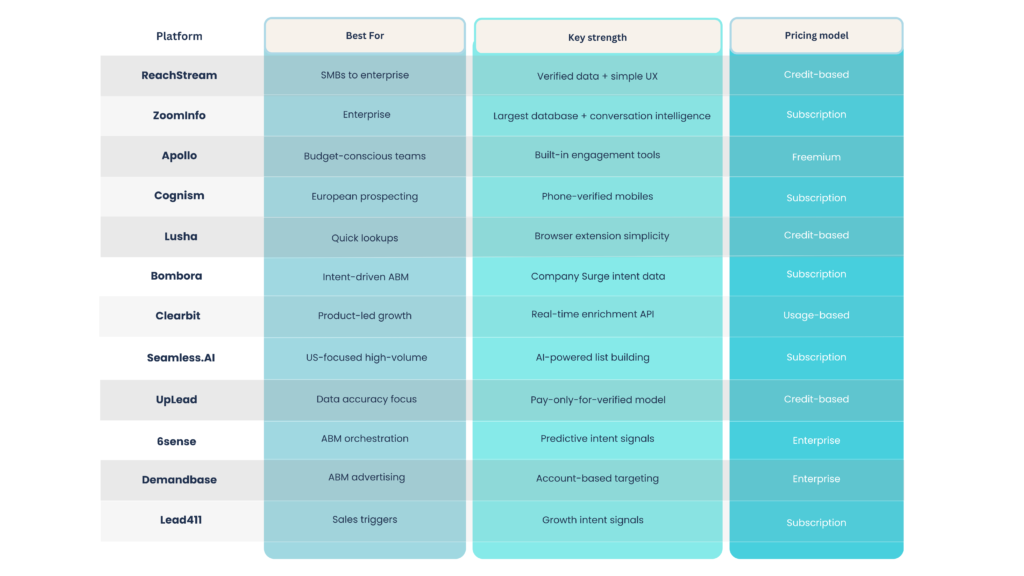
Quick comparison of the best B2B company data platforms

Quick comparison of the best B2B company data platforms

The 12 best B2B company data platforms reviewed

\With dozens of B2B data providers on the market, narrowing down the right options requires a closer look at how each platform performs in real-world use cases.

1. ReachStream

ReachStream is a B2B data platform built for revenue teams that want accurate, conversion-ready contacts without enterprise complexity. The platform combines a List Builder with 200M+ contacts, Data Enrichment for updating existing records, a LinkedIn Chrome Extension, and API access for workflow automation. 

  • Top features: Advanced filtering across 15+ attributes, ESP-verified emails, pay-only-for-valid-emails pricing, free automatic contact updates every three months 
  • Best for: Sales, marketing, ABM, RevOps, and recruiting teams across company sizes 
  • Pricing: Credit-based with a free Icebreaker plan, no credit card required 

2. ZoomInfo

ZoomInfo is often considered the industry standard for enterprise B2B data, offering 260M+ contacts with deep firmographic and technographic coverage. The platform includes conversation intelligence and extensive native integrations. 

  • Top features: Largest database, intent data, org charts, conversation intelligence 
  • Best for: Enterprise sales and marketing teams with budget for premium data 
  • Pricing: Annual subscription, typically $15K+ per year 

3. Apollo

Apollo combines a large contact database (275M+ contacts) with built-in sales engagement tools, making it popular among startups and SMBs. The freemium model lets teams start without a contract. 

  • Top features: Sequencing, email tracking, dialer, LinkedIn extension 
  • Best for: Budget-conscious teams wanting prospecting and outreach in one tool 
  • Pricing: Freemium with paid tiers starting around $49/month 

4. Cognism

Cognism specializes in GDPR-compliant data with human-verified mobile phone numbers, making it particularly strong for teams prospecting in European markets. 

  • Top features: Diamond Data (phone-verified mobiles), GDPR compliance, intent data 
  • Best for: Teams targeting EMEA markets with phone-heavy outreach 
  • Pricing: Annual subscription, custom pricing 

5. Lusha

Lusha offers a straightforward browser extension for quick contact lookups directly from LinkedIn and company websites. It’s designed for individual reps who want fast access to emails and phone numbers without navigating a complex platform. 

  • Top features: Simple Chrome extension, quick reveal, Salesforce integration 
  • Best for: Individual contributors and small teams 
  • Pricing: Credit-based with a free tier 

6. Bombora

Bombora is the leader in B2B intent data, tracking content consumption across a co-op of publishers to identify accounts actively researching relevant topics. The Company Surge methodology surfaces accounts showing increased interest in specific topics. 

  • Top features: Company Surge intent data, topic taxonomy, integration with major platforms 
  • Best for: ABM teams prioritizing accounts based on buying signals 
  • Pricing: Subscription, typically bundled with other platforms 

7. Clearbit

Clearbit (now part of HubSpot as Breeze Intelligence) provides real-time enrichment APIs for product-led growth teams and developers building data into applications. 

  • Top features: Real-time API enrichment, form shortening, website visitor identification 
  • Best for: Product and engineering teams embedding data into products 
  • Pricing: Usage-based API pricing 

8. Seamless.AI

Seamless.AI uses artificial intelligence for real-time contact discovery, focusing primarily on the US market. It’s known for high-volume list building with AI-powered search. 

  • Top features: AI-powered search, real-time verification, Chrome extension 
  • Best for: US-focused teams running high-volume prospecting 
  • Pricing: Subscription with tiered plans 

9. UpLead

UpLead emphasizes data accuracy with a 95% accuracy guarantee and pay-only-for-verified-emails model. It’s a solid mid-market alternative to larger enterprise platforms. 

  • Top features: Real-time verification, technographics, intent data 
  • Best for: Mid-market teams prioritizing accuracy over volume 
  • Pricing: Credit-based starting around $99/month 

10. 6sense

6sense is an ABM orchestration platform that uses predictive analytics and intent signals to identify accounts most likely to buy. It’s designed for sophisticated enterprise ABM programs. 

  • Top features: Predictive intent, account identification, orchestration 
  • Best for: Enterprise marketing teams running multi-channel ABM 
  • Pricing: Enterprise contracts, custom pricing 

11. Demandbase

Demandbase combines B2B data with account-based advertising and website personalization, making it strong for marketing teams focused on targeted display campaigns. 

  • Top features: ABM advertising, account identification, personalization 
  • Best for: Marketing teams running account-based display programs 
  • Pricing: Enterprise contracts, custom pricing 

12. Lead411

Lead411 provides sales intelligence with growth intent triggers like funding events, hiring signals, and technographic changes that indicate buying readiness. 

  • Top features: Growth intent triggers, verified emails, Bombora intent integration 
  • Best for: Teams using trigger-based outreach 
  • Pricing: Subscription starting around $99/month 
Try ReachStream free—no credit card required

How to choose the right B2B company data platform

With so many options available, the key is to evaluate platforms based on how well they align with your specific business goals and workflows.

Match data coverage to your target market

A platform strong in North America might lack depth in APAC or EMEA. Before committing, run test searches for your actual target segments—specific industries, company sizes, and geographies—to see what comes back. 

Evaluate your integration requirements

Map your existing tech stack (CRM, marketing automation, outreach tools) against each platform’s native integrations. The fewer manual exports and imports required, the cleaner your data stays over time. 

Assess total cost of ownership

Pricing models vary widely: credits, subscriptions, seats, usage-based. Calculate your cost per verified contact, not just the headline price. A cheaper platform with lower accuracy often costs more in wasted outreach. 

Factor in compliance and security

For enterprise buyers, evaluate SOC 2 compliance, GDPR readiness, and data sourcing transparency. Ask vendors directly how they collect data and what opt-out mechanisms exist. 

Final Thoughts

Accurate, verified data is foundational to predictable pipeline growth. The platforms reviewed here each solve different problems, excel at enterprise scale, others at affordability, and others at regional compliance. 

The right choice depends on your team size, target market, and existing tech stack. If you’re evaluating options, starting with a free trial lets you test data quality against your actual ICP before committing budget. 

Frequently asked questions

1. What is the difference between company data and contact data?

Company data includes firmographics like industry, employee count, revenue, and technology stack. Contact data includes individual details like email addresses, phone numbers, job titles, and departments. Most B2B data platforms provide both, allowing you to filter companies first and then access contacts within those accounts. 

B2B data decays as contacts change roles, companies merge, and phone numbers go stale. Platforms that refresh data quarterly or offer real-time verification at export maintain higher accuracy. Some platforms, like ReachStream, provide free automatic updates for previously downloaded contacts. 

Small businesses typically benefit from platforms with free tiers or credit-based pricing that doesn’t require annual contracts. ReachStream, Apollo, and Lusha all offer entry points that let smaller teams access verified data without enterprise commitments. 

Yes, many platforms support recruiting use cases by providing verified contact details for candidates filtered by job title, company, location, and seniority. The same data that helps sales teams reach decision-makers helps recruiters reach passive candidates. 

Compliant platforms source data from publicly available sources and legitimate business interest, provide clear opt-out mechanisms, and document their data processing practices. When evaluating vendors, ask specifically about data collection methods and how they handle subject access requests. 

Intent data tracks online behavior—like content consumption, search activity, and website visits—to identify accounts actively researching topics related to your solution. This allows sales teams to prioritize outreach toward buyers already in a research phase rather than cold accounts with no immediate interest. Bombora and 6sense are leading providers of intent signals. 

Manohar Devdiga

Marketing professional with a Master’s degree in Marketing, specializing in SEO, content strategy, social media, performance marketing, prospecting, and demand generation.

Share
Table of Contents

Access 200M+ verified business emails and grow your sales pipeline effortlessly.

Power Your Sales with Targeted Data

Don't forget to share this post!

Check out our other blogs!