

How to Evaluate B2B Data Vendors for Accuracy and Compliance
Most B2B teams don’t struggle to generate leads. They struggle to generate leads that turn into revenue. A list of a thousand contacts means nothing if half the emails bounce and the other half never respond. The gap between “leads” and “pipeline” is usually a strategy problem, not a volume problem.
This article breaks down ten proven approaches to B2B lead generation strategy that consistently produce qualified opportunities rather than inflated contact lists, so you can build a program that holds up under a revenue target rather than just a vanity metric.
If you’re looking for the broader framework first, our Ultimate B2B Lead Generation Guide covers the fundamentals of ICP definition, data quality, and lead qualification. This piece goes deeper into the specific tactics that make a lead generation strategy work in practice.
An effective lead generation strategy consistently delivers prospects who match your ideal customer profile, have a real need for your solution, and can move through a sales process without excessive manual cleanup. It’s measured not by names collected but by the percentage that convert into meetings, opportunities, and closed deals.
Three qualities separate an effective strategy from an ineffective one: it targets a clearly defined audience instead of casting a wide net, it uses accurate and current contact data instead of scraped or outdated lists, and it combines multiple channels so prospects encounter your brand more than once before a sales conversation.
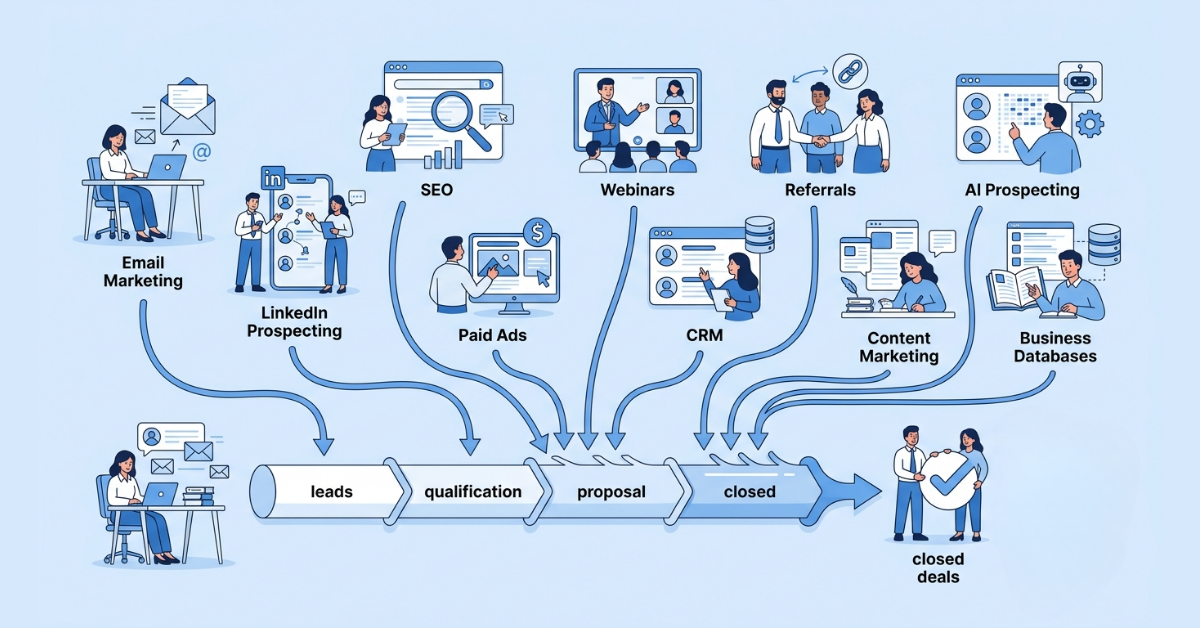
Relying on a single channel creates fragility. If a business depends entirely on cold email and deliverability drops, pipeline dries up overnight. A diversified approach spreads risk across channels and reaches buyers at different stages of awareness.
Buyers also don’t all behave the same way. Some respond to a well-timed cold call. Others ignore calls entirely but engage with a LinkedIn message. A mix of strategies means your team isn’t dependent on one type of buyer behavior to hit a number.
The strategies below cover outbound, inbound, and relationship-driven approaches. Most B2B teams combine several, weighted by sales cycle, deal size, and target audience.
Every other strategy depends on this step. Before outreach begins, sales and marketing need a list of companies and contacts matching the ideal customer profile, built from verified data rather than guesswork.
Cold email remains one of the most scalable lead generation strategies when personalized and sent to a well-qualified list. The difference between meetings and spam complaints usually comes down to targeting, not volume.
LinkedIn works well for B2B because decision makers are already active there professionally. Social selling isn’t about pitching in the first message — it’s about building visibility and credibility before an ask.
Inbound content builds a pipeline that compounds over time. Instead of chasing every prospect individually, well-targeted content attracts prospects already researching a solution.
Webinars generate leads who have already invested time in your topic, making them more sales-ready than a cold contact, and give sales a natural, low-pressure reason to follow up.
Account-based marketing (ABM) flips the funnel by starting with a defined list of target accounts and building coordinated campaigns around each. It suits businesses with fewer, higher-value accounts and longer sales cycles.
Referral leads typically convert faster because trust is already established, yet many B2B companies leave referrals to chance instead of building a structured process.
Paid campaigns on LinkedIn, Google, or industry platforms generate leads quickly, making them useful for filling short-term pipeline gaps or testing messaging before scaling.
In-person and virtual industry events remain a strong lead source, particularly for larger deals where relationship building matters. What works is preparation before the event, not just showing up with a booth.
Buyers rarely respond to one email or one LinkedIn message. A structured sequence combining email, phone, and social touches over several weeks consistently outperforms single-channel outreach.
The right mix depends on deal size, sales cycle, and how your buyers research and purchase. The table below outlines where each strategy tends to fit best.
AI-assisted prospecting is changing how quickly teams build and qualify lists, using predictive scoring to flag accounts showing buying signals before they actively search for a solution. Intent data, drawn from content consumption and search behavior, is helping teams prioritize accounts already in-market rather than cold accounts.
Automation is also extending into personalization, using account and contact data to tailor messaging at scale without it reading as generic. At the same time, buyers are growing more selective about what they respond to, which means data accuracy will matter more, not less, as automation increases.
Every strategy above depends on one requirement: accurate, current data about the right companies and contacts. ReachStream gives sales and marketing teams access to a verified B2B contact database, searchable by industry, company size, job role, and other firmographic filters.
Teams can use ReachStream to build targeted prospect lists for cold email or ABM campaigns, enrich CRM records that have gone stale, and identify decision makers before outreach begins. The ReachStream Chrome Extension also lets reps pull contact details while browsing LinkedIn or company websites, cutting the manual research time that slows outbound campaigns
There’s no single lead generation strategy that works for every B2B business, but the strongest programs share a few things: a clearly defined audience, accurate data, and a coordinated mix of channels rather than one tactic stretched too thin. Start with the strategies that match your sales cycle and deal size, measure conversion at each stage, and adjust based on what the data shows.
For a deeper look at how these tactics fit into a complete lead generation process, from ICP definition through qualification and data management, revisit our Ultimate B2B Lead Generation Guide.
Whichever strategies you prioritize, they all depend on accurate business data at the foundation. ReachStream gives sales and marketing teams verified contact information and company intelligence to build stronger prospect lists and spend less time on manual research. Start a free trial to see how accurate data strengthens your lead generation strategy.
There isn’t one strategy that works for every business. The right approach depends on deal size, sales cycle, and audience. Most successful teams combine several, such as verified prospect data, multi-channel outreach, and content marketing.
Most B2B teams benefit from three to five coordinated strategies rather than running every tactic simultaneously. A smaller, well-executed mix tends to outperform spreading resources too thin.
Outbound strategies like cold email and paid ads can produce results within days to weeks. Content marketing typically takes several months to build momentum but produces more sustainable pipeline over time.
Lead generation focuses on identifying and capturing individual prospects. Demand generation focuses on building broader awareness of a category or problem, which feeds the top of the lead generation funnel.
Most failures trace back to poor list quality, generic messaging, and no clear trigger for the outreach. Deliverability issues from unwarmed domains also lower response rates.
ABM works best with a defined list of high-value accounts and a sales process that supports longer engagement. Smaller companies with broader markets often see faster results from scalable strategies like cold email or content.
Marketing professional with a Master’s degree in Marketing, specializing in SEO, content strategy, social media, performance marketing, prospecting, and demand generation.
Access 200M+ verified business emails and grow your sales pipeline effortlessly.
Don't forget to share this post!















Check out our other blogs!
Email ID Checker: Verify Any Email ID Online
ICP Refinement for SDRs: Using Data Filters to Stop Wasting Touches

Email Validator: Validate Email Format, Domain and Mailbox