
Q3 Limited-Time Deal. Find verified B2B leads at half the cost. Get 50% Off with Coupon Code PROSPECT50. First 200 Users Only.
Company Contacts Database to Find Verified Decision-Makers
Written by:
Junaid Hussain Khan

Company Contacts Database: Find Verified Decision-Makers 

> Company Contacts

How to Evaluate B2B Data Vendors for Accuracy and Compliance

TL;DR

What Is a Company Contacts Database

company contacts database is a searchable collection of verified business contacts, typically including names, job titles, company emails, and often direct phone numbers, organized. Sales and marketing teams can filter by role, industry, or company size instead of researching one person at a time. 

The appeal is obvious once you have tried the alternative. Manually finding a decision-maker’s contact info means checking a company website, cross-referencing LinkedIn, and guessing at an email pattern, then hoping it is still accurate. A good company contacts database collapses that process into a search and a filter. 

This guide covers what actually separates a strong one from a weak one and how to evaluate contact and company search data before investing in a solution. 

Tip
Before comparing providers, write down the three filters you use most often, whether that is industry, company size, or seniority. That list will tell you more about which company contacts database fits than any feature comparison chart. 

What to Look for in a B2B Contact Database

Not every B2B contact database is built the same way, and the differences matter more once you are relying on the data for real outreach. 

Data Quality Over Volume

A provider advertising hundreds of millions of records is not automatically better than one with a smaller, more current set of verified records. Stale contact information costs you in bounced emails and wasted outreach hours. Ask any provider how often records are refreshed, not just how many they claim to have.

Real-Time Email Verification 

Real time email verification catches invalid addresses before they ever reach your sequencing tool. This is one of the clearest signals of a serious B2B contact data provider versus one relying on static lists that go stale within months.

Search Filters That Match How You Actually Sell

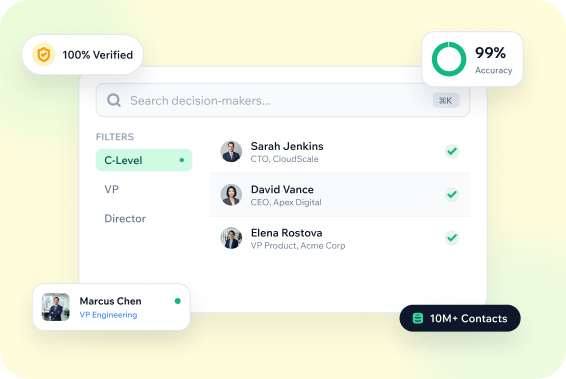
Search filters for industry, company size, seniority, and location are basic requirements. More advanced platforms add firmographic and technographics filtering, so you can find companies using specific tools or meeting specific growth criteria, not just a job title.

AI-Powered Scoring and Intent Data

AI-powered features and intent data are increasingly common additions to this kind of platform, helping surface which accounts are actively researching solutions like yours. These are genuinely useful, but only on top of accurate underlying data. Intent signals layered onto a stale contact list still point you toward a bad email address.
INDUSTRY INSIGHT 
Buyer research has shifted heavily toward self-directed evaluation before a sales conversation happens, which is part of why accuracy matters more than ever. A qualified decision-maker who never receives your first email because it bounced was never really reachable in the first place, regardless of how good the underlying records looked on paper. 
See what verified B2B company contacts look like 
Search real contact and company data with filters built for how sales and marketing teams actually work. 

Manual Research vs a Database Search

Manual research still works for a short list of high-value target accounts. If you are selling into twenty specific companies, a research-heavy, personalized approach can outperform a database search. 

Where manual research breaks down is scale. Checking company websites and LinkedIn one contact at a time might take fifteen or twenty minutes per verified decision-maker. A B2B contact database compresses that into seconds, provided the underlying data is accurate. 

TIP
Take Sally, an SDR at a 40-person fintech startup. Selling into a narrow list of 15 target enterprise accounts, she spends real time manually researching each decision-maker on LinkedIn, since the personalization pays off at that scale. For her broader outbound list of 300 mid-market prospects, she switches to a company contacts database instead. Same rep, two different approaches, matched to two different jobs. 
Approach  Best for  Time per verified contact  Scalability  Data freshness risk 
Manual research 
Small list of high-priority accounts 
15 to 20 minutes 
Low, does not scale past a short list 
Low, checked in real time by a person 
Database search 
Building lists at volume 
Seconds to minutes 
High, scales to thousands of records 
Depends entirely on provider refresh rate 
Hybrid 
Most sales and marketing teams 
Database for volume, manual for top accounts 
Medium, scales with team size 
Mixed, varies by which method sourced the contact 

How to Find Verified Decision-Makers, Step by Step

  1. Define the decision-maker profile: Job title alone is not enough. Note seniority level and department, since titles vary across companies. 
  2. Filter by industry, company size, and location: Narrow the list before you start reviewing individual records one at a time. 
  3. Check verification status: Confirm the platform verifies email addresses rather than only predicting them from a pattern. 
  4. Review contact depth: Look for more than just an email address. Direct phone numbers alongside a verified email give you more than one way to reach someone. 
  5. Export and route to your CRM: Keep the source noted so you can track reply and bounce rates by list. 
PRO TIP
Run a small test batch of 50 to 100 records through any new provider before committing to a larger export. Check actual bounce rates against what the provider claims, since advertised accuracy and real world performance do not always match. 

Free Plan vs Paid: What to Expect

A free plan is a reasonable way to test data quality in your specific industry before paying for anything. Most free tiers cap monthly exports or limit which fields you can see, which is normal and expected. 

QUICK CHECKLIST
BEST PRACTICE 
Treat a free plan as a genuine evaluation tool, not just a lead magnet to ignore. Pull a real sample against your actual ICP, check verified deliverability, and compare it against whatever you are using today before deciding whether to upgrade. 

Common Mistakes to Avoid 

  1. Skipping the verification question entirely: Many providers predict emails from a pattern without confirming the mailbox is live. Ask directly whether verification is built in. 
  2. Ignoring how contact information ages: A company contact list from a provider that never refreshes records degrades within months as people change roles and companies. 
  3. Overlooking export limits until they are hit: Test the actual export workflow before you build a process that depends on volume that a free or entry plan cannot support. 
  4. Buying on database size instead of fit: A B2B contact database with strong coverage in your specific industry beats a bigger, more generic one nearly every time. 
  5. Not involving the sales team in the evaluation: Sales and marketing teams both use this data differently. Get input from whoever will actually run outreach against the list before committing to a provider. 
PRO TIP 
Ask any provider what percentage of their records are verified versus predicted. A vague answer is itself useful information. 

Where ReachStream Prospect Fits In

ReachStream Prospect is built to solve this challenge by providing verified contact and company data, rather than a static list that goes stale after the first quarter. 

The platform includes advanced search filters for industry, company size, and seniority, along with firmographic and technographics data, so you can narrow a list to your actual ICP rather than a broad industry category. A built-in email verifier checks addresses before they reach your outreach sequence, and data enrichment fills in missing details on records you already have. 

Two plans support teams at different stages of that work. The Ice Breaker plan is free for life and includes 100 export credits every month, enough to test data quality against your specific market. The Glacier plan runs $39 per month for 5,000 export credits, built for teams that need consistent volume beyond the free tier. 

Test data quality before you commit 
Pull a real sample of verified decision-makers and compare it against what you are using today. 

Conclusion

company contacts database is only as useful as the accuracy behind it. Search filters, AI-powered scoring, and intent data all add value, but none of it matters if the underlying records are stale or unverified. Prioritize verification and data quality first, then evaluate features on top of that foundation. 

Manual research still has a place for a short list of high-priority accounts, but a proper B2B contact database is what lets sales and marketing teams build qualified lists at real scale. Test a free plan against your own ICP, check real bounce rates rather than advertised accuracy, and move to a paid plan once your volume genuinely outgrows what a free tier supports. 

Start building a verified contact list today 
See how ReachStream Prospect combines search filters, verification, and enrichment in one platform. 

Frequently Asked Questions

1. What is a company contacts database?

A searchable collection of verified business contacts, including names, job titles, company emails, and often phone numbers, organized so users can filter by role, industry, or company size instead of researching contacts manually.
A contact list is typically static and unfiltered. A database allows searching and filtering by criteria like industry, seniority, and company size, and a strong one includes real-time email verification rather than just raw, unverified entries.
Accuracy depends on how often records are refreshed and whether emails are verified rather than only predicted from a pattern. Ask any provider directly how frequently their company contact data is updated.
Yes, for evaluation purposes. A free plan lets you test data quality and coverage in your specific industry before committing budget to a paid subscription.
Industry, company size, seniority, and location cover most use cases. Firmographic and technographics filtering adds precision for teams targeting companies with specific characteristics or tech stacks.
It can, but only when layered on top of accurate, verified records. Intent signals pointing you toward a stale or unverified contact do not solve the underlying data quality problem.
This varies by provider and plan, but most free tiers cap monthly export credits. ReachStream Prospect’s Ice Breaker plan, for example, includes 100 export credits per month at no cost.
Yes. the Ice Breaker plan is free for life and includes 100 export credits per month. Teams that need more volume can move to the Glacier plan, which costs $39 per month for 5,000 export credits.
In most cases, yes. A shared, verified source of company contact data keeps both teams working from the same list and reduces duplicate or conflicting outreach to the same contacts.
Junaid Hussain Khan

Author

Junaid Hussain Khan
Junaid is Senior Manager – Brand Growth & Strategy at ReachStream, where he drives content, SEO, and growth strategy for B2B sales and marketing teams.
Share
Table of Contents

Access 200M+ verified business emails and grow your sales pipeline effortlessly.

Power Your Sales with Targeted Data
Junaid Hussain Khan
Junaid Hussain KhanAuthor
Junaid Hussain Khan is the Business Development Manager at ReachStream, adept at forging strategic partnerships and identifying new market opportunities to propel ReachStream's growth and strengthen its position in the B2B ecosystem.

Don't forget to share this post!

Check out our other blogs!