




> Sales
How to Evaluate B2B Data Vendors for Accuracy and Compliance

A B2B email campaign can have a clear audience, useful content, and a strong subject line, yet still produce disappointing results. The problem may begin before the message is written: the contact list contains invalid addresses, former employees, duplicate records, or people who no longer engage with the company.
That is why email deliverability depends on more than sending infrastructure. The quality of the contacts you send to affects bounces, engagement, sender reputation, and the chance that future messages reach the inbox. Clean contact data gives every other deliverability measure a stronger starting point.
Email deliverability describes the likelihood that a sent message reaches the recipient’s primary inbox. It is different from email delivery, which usually means the recipient’s mail server accepted the message. An accepted message can still go to spam, a promotions folder, quarantine, or another filtered location.
Open rate is different again. It measures how recipients interact with messages that were delivered, while deliverability focuses on whether the message gets a fair chance to be seen. A useful deliverability guide can help teams understand why inbox placement should be reviewed before open and click metrics.
The email deliverability rate is the share of sent messages that reach the intended inboxes, although providers may calculate and report it in different ways. Treat it as a performance signal rather than a promise that every message will avoid filtering.
Poor deliverability reduces the number of legitimate prospects who see a campaign. It can create higher bounce rates, fewer replies, weaker engagement, and wasted work for marketing and sales teams. If messages consistently fail or receive negative signals, the sender’s reputation may also suffer.
Sender reputation is the trust signal associated with a sending domain or IP address. Receiving providers consider factors such as bounces, spam complaints, sending behavior, authentication, and engagement. A B2B contact platform may help teams work from better records, but it cannot replace responsible sending, clear consent practices, or technical setup.
The practical lesson is simple: a campaign cannot perform well when a significant portion of its audience is unreachable or no longer relevant. Better data protects the time invested in strategy, writing, testing, and follow-up.
Clean contact data includes accurate, current, relevant records with business email addresses that have been checked before sending. It excludes invalid addresses, obvious typographical errors, duplicate entries, disposable addresses, and contacts who have left the company. A B2B list builder can support list creation, but each record still needs review and appropriate verification.
Poor contact data → more invalid emails → higher bounce rate → weaker sender reputation → greater spam-filtering risk → lower deliverability.
Consider a demand generation team preparing a campaign for 1,000 business contacts. If the list includes former employees, misspelled addresses, and old company domains, a portion of the messages will fail before the content can create any response. Removing those records and validating the remaining addresses gives the campaign a cleaner audience and reduces avoidable delivery problems.
Useful data checks include current company, role, domain, email status, duplicate status, and the source and date of the record. Role-based addresses such as info@ or support@ may be valid, but they often need separate treatment because they do not identify one individual decision-maker.
A hard bounce happens when an email cannot be delivered permanently, such as when an address does not exist or a domain is invalid. A soft bounce is usually temporary and may result from a full mailbox, a server problem, or a message that is too large.
Repeatedly sending to hard-bounced addresses raises your email bounce rate and creates a record of poor list quality. A high bounce rate is one of the email deliverability issues that should trigger a pause, investigation, and list cleanup rather than another large send.
B2B records change for ordinary business reasons. Employees change companies or roles, companies change domains, businesses close, and email accounts are deactivated. A database record can also become outdated when a team copies an old list into a new campaign without checking it first.
For that reason, list quality is a process rather than a one-time project. Review older records before using them, record important data changes, and avoid treating an old “valid” result as permanent proof that an address is still appropriate for a new campaign.
Email authentication helps receiving servers check whether a message is authorized to use your sending domain. It does not make a poor list safe, but it gives mailbox providers stronger evidence that legitimate messages come from an authorized source. The core standards are SPF, DKIM, and DMARC.
Teams do not need to become DNS specialists to understand the principle. Proper email authentication and aligned sending domains support trust, while clean contact data reduces the number of messages that create negative delivery signals. Review the records with an authentication checker or a comparable technical tool before increasing volume.
Email deliverability is shaped by several connected factors:
These factors interact. Strong authentication cannot compensate for a list full of invalid addresses, and a clean list cannot fix misleading content or a misconfigured domain.
Use these practices as a working routine rather than a one-time fix:
A contact data checklist can help teams evaluate the source and condition of a list. For address-level checks, use an email verification tool before the campaign enters the sending queue. These steps improve the odds of good inbox placement, but no provider can guarantee it.
A practical workflow can make data quality part of campaign planning:
This workflow helps teams improve email deliverability without treating one metric as the whole answer. It also makes it easier to identify whether a problem comes from data, authentication, content, volume, or audience fit.
Different tools answer different questions. Email verification tools check whether an address appears valid and safe to send to. An email deliverability checker may assess domain configuration, inbox placement signals, or message risk. Spam testing tools show how content may be interpreted by filtering systems.
Sender reputation monitoring tools help teams watch domain or IP signals. Authentication checkers inspect SPF, DKIM, and DMARC records. Campaign analytics platforms report bounces, complaints, opens, clicks, and replies. Together, these categories support deliverability testing before a send and deliverability monitoring after it.
The right set of email deliverability tools depends on the sending program. A small team may start with verification, authentication checks, and campaign analytics. A larger operation may add inbox placement tests, reputation monitoring, and automated suppression rules.
Before launching a B2B email campaign, confirm:
A list hygiene guide is useful when deciding how to handle uncertain records. Keep the checklist with the campaign brief so data, content, and technical checks happen before scheduling.
A B2B data platform such as ReachStream can support campaign preparation by helping teams find business contacts, apply filters, enrich records, and review email status. ReachStream Prospect provides a starting point for verified B2B data, while its data enrichment capability can help fill gaps in company and contact records.
That support is one part of a broader process. Teams still need to authenticate the sending domain, use responsible sending practices, respect applicable communication rules, maintain list hygiene, and monitor results. ReachStream does not by itself guarantee inbox placement or a particular email deliverability rate.
If you want to explore cleaner B2B contact data, Start Free Trial is a reasonable next step. Begin with a focused audience, validate the records, and measure the results before expanding a campaign.
Email deliverability depends on the whole sending system, including the people and addresses in the contact list. Clean contact data, email verification, authentication, responsible sending, and continuous monitoring work together to reduce avoidable bounces and support healthier campaigns.
The most useful place to start is often the list itself. Check whether the audience is current, relevant, and valid before changing your subject lines or increasing volume. Better data will not solve every deliverability problem, but it removes a preventable source of risk.
Access 400M+ verified business emails and grow your sales pipeline effortlessly.
Email deliverability is the likelihood that an email reaches the recipient’s inbox instead of spam, quarantine, or another filtered location. Email delivery only confirms that a recipient’s mail server accepted the message. Deliverability also reflects sender reputation, authentication, content, engagement, bounce rates, and list quality.
Clean contact data reduces messages sent to invalid, outdated, duplicate, or mistyped addresses. That can reduce avoidable hard bounces and help protect sender reputation. It also improves audience relevance, which supports better engagement. Data quality is one part of deliverability, so authentication and responsible sending practices still matter.
A high email bounce rate can result from invalid addresses, misspelled domains, former employees, closed businesses, full mailboxes, temporary server problems, or poor list maintenance. Hard bounces are permanent failures, while soft bounces may resolve later. Separate the two and investigate repeated failures before sending again.
Email authentication is a set of domain checks that helps receiving servers confirm whether a message is authorized. SPF lists approved sending sources, DKIM adds a verifiable signature, and DMARC defines handling and reporting for authentication failures. Together, these standards support trust but do not replace list hygiene.
Start by verifying contact addresses, reviewing bounce and complaint data, and checking SPF, DKIM, and DMARC. Use an email deliverability checker or spam test where appropriate, then monitor domain reputation and campaign engagement. Review results after each send and suppress addresses that repeatedly fail or generate complaints.
Author
Marketing professional with a Master’s degree in Marketing, specializing in SEO, content strategy, social media, performance marketing, prospecting, and demand generation.
Access 400M+ verified business emails and grow your sales pipeline effortlessly.
Don't forget to share this post!















Check out our other blogs!
Email Verification Tools: 15 Ways to Check Business Emails
B2B Data Providers: How to Compare Contact Data Platforms
CRM Data Enrichment: How to Improve Incomplete Contact Records
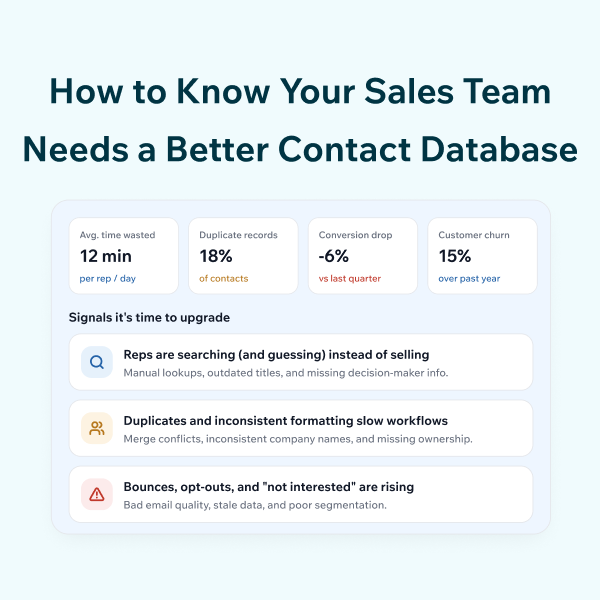
How to Know Your Sales Team Needs a Better Contact Database