

How to Evaluate B2B Data Vendors for Accuracy and Compliance

> Free Email

Every sales or marketing team eventually hits the same wall. You have a list of prospects, you are ready to send, and you have no idea how many of those addresses will actually land in an inbox instead of bouncing back. That is usually the moment someone searches for a free email checker and hopes it solves the problem.
Free email verification can work, for a while. It handles a quick gut check on ten or twenty addresses just fine. But the moment your list grows, or a bad send tanks your sender reputation, the gap between no-cost checkers and paid email verification tools becomes very real.
This guide breaks down how the two approaches differ, where each one holds up, and where each one quietly costs more than it saves, so you can decide whether free email verification is enough or it is time for a paid option.
Email list decay adds another layer to this. People change jobs and inboxes get abandoned constantly, so a list that was mostly clean a year ago will not stay that way on its own. That is why verification is not a “set it and forget it” step, and why the free versus paid decision keeps coming back around as teams grow.
Mailbox providers like Gmail and Outlook actively monitor bounce rates and spam complaints as part of how they decide whether your future emails land in the inbox or the spam folder. This is why deliverability teams treat list hygiene as an ongoing discipline, not a one-time task.
A typical no-cost tool stops there. It tells you whether an address is “probably fine” or “probably bad,” but it rarely goes deeper into mailbox-level detail, like whether the inbox is a spam trap, a disposable email address, or part of a catch-all domain that accepts everything regardless of whether the mailbox exists.
If you only need to check a handful of addresses before a small outreach push, a free email address verification tool is a reasonable first stop. Just do not treat a “valid” result as a guarantee.
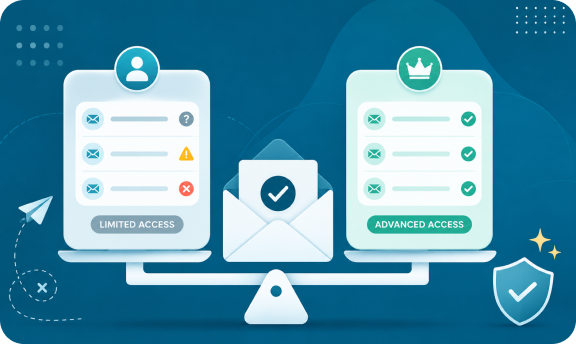
| Factor | Free Verification | Paid Verification |
|---|---|---|
|
Daily volume limits |
Usually capped low (10 to 100 checks) |
Built for large lists, often thousands per batch |
|
Accuracy depth |
Syntax and basic MX checks |
Syntax, MX, SMTP, catch-all, and disposable detection combined |
|
Result detail |
Valid or invalid only |
Multiple statuses: valid, invalid, risky, catch-all, unknown |
|
List upload support |
Rarely supported, or heavily limited |
Standard, with batch limits in the tens of thousands |
|
Data security and compliance |
Varies widely, often unclear |
Typically backed by formal compliance certifications |
|
Best for |
Small one-off checks, testing a handful of leads |
Ongoing list hygiene, sales outreach, email marketing at scale |
|
Cost over time |
No fee, but time-costly at volume |
Paid, but time and reputation saved at volume |
Run a sample of 50 addresses through both a no-cost checker and a paid tool. Comparing how many “valid” results differ tells you more about accuracy than any spec sheet.
If that describes your situation, a free option is a fine starting point. Just revisit the decision as soon as your list, your send frequency, or your reliance on email as a channel grows.
Treat verification as part of your ongoing email marketing strategy, not a one-time cleanup. Checking a list before every major send, and re-checking older segments quarterly, keeps bounce rates predictable instead of reactive.
ReachStream Email Verifier is built for teams that have outgrown what a no-cost checker can offer. It is offered as a standalone product, so you do not need to adopt a full sales intelligence platform just to get reliable list hygiene.
A few things worth knowing:
See how your current list holds up against a tool built for accuracy at scale, not just a quick syntax check.
Free email verification is not a bad option, it is just a limited one. It works for small, occasional checks, but it was never designed to protect a growing list or the sender reputation you depend on. Paid tools exist for the moment free options run out of road: checking at scale, deeper status detail, and compliance-ready handling of your data.
If you are still deciding, run a sample list through both and see where the results actually diverge. That single test tells you more than any spec sheet.
Try ReachStream Email Verifier for free and get 100 credits to test bulk verification and six-status accuracy on your own list.
For occasional checks, free email verification can catch obvious typos and dead domains. It becomes less reliable as list size and sending frequency grow, since most no-cost tools skip deeper checks like catch-all and disposable detection.
Most of these tools do not reliably detect disposable email addresses, since this requires maintaining an updated database of temporary domain providers, which is resource-intensive to keep current.
Cleaning an entire list in one pass keeps bounce rates low and protects sender reputation before a large send.
Verification, especially SMTP-level checks, consumes server resources, so providers cap free usage to control costs and differentiate from paid tiers.
Bounce rates usually climb, which mailbox providers read as poor list hygiene, and that can lower deliverability for future campaigns too.
ReachStream Email Verifier offers 100 free credits on signup, so you can test verification accuracy on a real sample of your list before deciding whether to upgrade.
A catch-all result means the domain’s mail server accepts all incoming email regardless of whether the specific mailbox exists, so verification tools cannot fully confirm deliverability for that address.
Most teams verify before every major campaign send and run a full pass quarterly, since list decay happens continuously as people change jobs and abandon old inboxes.
Author

Access 200M+ verified business emails and grow your sales pipeline effortlessly.
Don't forget to share this post!















Check out our other blogs!
How Many Follow-Ups Should a Cold Email Sequence Have?

How a Medical Device Company Can Reach Hospital Decision-Makers
What Data Fields Should a Healthcare Marketing Database Include?
ReachStream Prospect vs Prospeo: Who Delivers Accurate Data?