

> Sales
How to Evaluate B2B Data Vendors for Accuracy and Compliance

A sales team can have 10,000 contacts in its CRM and still struggle to find people worth contacting. Job titles change, employees move companies, email addresses stop working, and company information becomes outdated.
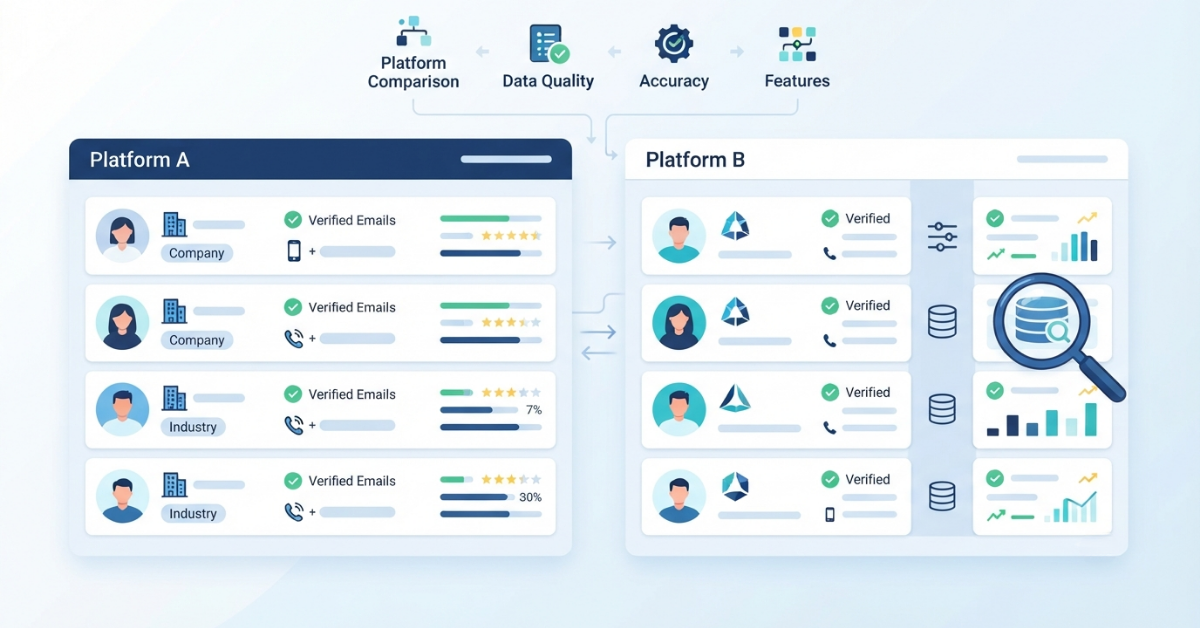
B2B data providers address that problem by collecting, verifying, organizing, and enriching business contact information. The challenge is choosing the right platform: coverage, accuracy, freshness, filters, integrations, compliance, and total cost matter more than a headline contact count.
B2B data providers are companies that collect and organize information about businesses and their employees. Their B2B data services may include searchable contacts, company profiles, business email addresses, phone numbers, job titles, industry details, and tools for exporting or enriching records.
A basic contact database may be static, while a modern platform adds filters, verification, enrichment, integrations, and refreshes. Sales teams use these tools for prospecting; marketing teams for account-based campaigns and CRM enrichment; recruiters and research teams for targeted discovery.
Providers differ in what they collect, how they source it, and how often they update it. Treat database size as one data point, not a quality score.
The mix varies by vendor and plan, but common categories include company data and contact records, along with the categories below:
Teams use these platforms to find relevant accounts faster than manual research allows. A list builder can turn a search into an organized working list. A sales development team might filter for operations leaders at logistics companies with 200–1,000 employees, while marketing may use company data for account-based segments, CRM enrichment, and industry personalization.
They can also cleanse CRM records by adding missing fields or flagging outdated emails. Measure the result in time saved, fewer unusable records, and better targeting—not a guaranteed conversion rate.
Start with your audience, then compare each platform against that use case. Strong North American coverage may not help a team targeting niche European industries. Also test the Chrome extension or other workflow features if your researchers work in browser-based tools.
Score each provider against the same audience, sample size, workflow, and budget.
Factor | What to check | Why it matters |
Data accuracy | Verification and update process | Reduces unusable records |
Coverage | Industries, countries, and job titles | Determines targeting options |
Freshness | Review and refresh frequency | Helps limit outdated data |
Filters | Contact and company attributes | Makes list building easier |
Integrations | CRM, API, CSV, and sales tools | Fits existing workflows |
Pricing | Credits, seats, exports, and subscriptions | Shows likely total cost |
Compliance | Privacy and security practices | Supports responsible use |
Support | Documentation and customer service | Helps resolve issues |
Compare the records and workflow you can actually use, rather than marketing claims in isolation.
B2B data provider pricing commonly uses monthly or annual subscriptions, credit-based access, per-contact charges, per-export fees, user or seat limits, API usage, or custom enterprise agreements. Some platforms combine several models, such as a subscription with a monthly credit allowance. Some platforms combine several models, such as a subscription with a monthly credit allowance.
Calculate how your team will use the platform. A low-cost plan can become expensive when it limits exports, charges separately for verified emails, restricts CRM access, or requires extra seats.
Review ReachStream pricing to see why plan details matter. Check credits, limits, expiry rules, upgrades, and cost per usable contact.
The strongest test is cost per usable contact. If 5,000 purchased records produce 2,000 usable contacts, calculate value from those 2,000 and include cleanup time. A data enrichment workflow can be worth assessing when manual cleanup is a major cost.
A provider may justify its cost by reducing research, improving CRM completeness, supporting segmentation, or giving sales representatives more time for qualified conversations. Track those measures during a pilot rather than assuming a guaranteed revenue result.
There is no universal best B2B data provider. The right choice depends on market, workflow, team size, budget, and tolerance for manual review. A contact provider roundup can provide comparison ideas, but your own sample should decide the fit.
Use evaluation categories instead of unsupported rankings:
A free plan, sample records, clear documentation, or guided trial can be more useful than a long feature page. Teams with technical workflows should also review the Reach API.
Look for B2B data provider alternatives when the current platform does not cover your target countries or industries, its data quality misses your benchmark, or required CRM and API connections are unavailable. Enterprise buyers can compare requirements against an enterprise data platform. Limited filters, weak verification, unclear privacy practices, and pricing that does not match your usage are also reasonable reasons to switch.
Before moving, document field mappings, remove duplicates, and test the replacement with the same audience definition. A platform such as ReachStream’s data platform may be worth evaluating if your team wants contact and company search, list building, filters, and verification in one workflow. Treat it as a candidate to test, not an automatic recommendation.
Choosing based only on database size is the most common mistake. A practical data freshness guide can help teams spot warning signs. A large total count says little about coverage in your market or the accuracy of your required job titles.
Other mistakes include ignoring freshness, skipping sample tests, overlooking regional coverage, forgetting CRM or API needs, and buying more contacts than the team can use.
Calculate the cost of usable data. Ask for a sample. Run the workflow with the people who will actually use the platform. Those steps reveal more than a polished sales presentation.
A structured pilot can answer the important questions quickly. Start with a data verification guide if your team has not set a quality benchmark.
Connect or simulate your CRM, API, CSV, and other workflow requirements. Confirm field mapping, permissions, duplicate handling, and error messages.
A good pilot should answer five questions: Does the sample match our audience? Are enough records usable? Can the team work efficiently? Does the total cost fit? Can we use the data responsibly?
ReachStream is one platform buyers may include in a comparison. Its contact data platform describes company and contact data, search, filtering, and prospecting workflows. It states coverage of 150+ countries and 400+ industries; test that against your audience.
The list builder supports saving and segmenting contacts and companies by role, industry, and location. This can reduce dependence on separate spreadsheets.
For LinkedIn research, evaluate the Chrome extension for capturing contact and company information while browsing. An email verifier can be tested before campaigns.
Teams with existing systems can review the Reach API and data enrichment tools when research must feed a CRM or repeatable data process.
ReachStream also publishes a company data comparison that can help shape trial questions. Validate the claims with sample records and your own workflow, then consider a free trial.
Choosing among B2B data providers comes down to fit and evidence. Compare data accuracy, coverage, freshness, verification, filters, integrations, pricing, compliance, and support against the work your team needs to do.
A practical trial is usually the safest path. Define your audience, test a realistic sample, measure usable records, run the integrations, and calculate the cost of maintaining the workflow. That process will help you choose a platform that supports prospecting and data quality without paying for a database your team cannot use.
Access 400M+ verified business emails and grow your sales pipeline effortlessly.
B2B data providers collect, organize, verify, and supply information about companies and business contacts. Depending on the platform, buyers may receive names, job titles, business emails, phone numbers, company details, firmographic attributes, technology data, and sometimes intent signals.
Most providers offer searchable contact and company records. Common features include filters, list building, email verification, data enrichment, CSV exports, CRM integrations, APIs, and browser extensions. The exact fields and tools differ, so buyers should compare them against their target audience and workflow.
Pricing varies by provider and may use monthly or annual subscriptions, credits, per-contact fees, exports, seats, API usage, or custom enterprise plans. Compare the total cost of the records and features you can use, including verification, integrations, additional users, and export limits.
Compare providers using the same audience definition and sample size. Review accuracy, coverage, freshness, verification, filters, integrations, security, support, and pricing. Then run a pilot and calculate the cost per usable contact rather than relying on database size or advertised starting prices.
Check how records are sourced, updated, and verified. Confirm country and industry coverage, job-title filters, export rules, CRM or API support, privacy practices, and inaccurate-data policies. Ask whether you can test realistic sample records before entering a subscription.
They can be worthwhile when they reduce manual research, improve CRM quality, and help teams find relevant accounts faster. The value depends on usable data and workflow fit. Measure the time saved, accuracy of sample records, and total cost before expanding the purchase.
The terms are often used interchangeably. “B2B database provider” usually emphasizes the collection of company and contact records, while “B2B data provider” can include broader services such as verification, enrichment, APIs, filtering, and workflow integrations.

Author
Marketing professional with a Master’s degree in Marketing, specializing in SEO, content strategy, social media, performance marketing, prospecting, and demand generation.
Access 400M+ verified business emails and grow your sales pipeline effortlessly.
Don't forget to share this post!















Check out our other blogs!
Email Verification Tools: 15 Ways to Check Business Emails
B2B Data Providers: How to Compare Contact Data Platforms
CRM Data Enrichment: How to Improve Incomplete Contact Records
How to Know Your Sales Team Needs a Better Contact Database