

> Sales
How to Evaluate B2B Data Vendors for Accuracy and Compliance

A clean business email list supports campaigns, CRM imports, and prospect research. Email verification tools check whether an address is correctly formatted, connected to an active domain, and likely to accept mail before it enters a workflow. That can help reduce hard bounces, protect sender reputation, and prevent teams from spending time on unusable records.
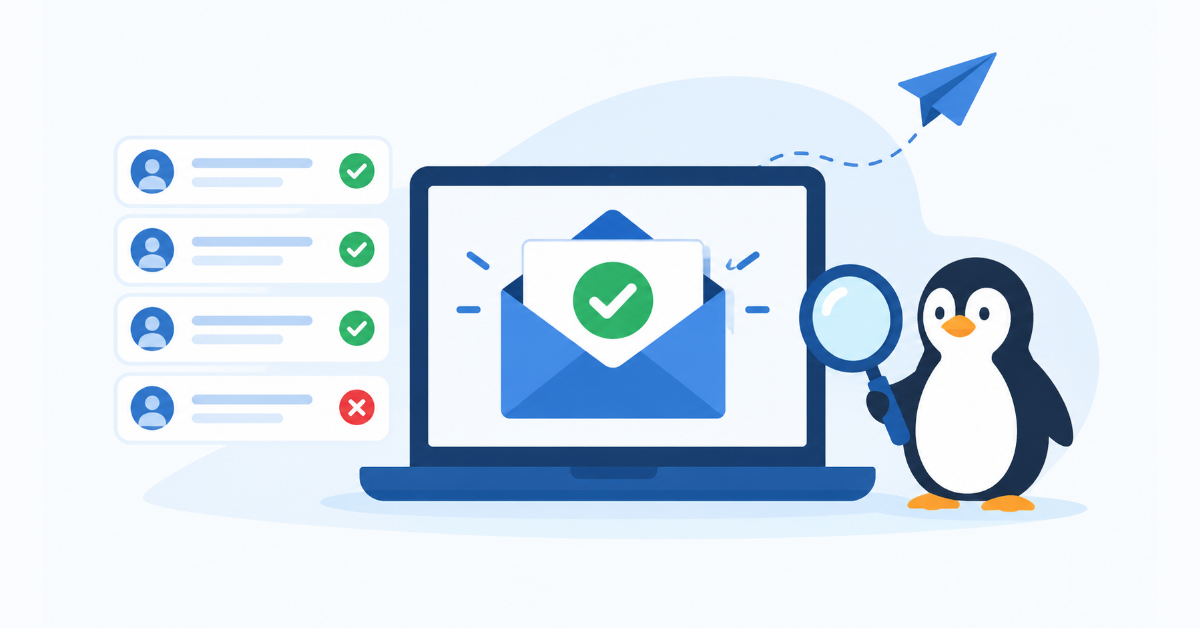
Email verification tools assess an address and return a deliverability status. They may flag invalid, risky, disposable, role-based, catch-all, or apparently active addresses. The result is time-sensitive, not a permanent inbox guarantee.
Validation checks format and domain structure; verification adds DNS, mail-server, and risk checks. An address can look valid while the mailbox no longer exists. See ReachStream’s B2B data guide for broader context.
Use verification before campaigns, CRM uploads, and sales handoffs. Pair it with consent, suppression, authentication, and sound sending practices.
Most providers process an address through several layers:
SMTP verification is imperfect because servers may block probing, accept every address, or return temporary responses. Results can also change when people leave or domains change. See ReachStream’s real-time verification overview.
These checks explain what providers evaluate and when each matters.
Start with workflow. The service should support your volume, data sources, and systems. ReachStream’s Email Verifier features page illustrates useful status and reporting details.
Look for single checks, bulk CSV upload and download, clear classifications, verification history, and real-time processing. For automatic checks, review the provider’s verification API documentation, including limits and response fields.
Assess integrations, duplicate handling, speed, credits, retention, access controls, deletion practices, and support. A fast tool with unclear exports can create extra work.
Single verification checks one address when a user enters a lead, reviews a prospect, or prepares an individual message. Bulk verification processes a file or connected dataset and is better for campaign preparation, CRM cleanup, and regular database maintenance. ReachStream describes its bulk email verifier as a separate workflow for larger files and automatic deduplication.
Feature | Single verification | Bulk verification |
Best for | One prospect or form entry | Campaign and database cleaning |
Volume | One address at a time | Hundreds or thousands of records |
Workflow | Instant check during research | Upload, process, review, export |
Typical use case | Pre-send or lead capture | Pre-campaign list hygiene |
API support | Often real-time endpoint | Often batch or asynchronous endpoint |
Free tools suit workflow tests and small batches. Common limits include credits, restricted exports, no bulk processing, limited integrations, and little reporting.
Paid plans suit recurring cleaning, larger volumes, APIs, shared usage, support, or stronger controls. Compare cost per address. ReachStream’s pricing options separate prospecting and verification.
The best tool depends on volume, integrations, and workflow. Score candidates against one sample:
Evaluation area | Questions to ask |
Accuracy | Does it correctly separate valid, invalid, risky, and unknown records? |
Methods | Does it use syntax, DNS, MX, SMTP, disposable, and catch-all checks? |
Scale | Can it process your largest file within the required window? |
Automation | Does the API support your forms, CRM, or data pipeline? |
Usability | Can nontechnical users upload, filter, and export results? |
Cost | Are credits, overages, and rechecks easy to understand? |
Governance | Are security, retention, and deletion practices documented? |
Support | Can your team get help when an import or API job fails? |
Use a controlled sample rather than popularity rankings. Include different domains, older records, role accounts, catch-all domains, and known invalid examples.
Email verification software usually provides a dashboard for manual checks, CSV uploads, status review, and exports. It suits teams that clean lists periodically and want a low-code workflow. An API connects verification to a form, CRM, application, or internal data process so checks can run automatically. For prospecting systems that need data retrieval and workflow integration, ReachStream’s ReachAPI overview provides a useful product example.
Choose an API for real-time checks or recurring jobs. Confirm authentication, rate limits, retries, bulk support, webhooks, and storage rules.
Verify before campaigns, CRM imports, and form follow-up. Recheck older records before major sales pushes because people change roles and domains change.
Use event-based checks with periodic maintenance. Teams building lists from professional networks may review a B2B contact platform that combines discovery and verification.
Do not treat one result as permanent. Review risky, catch-all, role-based, and unknown statuses instead of sending to every valid result. Do not skip a sample comparison.
Also avoid duplicates, API-limit surprises, unsuppressed hard bounces, and permanent reliance on old results. Verification should support consent, suppression, authentication, segmentation, and monitoring.
Use a mixed sample containing valid, invalid, disposable, role, catch-all, old, duplicate, and typo records. Compare statuses, speed, exports, cost, and uncertain-result handling.
For API testing, measure response time, errors, retries, authentication, rate limits, and dashboard consistency.
Quick Checklist :
Verification is one step in a contact-data workflow connecting prospecting, enrichment, and CRM management. ReachStream’s data enrichment workflow shows how incomplete records can be improved.
The best setup sends only appropriate statuses into downstream systems. For example, valid addresses may enter a campaign, risky addresses may require review, and invalid or do-not-mail records may be suppressed. This separation improves data quality without pretending that verification replaces deliverability management.
ReachStream combines B2B contact and company data with prospecting and email-verification workflows. Its Prospect product supports search, filtering, list building, enrichment, and CRM-ready data workflows. Its Email Verifier supports individual checks, CSV-based bulk processing, status labels, verification history, and API-based automation. Teams can review the built-in verifier when they want verification close to the prospecting workflow.
The platform can support list creation before verification: find contacts, apply filters, enrich records, verify addresses, and export a reviewable set. The right fit still depends on volume, systems, compliance requirements, and sample-test results.
Email verification tools identify risky and unusable addresses before they affect campaigns or CRM data. The 15 checks show why formatting alone is insufficient.
Compare methods, bulk capacity, APIs, integrations, reporting, security, and cost. Test a mixed sample before committing. Connect verification with prospecting, enrichment, CRM management, and monitoring. Compare B2B enrichment tools.
If you need to assess email data alongside prospect research, compare ReachStream with your workflow and contact data.
Access 400M+ verified business emails and grow your sales pipeline effortlessly.
Email verification tools assess whether an email address is correctly formed, connected to a working domain, and likely to accept mail. They may also flag disposable, role-based, catch-all, risky, or invalid addresses.
It typically combines syntax checks, domain and MX lookups, SMTP-level signals, mailbox checks, and risk classification. Results are time-sensitive because mailbox and domain conditions can change.
Validation often means checking whether an address follows the expected format. Verification is broader and may test domain configuration, mail-server behavior, mailbox signals, and risk indicators.
A free tool can be useful for a small test, but free plans often limit credits, bulk processing, exports, integrations, or support. Test the same sample in a paid candidate before choosing a production service.
Bulk email verification checks a file or dataset containing multiple addresses. It is commonly used for campaign preparation, CRM cleanup, database maintenance, and list deduplication.
An email verification API lets software submit an address and receive a status automatically. It is useful for forms, CRMs, SaaS products, and recurring data workflows that should not depend on manual uploads.
Verify new addresses before important sends and recheck older records on a schedule based on list age, sending frequency, and bounce history. High-change databases generally need more frequent maintenance.

Author
Marketing professional with a Master’s degree in Marketing, specializing in SEO, content strategy, social media, performance marketing, prospecting, and demand generation.
Access 400M+ verified business emails and grow your sales pipeline effortlessly.
Don't forget to share this post!















Check out our other blogs!
Email Verification Tools: 15 Ways to Check Business Emails
B2B Data Providers: How to Compare Contact Data Platforms
CRM Data Enrichment: How to Improve Incomplete Contact Records
How to Know Your Sales Team Needs a Better Contact Database