



How to Evaluate B2B Data Vendors for Accuracy and Compliance

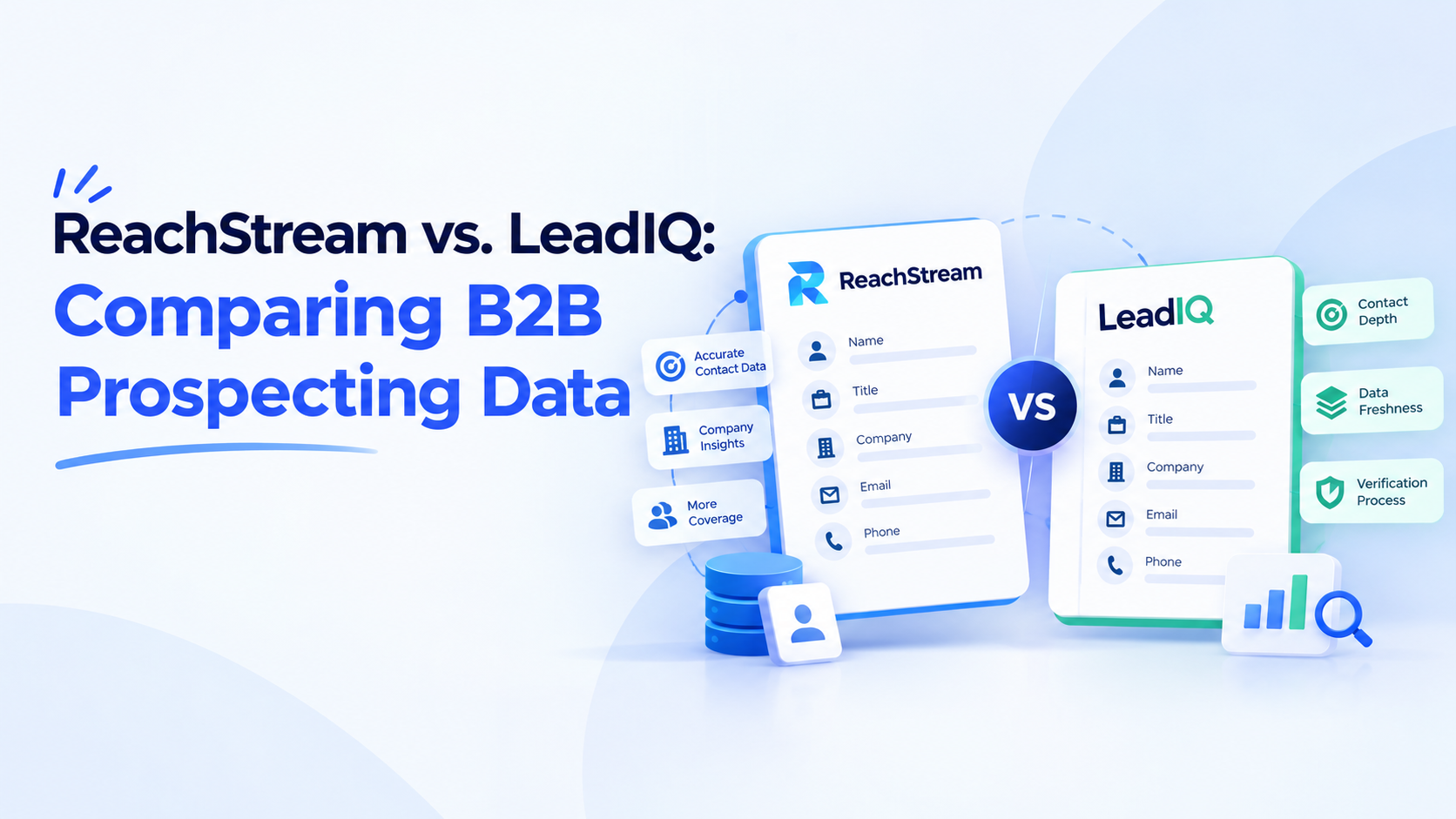
ReachStream Prospect vs. LeadIQ is really a choice between two ways of getting outreach data. ReachStream Prospect is a searchable B2B contact database where you filter, view, and export records. LeadIQ is a prospecting platform built around capturing contacts from your browser, then pushing them into your CRM or sequencer.
Both cover the basics of B2B prospecting: emails, phone numbers, company data, a Chrome extension, and a free plan to try. They split on pricing logic, phone data, and how much of the workflow lives inside the tool rather than your CRM. Think of this page as a LeadIQ review 2026 and a ReachStream Prospect review rolled into one, written for SDRs, marketers, founders, and sales ops teams who would rather not sit through five demos.
ReachStream Prospect covers 500M+ contacts, 50M+ companies, and 100M+ direct dials, with filters for job title, seniority, industry, employee size, revenue, location, and technology. LeadIQ searches a dataset of 750M+ professional profiles that is refreshed monthly, and up to 200M of those records are re-verified as people change jobs.
Those headline counts measure different things. One counts contacts, the other counts profiles, and neither says how many records are reachable in your market. Use them for context, then check both against your own target accounts.
Phones are where the two models pull furthest apart. LeadIQ puts verified numbers through carrier checks and lists phone accuracy above 90%, with an 85% mobile match rate globally and 70% in EMEA. On LeadIQ phone number accuracy alone, that is the sort of coverage meant to cut the number of vendors in a waterfall. The tradeoff is cost: a phone number is 10 credits, against 1 credit for an email.
ReachStream Prospect includes direct dials on its paid plans, and unlimited record views mean you can look at a contact before any credit is spent. Overall data accuracy is 95%, so a quick phone-only test on your own list is still worth the hour it takes.
For email, both platforms lean on verification rather than pattern guessing. ReachStream Prospect marks records as ESP-verified, includes a built-in email verifier, and lists 90% email deliverability. LeadIQ scores every email and phone number with proprietary algorithms and multi-layer verification, so a rep sees a confidence level before hitting send.
Accuracy figures are easy to publish and hard to judge. That goes for LeadIQ email finder accuracy and ReachStream’s alike. Pull 100 addresses from each tool, send them at low volume from a secondary domain, and compare bounce rates before you scale anything.
Waterfall enrichment means a tool asks several data providers in sequence until one returns a verified result. Neither enrichment page lists a native multi-provider waterfall as a feature, so do not assume one is included.
What both do offer is contact data enrichment from their own datasets. ReachStream Prospect includes data enrichment and ReachAPI for connecting other systems, while LeadIQ offers CRM enrichment, webform enrichment, and an API, with CSV file enrichment on its Enterprise tier.
Both tools sit on top of LinkedIn through a Chrome extension, which makes this a fair LinkedIn prospecting tool comparison.
The LeadIQ Chrome extension captures prospects while you browse, shows email, mobile, and location details next to account information, and pushes contacts to Salesforce, HubSpot, Outreach, Salesloft, or Gong. The ReachStream Prospect extension pulls verified contact details from LinkedIn without leaving the tab, and lets users capture and enrich leads as they browse.
The difference is the workflow around the extension.
LeadIQ adds champion tracking for job changes, buyer intent style signals such as hiring and podcast mentions, and an AI message writer, so it leans toward the SDR who wants research, capture, and first-line drafting in one place. ReachStream Prospect leans toward list building, with an ABM list builder, advanced filters, and AI Conversational Search and Similar Companies, which are designed to help teams find contacts and lookalike accounts without stacking manual filters.
It also helps to frame the choice as email finder vs CRM capture. If you mostly need verified data to build lists, a database-first tool keeps things simple. If you live in the browser and every lead must land in Salesforce with the right fields, capture-first matters more.
The comparison table below shows how that plays out, with the main differences side by side.
| Feature | ReachStream Prospect | LeadIQ |
|---|---|---|
|
Core approach |
Searchable contact database; view records, spend export credits to download or sync |
Browser capture and prospecting platform; contacts pushed to your CRM or sequencer |
|
Data size |
500M+ contacts, 50M+ companies, 100M+ direct dials |
750M+ professional profiles, refreshed monthly |
|
Search and filters |
Title, seniority, department, industry, SIC code, technology, company type, size, revenue, location |
People search and company search (firmographics, technographics); limited database search |
|
Email data |
ESP-verified emails, built-in email verifier, 90% email deliverability |
Proprietary scoring with a confidence level shown per contact |
|
Phone numbers |
Direct dials on paid plans |
Verified phone accuracy above 90%, 85% global mobile match rate |
|
Data accuracy |
95% overall |
Verified phone accuracy above 90% |
|
Chrome extension |
All plans, including Free |
All plans, including Free |
|
Enrichment |
Data enrichment and ReachAPI |
CRM enrichment, webform enrichment, API; CSV file enrichment on Enterprise |
|
Waterfall enrichment |
Not offered |
Not offered |
|
AI features |
AI Conversational Search, Similar Companies |
AI message writer; AI account prospecting and Lando agent on Enterprise |
|
Buying signals |
Not offered |
Champion job-change tracking; hiring and podcast-mention signals |
|
List building |
ABM list builder, saved searches |
Custom lead lists via the extension |
|
CRM and integrations |
Native Salesforce and HubSpot |
Salesforce Managed Package, HubSpot via Workato, Outreach, Salesloft, Gong, Zapier, Clay |
|
Sequencing |
Outreach coming soon |
None; hands contacts to sequencers |
|
Credit model |
Unlimited record views; export credits; no rollover |
One pool: email 1, phone 10, email plus phone 11, account enrichment 3 |
|
Free plan |
$0, 100 export credits a month |
$0, 1 user, 50 credits; any plan free for 30 days |
|
Paid plans |
Starter $29, Pro $49, Business $79 a month billed annually |
Pro from $15 a month billed annually ($20 monthly) at 200 credits, rising with credit volume; Enterprise custom |
|
Seats |
1 (Free, Starter, Pro); 3 (Business) |
1 (Free); up to 5 (Pro) |
|
Compliance |
SOC 2, ISO 27001:2022, GDPR, CCPA, PIPEDA, DPDPA |
SOC 2 Type II, GDPR |
The two pricing models are built differently, so a straight price comparison can mislead.
ReachStream Prospect pricing runs on export credits: viewing contact and company records is unlimited, and credits are spent when you download a list or sync records to a CRM. Free is $0 with 100 export credits a month (1,200 a year on annual billing). Starter is $29 per month billed annually ($39 billed monthly) with 60,000 credits a year, Pro is $49 ($59 monthly) with 120,000, and Business is $79 ($99 monthly) with 240,000 credits and three seats. Enterprise is custom, and unused credits do not roll over.
If you are looking for LeadIQ alternatives with a free plan, ReachStream Prospect is one to test. Its Free plan gives you 100 export credits a month. LeadIQ has its own free plan with 50 credits to spend across emails and phone numbers, so you can try both side by side at no cost.
ReachStream Prospect tends to suit teams that build lists at volume, want unlimited record views, and prefer credits tied to exports. It pairs 500M+ contacts, 50M+ companies, and 100M+ direct dials with native Salesforce and HubSpot integrations, and its AI Conversational Search and Similar Companies features are designed to help teams widen a target list faster. Compliance credentials include SOC 2, ISO 27001:2022, GDPR, and CCPA.
LeadIQ tends to suit SDR teams that live in LinkedIn and want capture, champion tracking, and message drafting close together, especially with Outreach, Salesloft, or Gong already in the stack. It is SOC 2 Type II certified and GDPR compliant, and its Enterprise tier adds governance controls, Salesforce duplicate detection, and team analytics.
There is no single winner here, and any article that names one without knowing your workflow is guessing. ReachStream Prospect vs. LeadIQ is a question of where your team spends its time: building and exporting lists, or capturing prospects while browsing and syncing them to a CRM.
Use the numbers as a starting point: 500M+ contacts, 50M+ companies, and 100M+ direct dials on one side, 750M+ profiles, a 10-credit phone price, and a 30-day trial on the other. Then let a 50-account test settle it. If you are also shortlisting the best B2B prospecting tools 2026 has to offer, or collecting LeadIQ alternatives 2026 for a review, the same test works on every name on the list.
Last, read both pricing pages again before you buy. Credits, limits, and plan names move faster than most articles do.
Author

Don't forget to share this post!















Check out our other blogs!
What Is B2B Data and Why It Matters for Modern Sales Teams
A Buyer’s Checklist for Evaluating B2B Data Providers
How to Sync B2B Data with Your Outreach Sequences