



> Company Contacts
How to Evaluate B2B Data Vendors for Accuracy and Compliance

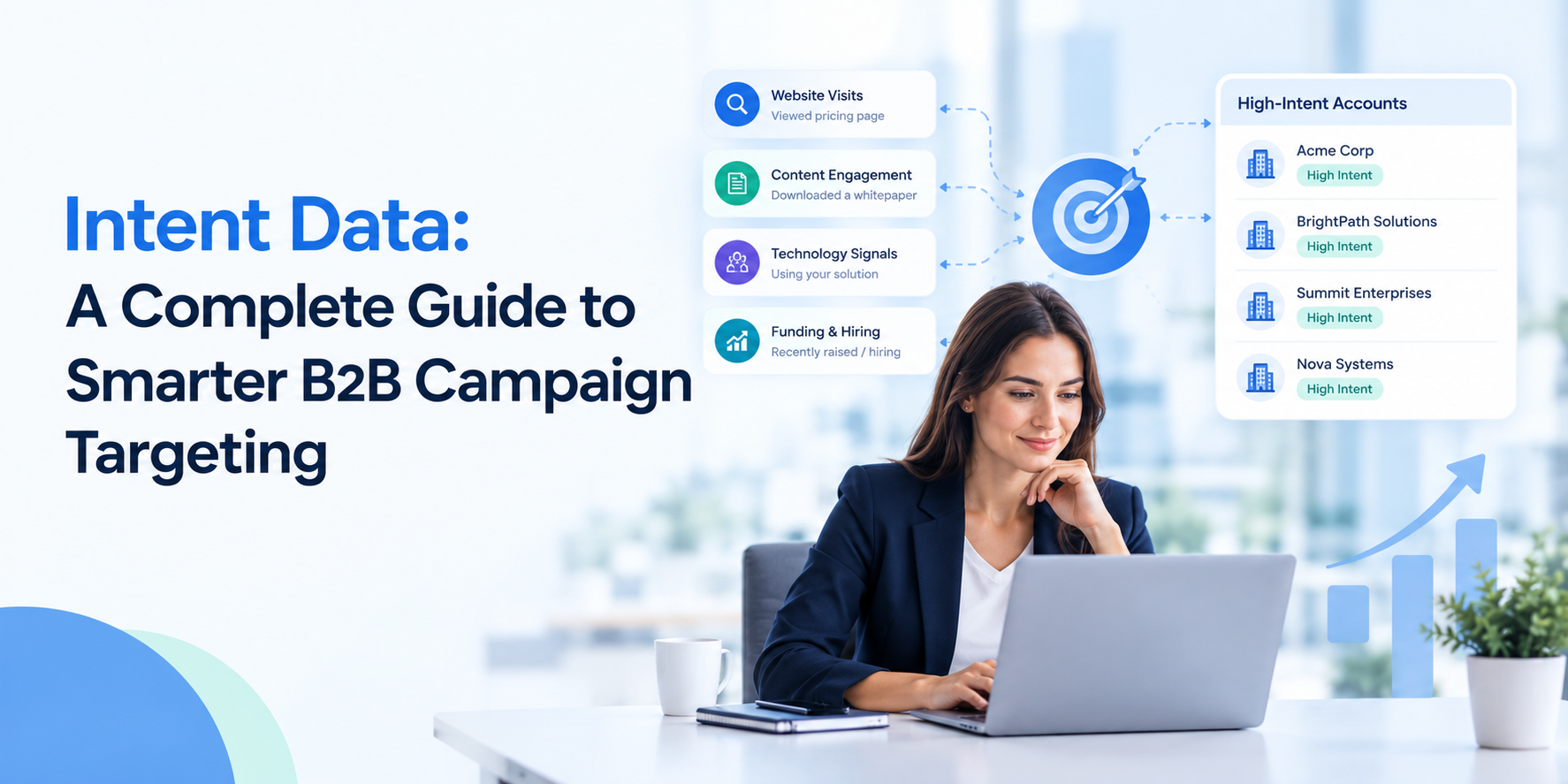
Intent data is behavioral signal data showing when a person or company is actively researching a topic, product category, or solution similar to yours. It’s built from digital footprints, content consumption, search queries, site visits, review site activity, and it’s used to flag which accounts are likely to be somewhere in an active buying cycle.
On its own, an intent signal is just that: a signal. It becomes useful once it’s combined with firmographic data, technographic data, and verified contact data, so a team knows not just that an account is researching, but who to reach and whether that account actually fits their ICP.
Intent data platforms track digital behavior across a network of publisher sites, content cooperatives, and review platforms, then match that activity back to a specific company using IP resolution or cookie-based identification. Each piece of tracked activity, a whitepaper download, a comparison page visit, a search query, gets tagged to a topic and rolled up into a topic score for that account.
Marketing and sales teams then set a threshold: once an account’s engagement score crosses that line for topics relevant to their product, the account gets flagged as in-market. How is intent data collected matters here too, first-party signals come straight from your own properties, while third-party signals are aggregated across a much wider network you don’t control directly.
First-party intent data comes from behavior on your own properties, website visits, content downloads, product usage, so it’s highly accurate but limited to accounts already engaging with you directly. Third-party intent data comes from a provider tracking behavior across a much wider network of sites, which surfaces net-new accounts researching your category before they’ve ever visited your site.
The trade-off is straightforward: first-party intent data is narrower but more trustworthy, third-party intent data is broader but more variable in accuracy. Most mature intent-data strategies combine both rather than relying on just one, using first-party signals to confirm engagement and third-party signals to find accounts they wouldn’t otherwise see.
Intent data is collected primarily through cooperative data networks, publisher partnerships, and content syndication platforms where B2B professionals research topics, review software, or read industry content. When someone reads an article, downloads a report, or compares vendors on a review site, that action gets logged, tagged to a topic, and matched to a company.
First-party collection works differently: it pulls directly from your own website analytics, CRM, and marketing automation platform, tracking which of your own pages and content an account engages with. Combining both collection methods gives a fuller picture than relying on either one in isolation.
Intent data tells marketers which accounts are actively researching topics related to their product, and roughly how urgently, based on the volume and recency of that research activity. What it doesn’t tell you is who specifically at the account is researching, or why, that still requires firmographic data and verified contact data layered on top of the signal.
Used well, intent data shifts a marketing team’s targeting from a flat, unranked account list to one ordered by real buying signals. Used poorly, it becomes another dashboard number that never quite translates into pipeline, which is a gap this guide comes back to in the section on measuring ROI.
Intent data for ABM works by feeding topic and engagement scores into account selection, so a target account list isn’t built purely on firmographic fit but on a combination of fit and active buying behavior. An account that matches your ICP and shows strong intent signals deserves a different level of campaign personalization than one that matches on paper but shows no research activity at all.
This is where account prioritization becomes genuinely dynamic instead of static. A quarterly ABM list built once and left alone misses accounts that enter an active buying window mid-quarter, intent data lets a team catch that shift and adjust targeted messaging accordingly.
Pair intent signals with verified firmographic and contact data so a high-scoring account is also one you can actually reach.
Intent signals, firmographic data, and technographic data answer different questions, and conflating them is a common mistake. Firmographic data describes what a company is, industry, size, revenue. Technographic data describes what a company uses, its tech stack. Intent signals describe what a company is currently researching.
Account intelligence gets meaningfully stronger when all three are combined rather than used in isolation. A company matching your ICP on firmographic and technographic data, showing strong intent signals on top, is a far stronger account prioritization case than any single data type on its own.
| Signal source | Best for | Signal freshness | Scalability | Accuracy risk |
|---|---|---|---|---|
|
First-party intent data |
Best for |
Signal freshness |
Scalability |
Accuracy risk |
|
Third-party intent data |
Best for |
Signal freshness |
Scalability |
Accuracy risk |
|
Combined (first + third-party) |
Best for |
Signal freshness |
Scalability |
Accuracy risk |
Intent data for sales usually shows up as a re-ranked call list rather than a brand-new one. Reps working a flat list in alphabetical or arbitrary order start working the same list ordered by intent score, calling the accounts most likely to be actively evaluating first.
Prospect prioritization built this way tends to improve connect rates and meeting rates without adding headcount or expanding the account list, since reps are simply spending their limited time where the buying signal is actually strongest. Pairing that prioritization with verified contact data is what turns a ranked list into calls that actually connect.
ReachStream Prospect is built to sit alongside an intent-data program rather than compete with it: once an account is flagged as in-market, the next problem is knowing exactly who to reach there and having a verified way to reach them. With 450M+ contacts, 25M+ companies, and 55M+ direct dials, filterable by industry, seniority, and company size, teams can turn an intent-flagged account into a specific, verified contact list in minutes instead of researching each account manually.
Its AI Conversational Search can make it faster to pull the right contacts once an account is flagged, and Similar Companies can help expand a target list from accounts that already resemble the ones showing the strongest intent signals. For a GTM strategy built around acting quickly on in-market accounts, having verified contact data ready the moment a signal fires is what keeps the whole motion from stalling at the handoff between marketing and sales.
Pull a sample of verified accounts and compare how prioritizing by intent changes your outreach results.
Intent data is a prioritization tool, not a targeting strategy on its own. It tells you which accounts are actively researching a relevant topic, but converting that signal into pipeline still depends on verified contact data, a sensible score threshold, and campaigns matched to how close an account actually is to a decision.
Teams getting real ROI from intent data are the ones treating it as one input among several, layered on firmographic fit and verified contact data, reviewed and adjusted regularly, rather than a dashboard number chased for its own sake. Used that way, intent data for campaign targeting turns a flat account list into a ranked one worth acting on.
See how ReachStream Prospect combines verified contact data with the filters you need to act on intent signals.
Layer intent signals on top of your existing lead scoring model rather than replacing it. An account showing strong topic engagement combined with a title and company size that match your ICP is a stronger sales-qualified lead than either signal alone. Route these accounts to sales with the specific topics or pages driving the signal, so reps can open the conversation with real context.
Intent data is behavioral signal data that shows when a person or company is actively researching a topic, product category, or solution. It’s built from actions like content consumption, search queries, and site visits, and it’s used to flag which accounts are likely to be in an active buying cycle. On its own it’s a signal, not a lead, it becomes useful once it’s combined with firmographic and contact data.
B2B intent data applies that same behavioral signal specifically to companies and buying groups rather than individual consumers. It aggregates research activity, content downloads, and search behavior across a business’s likely stakeholders to estimate how close that account is to a purchase decision. Most B2B intent providers report at the account level, not the individual level, since B2B buying decisions are rarely made by one person.
Intent data platforms track digital behavior, page visits, content consumption, search queries, review site activity, across a network of publisher and cooperative data partners, then match that activity back to a company using IP resolution or cookie-based identification. The activity gets scored against specific topics your team cares about, producing a topic score or intent score for each account. Marketing and sales teams then use that score to prioritize which accounts to target first.
Intent data tells marketers which accounts are actively researching topics related to their product, and roughly how urgently. It doesn’t tell you who at the account is researching or why, that still requires firmographic and contact data layered on top. Used well, it shifts a team’s targeting from a flat account list to a ranked one based on real buying signals.
Start by defining the specific topics that correlate with buying intent for your product, then set an intent score threshold that flags an account as in-market. From there, route high-scoring accounts into more personalized, higher-touch campaigns while lower-scoring accounts stay in broader nurture sequences. The goal is matching campaign intensity to how close an account actually is to a decision, not treating every account the same.
First-party intent data comes from behavior on your own properties, website visits, content downloads, product usage, so it’s highly accurate but limited to accounts already engaging with you directly. Third-party intent data comes from a provider tracking behavior across a much wider network of sites, which surfaces net-new accounts you haven’t reached yet but with more variable accuracy. Most mature intent-data strategies combine both rather than relying on just one.
Set an intent score threshold above which an account gets flagged as in-market, then route those accounts into an ABM motion with personalized messaging tied to the specific topics driving the signal. Cross-check the signal against firmographic fit before investing budget, a high intent score on a company outside your ICP usually isn’t worth chasing. Review and adjust the threshold regularly, since what counts as a strong signal shifts as your data volume and account list change.
Track pipeline and closed revenue from intent-flagged accounts separately from your baseline, then compare conversion rate and deal velocity against non-flagged accounts targeted the same way. A meaningful ROI signal shows up as intent-flagged accounts converting faster or at a higher rate, not just as more activity or more dashboard green checkmarks. Tie the measurement to a specific campaign window so the comparison isn’t diluted by unrelated pipeline.
Author

Access 200M+ verified business emails and grow your sales pipeline effortlessly.
Don't forget to share this post!















Check out our other blogs!
Is Buying B2B Data Legal? What You Need to Know
Intent Data: What It Is and How to Use It for Campaign Targeting
What Mid-Market SaaS Teams Need in Lead Gen Tools
ReachStream Prospect for E-commerce Brands: Outbound Case Study