How to Evaluate B2B Data Vendors for Accuracy and Compliance
TL;DR
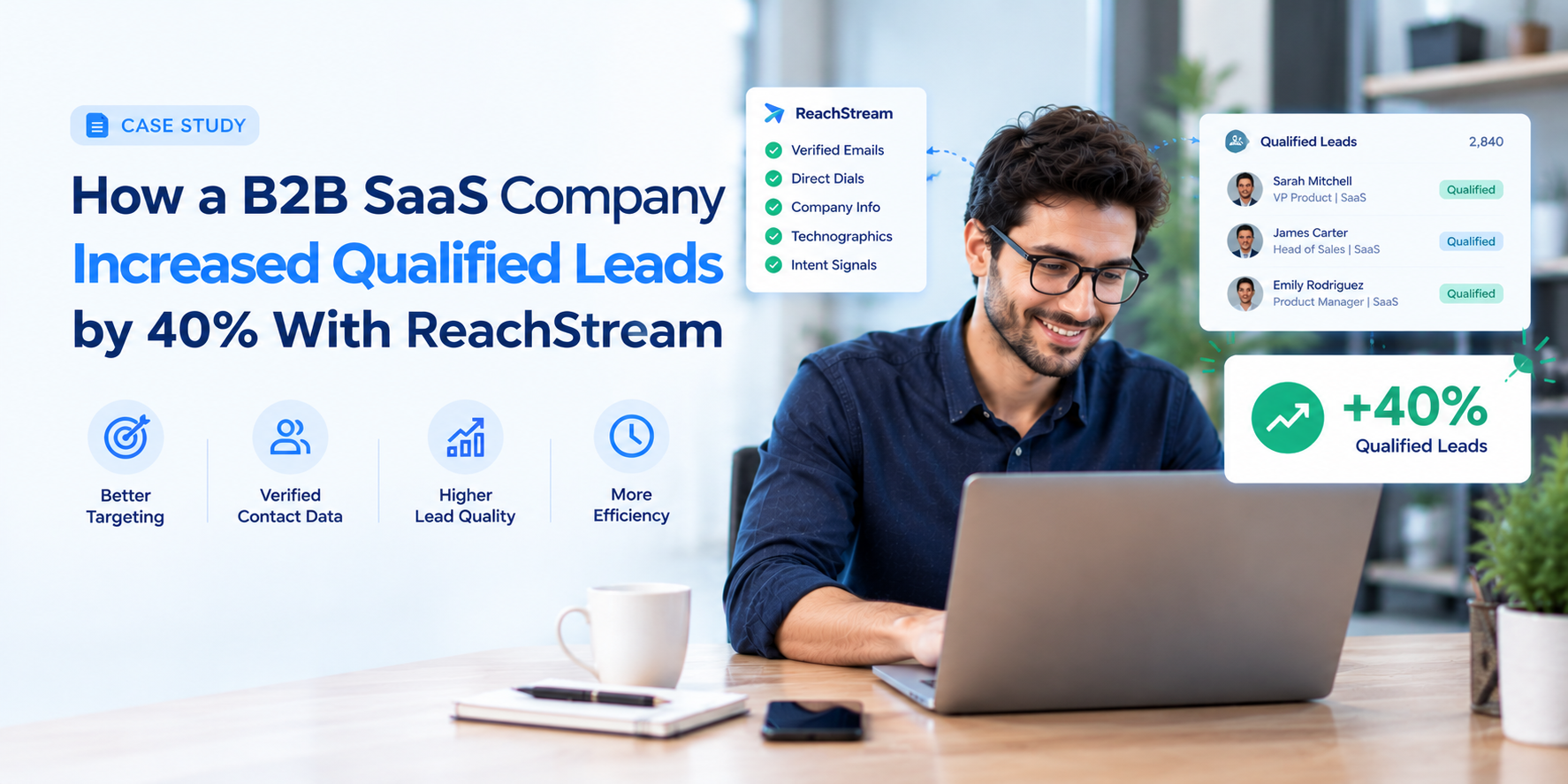
This ReachStream SaaS case study walks through how one B2B SaaS team lifted sales-qualified leads by 40% without adding headcount.
The jump came from fixing lead quality before leads ever reached a rep, not from sending more outbound.
B2B SaaS lead quality tends to break down at the handoff between marketing and sales, more than at the top of the funnel.
Properly qualified leads convert at roughly 40%, against about 11% for leads that were never really qualified.
SaaS lead qualification got faster once firmographic and verification data sat inside the CRM instead of a spreadsheet.
Pipeline generation improved most on mid-market accounts, where the team had been guessing at company size and seniority.
None of this required new headcount — just better data feeding the same sales pipeline.
What This ReachStream SaaS Case Study Is Actually About
This ReachStream SaaS case study looks at a B2B SaaS sales team that increased qualified leads by 40% in a single quarter, mostly by fixing B2B SaaS lead quality upstream instead of pushing more volume into an already full pipeline. The team didn’t change headcount or messaging much they changed what counted as a qualified lead in the first place.
SaaS lead qualification usually breaks in a predictable spot: marketing hands off a list, sales burns a few days finding out half of it doesn’t match the ICP, and reps quietly start ignoring new leads. Fixing that gap, not adding more leads, is what actually moved the number here.
Why Most SaaS Teams Struggle to Find a Good B2B Data Provider for SaaS
Picking a B2B data provider for SaaS isn’t like picking one for enterprise sales. SaaS companies sell to a narrower band of titles, move faster, and can’t afford a data vendor that’s slow to refresh or priced for a 200-person sales floor.
The team in this case study had tried two providers before landing on one that actually fit. Neither was bad, exactly one was built for enterprise accounts and priced accordingly, the other was cheap but stale within a month. Finding the best B2B data for SaaS mostly came down to matching refresh cadence and price to how fast a SaaS pipeline actually moves.
What Changed When They Switched SaaS Lead Generation Tools
Swapping SaaS lead generation tools didn’t fix anything by itself. What helped was pairing the new tool with a clearer filter for company size, tech stack, and buying signal, so the list going to sales was smaller but tighter.
That’s also where B2B SaaS prospecting improved, reps spent less time disqualifying bad fits and more time actually working accounts that matched.
Treating This Like a SaaS Sales Intelligence Platform, Not Just a List
A SaaS sales intelligence platform is supposed to do more than hand over emails, it should tell a rep who’s actually worth calling first. Once the team started using firmographic and intent signals instead of a flat list, lead conversion improved noticeably within the first few weeks.
Where SaaS Sales Prospecting Actually Loses Time
Most of the wasted time in SaaS sales prospecting isn’t prospecting it’s verifying. Reps were spending close to an hour a day just confirming a contact still worked at the company before sending anything. Once that got handled upstream, qualified B2B leads started showing up in the CRM already verified, and reps got that hour back.
Why Pipeline Generation Improved Faster Than Expected
Pipeline generation picked up faster than the team expected, mostly because reps stopped second-guessing the list. When a rep trusts that a lead is real and roughly the right fit, they call it the same day instead of letting it sit. That alone moved more into the sales pipeline than any new outbound sequence did.
See What ReachStream SaaS Pricing Actually Covers
Check ReachStream SaaS pricing against what you’re currently paying for a data provider and a verification tool combined — most SaaS teams are surprised how close the free tier gets them before they need to upgrade.
SaaS Pipeline Generation Before and After the Switch
Before, SaaS pipeline generation depended heavily on whichever rep was best at manually digging up contacts. After, the baseline moved even a newer rep had a reasonably accurate, verified list to start from, so SaaS sales pipeline stopped being so dependent on tenure.
Approach
Best for
Time per verified contact
Scalability
Data freshness risk
Enterprise-focused data provider
Large enterprise sales teams
Fast, but priced for high seat counts
High, but expensive for a small SaaS team
Low to medium
Low-cost unverified list provider
Teams testing a new market on a tight budget
Fast export, slow manual verification after
Medium, quality drops as volume grows
High, stale within a month
ReachStream
SaaS teams that need verified, filtered contacts at SaaS-friendly pricing
Seconds, verified at export
High, scales with plan tier
Low, continuously refreshed
ReachStream SaaS Case Study: How the Pipeline Was Rebuilt, Step by Step
Audit the current ICP filters. Most SaaS teams are filtering on company size alone and missing tech stack or buying signal.
Pull a verified sample first. Test a small batch of qualified B2B leads before replacing the whole pipeline.
Set a shared definition of ‘qualified.’ Get marketing and sales to agree on it before the new data arrives, not after.
Route verified leads straight to reps. Skip the manual re-verification step that used to eat an hour a day.
Track lead quality, not just lead count. Watch conversion by source, not total leads generated.
What This ReachStream Case Study for SaaS Doesn't Claim
This isn’t 40% guarantee B2B SaaS lead quality problems vary a lot by company. What’s consistent across teams we talk to is the shape of the fix: tighter filters, verified contacts, and a shared definition of qualified between marketing and sales.
Common Mistakes SaaS Teams Make With Lead Data
Chasing volume over fit. More leads without better SaaS prospecting tools just moves the qualification problem downstream.
No shared definition of qualified. Marketing and sales scoring leads differently guarantees friction at handoff.
Skipping the test batch. Replacing an entire B2B SaaS prospecting workflow at once makes it hard to tell what actually worked.
Ignoring refresh rate. A cheap list that’s six months stale costs more in wasted rep time than it saves.
Where This ReachStream B2B SaaS Case Study Lands
This ReachStream case study saas teams keep asking about usually comes down to the same thing: the lift wasn’t from a bigger list, it was from a more accurate one. ReachStream case study for SaaS patterns we’ve seen tend to repeat fewer, better-matched leads outperform more, loosely-matched ones almost every time.
For teams evaluating ReachStream for SaaS companies, the free plan is usually enough to test this on one segment before committing to a paid tier.
Test This on One Segment First
Pull a verified sample for one segment of your pipeline and compare lead quality against what you’re currently getting — a practical way to judge affordable B2B data for SaaS before rolling anything out team-wide.
The headline number in this case study is 40% more qualified leads, but the real change was upstream: better B2B SaaS qualified leads going to reps, a shared definition of what counts as qualified, and less time spent manually re-verifying contacts. SaaS lead generation gets a lot easier once the data feeding it is accurate by default.
If your team is seeing plenty of leads but a disappointing SQL rate, the fix is rarely ‘generate more.’ It’s usually ‘qualify earlier.’
Start Building a Verified SaaS Pipeline
See how ReachStream for SaaS companies combines verified contacts, firmographic filters, and SaaS-friendly pricing in one platform.
1. How did ReachStream help the B2B SaaS company improve lead quality?
By replacing a mostly unverified contact list with filtered, verified records matched to the company’s actual ICP, so fewer leads needed to be disqualified manually after the fact. B2B SaaS lead quality improved because the filtering happened before leads reached a rep, not after.
2. How can ReachStream help SaaS companies generate qualified leads?
ReachStream for SaaS companies combines firmographic filtering with verified contact data, so SaaS lead generation tools pull a list that’s already closer to a sales-qualified lead instead of a raw export that still needs cleanup.
3. How can ReachStream help B2B SaaS companies build qualified pipeline?
Pipeline generation improves when reps spend their time on accounts that actually match the ICP instead of disqualifying bad fits. Verified, filtered contacts shrink that wasted time and let reps work more of the sales pipeline that’s genuinely worth working.
4. How does B2B data enrichment improve SaaS sales pipelines?
Enrichment adds the firmographic and verification detail — company size, title accuracy, active email status — that turns a flat contact list into something a rep can actually prioritize, which is usually what separates a good SaaS sales pipeline from a crowded one.
5. How does ReachStream compare with other B2B data platforms for SaaS companies?
Most comparisons, including ReachStream vs Apollo for SaaS, come down to price per verified contact at a SaaS team’s actual seat count rather than raw database size. ReachStream SaaS pricing tends to fit smaller, faster-moving teams better than platforms priced around enterprise seat counts.
Abdul Kareem
Author
Abdul Kareem
Abdul Kareem covers B2B sales and marketing operations at ReachStream, focusing on how verified contact data and ongoing email verification keep outreach lists usable instead of just accurate on paper.
Share
Table of Contents
Access 200M+ verified business emails and grow your sales pipeline effortlessly.
Abdul Kareem writes about B2B sales prospecting, email deliverability, and cold outreach for ReachStream, focusing on practical guidance that sales and marketing teams can put to use right away.