

How to Evaluate B2B Data Vendors for Accuracy and Compliance
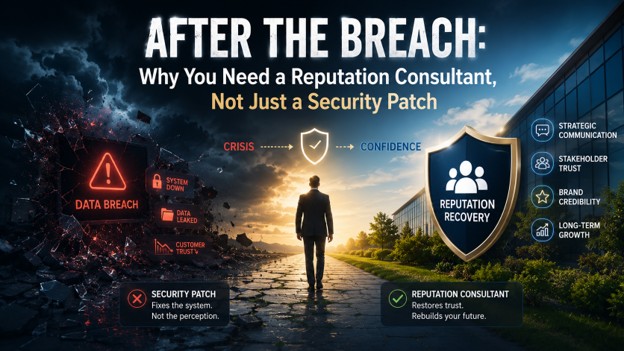
The incident response playbook is well rehearsed by now. Contain, eradicate, recover. Forensics arrives, logs are pulled, the vulnerability is closed, and legal drafts the notification letter. Somebody presents a timeline to the board with green checkmarks.
Then the patch ships, the CISO exhales, and the actual damage begins.
Because the vulnerability was never the thing your customers were going to remember. What they remember is the headline, the two weeks of silence, the support line that rang out, and the fact that “did [your company] get hacked” now autocompletes in Google. None of that gets fixed by a patch. It gets fixed, if at all, by somebody whose job is reputation, and most companies do not have that person until the second week of the crisis, which is roughly four days too late.
IBM’s 2026 Cost of a Data Breach report put the global average at $4.99 million, up 12% year over year, with healthcare at $6.6 million for the thirteenth consecutive year, the highest. The 2025 edition put the U.S. average at $10.22 million, the highest in the world, with a mean time to identify and contain of 241 days.
Look at what makes up that number. Detection and escalation runs about a third of it. Lost business runs about another third, and it means customer churn, revenue you did not book, and reputational damage.
So roughly a third of a multimillion-dollar loss sits in a category your security vendor does not sell a product for, cannot measure, and will not be held accountable for. It gets absorbed into next quarter’s pipeline shortfall and blamed on the market.
Attackers already understand this better than most boards do. In the 2026 IBM data, 41% of ransomware victims reported that attackers explicitly threatened to damage their brand reputation. Reputation is not a downstream consequence of the attack anymore. It is the leverage.
If you are a public company, SEC rules require a Form 8-K under Item 1.05 within four business days of determining that a cybersecurity incident is material. Materiality turns on whether a reasonable shareholder would consider it important. Between April 2024 and early 2025, 41 cybersecurity disclosures were filed, 15 under mandatory Item 1.05 and 26 voluntarily under Item 8.01.
Four business days. That is the window in which the entire public narrative gets set.
Here is what actually happens inside it. Legal writing for regulators and plaintiffs’ lawyers tends to be flat and defensive. Security writes for accuracy, so it hedges on numbers that are still moving. Communications gets both drafts handed to them on a Thursday afternoon and is asked to make them sound reassuring. The result is a statement that satisfies counsel, tells customers nothing, and reads to a journalist like an admission that you are hiding something.
A reputation consultant sits in that room for a specific reason: to represent the audience nobody else in the room is writing for. Not the regulator, not the litigator, not the analyst. The customer who is going to search your name that night, and the search engine and AI assistant that will answer them.
That distinction sounds soft until you price it. Regulatory fines were imposed on 32% of breached organizations, with nearly half of those fines exceeding $100,000. Customer churn is usually the larger number, and it is set almost entirely by how the first 96 hours read.
This is the part that gets misunderstood, and it is worth taking a clear position on.
A study in the Journal of Cybersecurity tracked 45 companies from 2002 to 2018 using CoreBrand Index survey data from 1,600 business executives. Average breaches were associated with a 26%-29% increase in reputational intangible capital. Familiarity went up about 20%. In other words, a routine breach mostly just makes people aware you exist.
The large, heavily publicized breaches are a different animal. Those showed declines in brand power of 5% to 9%. For consumer-facing companies, large breaches reduced brand power by 23% and familiarity by 6%.
Two conclusions follow from that, and they point in opposite directions from the usual advice.
First, panic is expensive and usually unwarranted. If your breach is small and your customers are other businesses, the reputational math may genuinely be neutral or mildly positive. Spending crisis-PR money on it is a waste.
Second, if you are consumer-facing and the story is going to be big, the damage is severe and measurable, and it does not appear to mean-revert on its own within the observation window. That is not a communications problem. That is a balance sheet problem with a communications trigger.
The job of a reputation consultant in the first 48 hours is to tell you honestly which of those two situations you are in, before you either overspend on a nothing or underspend on a catastrophe. Very few internal teams can make that call under pressure because, internally, every breach feels like the end of the world on day one.
Comparitech analyzed 118 NYSE and NASDAQ companies with disclosed breaches between 2007 and 2023. Share prices bottomed at an average of 1.4% down, or 1.9% against the NASDAQ, about 41 business days after disclosure. They recovered to pre-disclosure levels in an average of 53 days. Over the following six months, though, breached companies underperformed the NASDAQ by 3.2%. Healthcare fared the worst, with 10.6% underperformance. Retail actually outperformed.
Read that carefully. The stock recovers in under two months and then quietly lags for half a year. The visible wound closes while the bleeding continues somewhere nobody is looking.
That gap is where reputation work lives. The dip is priced by traders reacting to a headline. The six-month lag is priced by customers not renewing, prospects choosing a competitor, and partners quietly rebalancing. Those decisions are made by people reading search results and asking an AI assistant whether you are trustworthy.
Vercara research found 75% of consumers say they would sever ties with a brand after a cybersecurity issue, and 66% of U.S. consumers said they would not trust a company with their data following a breach. Forty-four percent blame inadequate security rather than sophisticated attackers. And 54% show leniency toward smaller brands.
Stated intent always overstates actual behavior. People say they will leave more often than they leave. But that 44% number is the one to sit with, because it says the public reads a breach as negligence by default. Your engineering team knows the attack was a zero-day in a third-party library. Nobody outside the building will ever know that unless somebody makes it their job to say so, in language a person can understand, in a place a search engine will index.
Meanwhile, cyberattacks now top the reputational risk list for 2026, with 67% of surveyed organizations citing them. Board-level formal processes for reputational risk jumped to 46% from 15%. But only 41% of companies know which reputational issues matter most to their stakeholders, down from 58%.
More governance, less understanding. That is a strange combination, and it explains why so many breach responses are procedurally flawless and publicly disastrous.
For twenty years, the reputational half-life of a breach was set by search. Coverage spiked, then decayed, then the negative articles slid to page two and stayed there as a permanent tax on your branded search results.
That model is now incomplete. When a prospect asks ChatGPT, Gemini, or Perplexity whether your company is a safe vendor, the model does not rank ten links and let the user judge. It synthesizes one paragraph. And it builds that paragraph from sources it treats as independent: news coverage, regulatory filings, third-party analysis. Your incident response page ranks low on that list precisely because you wrote it.
Which means three things, concretely.
The corrective record has to exist somewhere you do not own. A statement on your own newsroom is necessary but insufficient. Substantive coverage of what you actually did, in outlets a model treats as neutral, is what changes the generated answer.
Structured data determines whether you get quoted or paraphrased. Article and FAQPage schema on your incident disclosures and your security posture pages give a model something liftable instead of something it has to interpret. Unmarked prose gets summarized by inference, and inference on a breach story defaults to negative.
Silence gets filled by whoever else is writing. If you publish nothing substantive after the initial notification, the model’s answer regarding your breach is based entirely on the coverage of the incident. There is no counterweight in the source set. This is the single most common failure, and it costs almost nothing to avoid.
Post-breach reputation repair firms, including NetReputation, typically begin engagements by auditing exactly this: what the branded search result and the generated AI answer currently say, before a single piece of content gets produced. The gap between those two things is usually the whole story.
Six functions, none of which appear in an incident response plan.
Not to soften the language, which backfires, but to make sure the statement answers the three questions a customer will actually ask: Is my data affected? What are you doing? What should I do? Most 8-K derived statements answer none of them.
A small B2B breach or large consumer breach determines your entire spend. Getting this wrong in either direction is the most expensive error you can make.
Branded search results, autocomplete, third-party profiles, and generated answers from the major assistants, tracked weekly during the crisis and monthly after. Take a screenshot of the baseline before you publish anything.
Placed coverage, executive commentary, technical postmortems where appropriate. Sources that are not your own domain, because those are the ones that move a model’s answer and a skeptical buyer’s mind.
Hold times, email response latency, whether the credit monitoring signup page actually works. Reputational damage after a breach is driven mostly by service failures, not press coverage. The support queue is a communications channel.
Churn by cohort, branded search volume and sentiment, win rate on deals where the breach came up. That is where the 3.2% underperformance lives, and nobody is currently measuring it.
The security team’s job is to make sure it does not happen again. That is a genuinely different job from making sure the market, your customers, and every AI assistant your buyers use stop treating it as the primary fact about your company. Companies that separate those two roles recover. Companies that hand both to the CISO patch the hole and lose the customers anyway.
A reputation consultant is a specialist who manages how an organization is perceived by customers, media, search engines, and AI assistants, particularly during and after a crisis such as a data breach. The role covers crisis messaging, search results and AI answer monitoring, third-party media placement, review and profile management, and reporting on trust-related business metrics such as customer churn and win rate.
Because roughly a third of total breach cost sits in lost business, which includes customer churn and reputation damage, and no security remediation addresses it. Comparitech found that breached public companies recover their share price in about 53 days but then underperform the NASDAQ by 3.2% over the following six months, indicating the commercial damage continues long after the technical fix.
IBM’s 2026 Cost of a Data Breach report put the global average at $4.99 million, a 12% year-over-year increase, with healthcare highest at $6.6 million. The 2025 report put the U.S. average at $10.22 million, the highest of any country, with a mean time to identify and contain of 241 days.
Not uniformly. Research in the Journal of Cybersecurity covering 45 companies from 2002 to 2018 found that average breaches were associated with a 26% to 29% increase in reputational intangible capital, largely through increased familiarity. Large, heavily publicized breaches showed brand power declines of 5% to 9%, and 23% for consumer-facing companies. Severity and public visibility, not the breach itself, determine reputational impact.
Public companies in the U.S. must file a Form 8-K under Item 1.05 within four business days of determining that a cybersecurity incident is material, measured against whether a reasonable shareholder would consider it important. State notification laws and sector regulations impose separate, often shorter deadlines for notifying affected individuals.
Vercara Research found that 75% of consumers say they would sever ties with a brand after a cybersecurity incident, and 66% of U.S. consumers would not trust a company with their data afterward. Stated intent overstates actual behavior, but 44% attribute breaches to inadequate security rather than attacker sophistication, meaning the public default assumption is negligence unless the company actively corrects it.
AI assistants synthesize a single answer from sources they treat as independent, such as news coverage and regulatory filings, and systematically discount a company’s own incident response page as self-interested. If a company publishes nothing substantive beyond its initial notification, the generated answer about the breach is built entirely from incident coverage, with no counterweight in the source set.
Assess severity honestly to determine spend, participate in disclosure drafting so the public statement answers customer questions rather than only legal and regulatory ones, capture a baseline of branded search results and AI-generated answers before anything is published, and audit customer-facing service capacity, since most post-breach reputation damage is delivered through support failures rather than press coverage.
Don't forget to share this post!















Check out our other blogs!
Email ID Checker: Verify Any Email ID Online

ICP Refinement for SDRs: Using Data Filters to Stop Wasting Touches

Email Validator: Validate Email Format, Domain and Mailbox