Written by:

Abdul Kareem
B2B Data for Ed-Tech Companies: How to Reach School Leaders
How to find, verify and reach school, university and corporate learning buyers with business contact data

TL;DR
- B2B data for ed-tech is business contact information used to find school, university and corporate learning buyers.
- Education purchases involve several roles, so map the buyers before you build a list.
- Filter by title, seniority, industry, location and company size, then verify every email.
- Segment lists by K-12, higher education and corporate learning.
- Sync clean records to your CRM and re-check them before each buying season.
- Track reply rate, bounce rate and meetings booked by segment.
- ReachStream offers 500M+ contacts, 50M+ companies and 100M+ direct dials, plus 100 free export credits a month.
What Is B2B Data for Ed-Tech Companies?
EdTech B2B data is business information about education buyers and institutions, such as title, organization, work email and phone number. Education decision-makers are the people who choose or approve a purchase, from school administrators to university procurement teams.
A learning management system (LMS) is the software schools and companies use to deliver and track courses. A sales cycle is the time from first contact to a signed deal. Lead quality is how closely a contact matches your ideal buyer agenda.
B2B data for ed-tech is verified business information about the people and organizations that buy education technology, such as school administrators, district technology leaders, university procurement teams and corporate learning managers.
It gives an education technology company a way to find the right buyer, reach them directly and stop guessing who signs off on a purchase. ReachStream offers 500M+ contacts, 50M+ companies and 100M+ direct dials, and the Free plan includes 100 export credits a month with no credit card, so you can test it on a real search.
Who Buys Education Technology and How?
Education buying is rarely one person’s call. In K-12 education technology, a teacher or curriculum lead may ask for a tool, but a principal, a district technology director and a finance or procurement office often have to agree.
In higher education technology, departments, IT and university procurement teams all play a part, and corporate learning platforms are usually bought by learning and development or HR leaders. Education software providers that map these roles early tend to waste less time on contacts who cannot say yes.
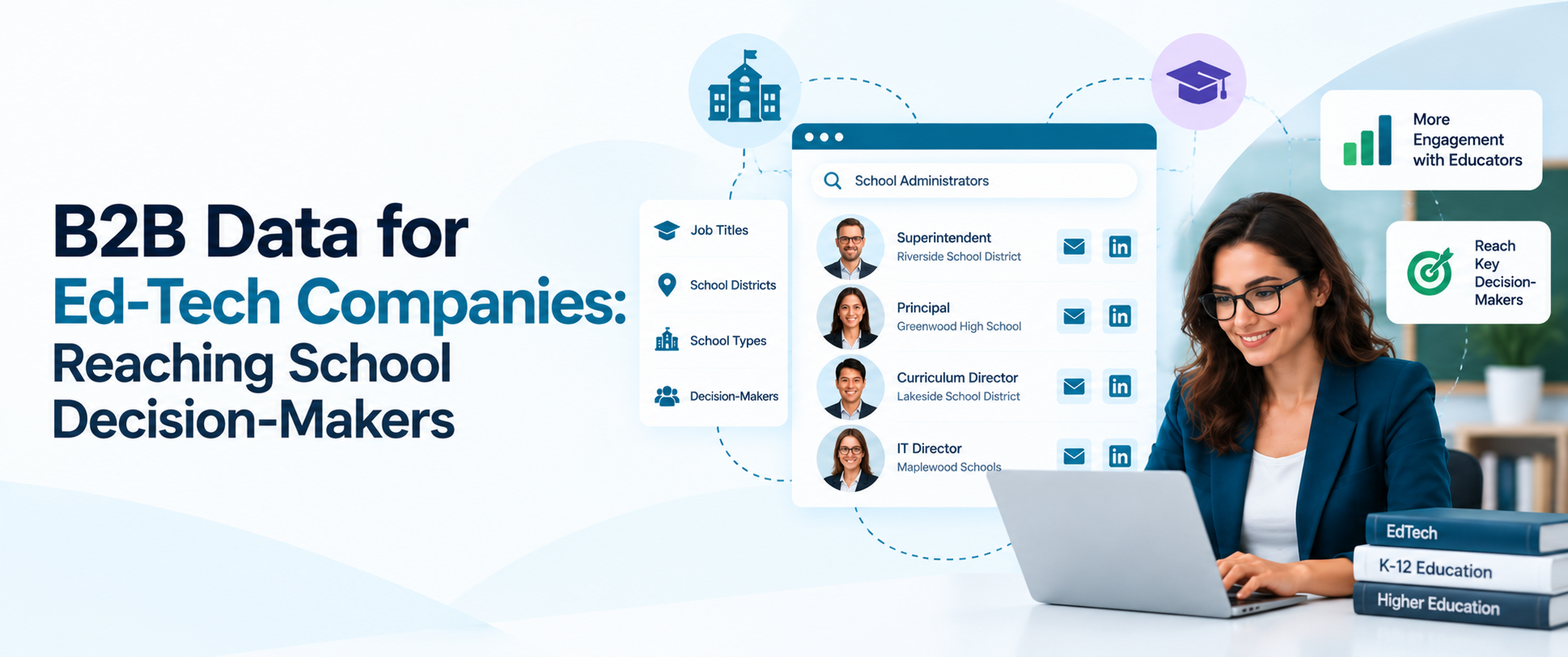
That is where B2B data for ed-tech earns its place: it lets you search by title, seniority and organization instead of hunting for names one at a time. Our guide on how to find education industry contacts goes deeper on the sector, and the same approach helps you build B2B leads for EdTech companies of any size, from early-stage online learning platforms to established vendors.
Which Education Decision-Makers Should You Target?
Start with the buyer, not the product. School administrators such as principals and district leaders care about outcomes, budgets and safety. Technology directors check security, integration and support. Procurement teams look at contracts and compliance, and department heads or faculty champions often bring a tool in for a pilot.
For digital learning solutions and corporate learning platforms, the buyer is usually a learning leader or an HR director. An education decision-maker database should let you filter by job title and seniority so you can reach each role with a message that fits it.
It also helps to look for education technology leads in organizations that already use tools close to yours, since they understand the problem you solve. Our guide to ICP refinement with data filters shows how to turn those roles into a clear target.
What Should an EdTech Contact Database Include?
At the person level, look for job title, seniority, department, organization, location, a verified work email and a direct dial where available. At the organization level, capture type (school, district, college, university or company), size, region and the technology it already uses.
Those fields let you segment an education technology contact list by buyer role and institution type instead of sending one message to everyone. ReachStream filters by industry, job title, seniority, location, company size and technologies used.
Technology Insights adds filters based on 22K technologies, which can help you find organizations running a specific learning management system where that data is available. AI Search lets you describe the buyers you want in everyday language, and Similar Companies expands from accounts that already fit. Coverage for education roles varies, so run a test search before you plan a campaign.
How Do You Verify Education Contacts?
Education data goes stale quickly. Staff change schools, districts reorganize and the new school year moves people every summer. Before any campaign, run every address through an email verifier, watch the bounce rate and remove anything that fails. ReachStream includes a built-in email verifier, and we refresh records on a 45-day cycle.
Many schools and universities filter email carefully, so a clean sender reputation matters. Record the source and date of each contact and test a small batch before you scale. Our guide to B2B data accuracy explains how to check a sample before you commit to any vendor.
How Do You Build Lists for K-12 and Higher Ed?
Build one list per segment instead of one giant list. A K-12 list might target district technology directors and principals, a higher education list might target heads of IT, deans and university procurement teams, and a corporate list might target learning and development leaders.
In ReachStream, filter by title, seniority, location and company size, then save each search as a dynamic list so it stays current. An education industry email list is only useful when it is filtered to the roles you actually sell to. For wider sourcing, our guides on how to find a schools database and how to find teachers contact lists cover related audiences, and both pair well with an EdTech leads database that you build from filters. Use any school administrator email list with care: respect local rules for contacting school staff, keep an opt-out list and ask your legal team to review your process.
Try B2B data for ed-tech with ReachStream
Filter by title, industry and location, then export verified business contacts.
Which Data Source Fits Which EdTech Task?
The table below compares common data sources for ed-tech teams. Most teams combine them, so adjust the rows to your own stack.
| Source | Best for | Typical fields | Watch-outs | What to test |
|---|---|---|---|---|
|
Contact database |
Reaching education buyers directly |
Title, organization, verified email, direct dial |
Coverage varies by role and region |
Share of target roles found |
|
CRM |
Tracking accounts and deals |
Contacts, notes, stages, history |
Records go stale without enrichment |
Share of records updated this quarter |
|
Conferences and public lists |
Warm leads and local context |
Names, events, program lists |
Slow to collect and hard to keep current |
Cost per usable contact |
How Do You Run EdTech Lead Generation?
- Define the segment: Pick K-12, higher education or corporate learning, with a region and size.
- Map the buyers: List the titles that influence and approve a purchase.
- Build the list: Filter in ReachStream and save it as a dynamic list.
- Verify and enrich: Run the built-in email verifier and fill missing fields.
- Reach out: Send a short message tied to the buyer’s role and the school year.
- Sync and measure: Export to CSV or sync to Salesforce or HubSpot, then track replies and meetings.
How Do You Keep Education Data Clean in a CRM?
Your CRM should hold one record per person, tied to one record per institution. ReachStream offers CSV export, native Salesforce and HubSpot sync, data enrichment and the Reach API, so a saved list can flow into the tools your reps already use. Tag every record with its segment, source and import date so you can see which lists produce meetings.
Plan for turnover. Education contacts move often, so schedule a re-check before each buying season, such as budget planning or the start of a school year, and remove or update anyone who has left. Set a retention period and honor requests to access, correct or delete personal data under laws such as GDPR and CCPA. Our guide to B2B email outreach compliance covers the basics. This is general information, not legal advice.
How Can EdTech Teams Improve Lead Quality?
- Reply rate: The share of messages that get a reply.
- Bounce rate: The share of emails that fail, which shows data quality.
- Meetings booked: Conversations that reach a real buyer.
- Pipeline by segment: Qualified deals in K-12, higher education and corporate learning.
- Sales cycle length: Time from first contact to a signed deal.
- Cost per qualified lead: What each lead costs across tools and time.
How Does ReachStream Support EdTech Teams?
For B2B data for ed-tech, ReachStream Prospect is designed to help sales teams find professionals and decision makers across 500M+ contacts, 50M+ companies and 100M+ direct dials. Dynamic lists stay current, the Chrome Extension helps capture leads from LinkedIn, and data enrichment, CSV export, the Reach API and native Salesforce and HubSpot sync move data into your stack.
You can also use it to research vendors, partners and competitors, much like an EdTech companies database that you filter yourself. Coverage differs by role and region, so test the searches you run most on the Free plan. You can explore the platform on the ReachStream Prospect page. ReachStream is ISO 27001:2022 certified and SOC 2 Type II, and lists GDPR, CCPA, PIPEDA and DPDPA compliance.
To recap the plans: the Free plan includes 100 export credits a month with no credit card, Starter is $29 a month billed yearly ($39 monthly) for 5,000 export credits a month, Pro is $49 a month billed yearly ($59 monthly) for 10,000, and Business is $79 a month billed yearly ($99 monthly) for 20,000 credits and 3 seats. Enterprise is custom.
Start with 100 free export credits a month
No credit card needed. Test coverage for the education roles you sell to.
B2B Data for Ed-Tech: The Short Version
The short version: B2B data for ed-tech is business contact information you use to find school, university and corporate learning buyers, always with verified details and respect for privacy law. Map the buyers, filter and verify, sync to your CRM and track reply rate and lead quality.
For your next read, see our guide to B2B SaaS lead generation and our guide to B2B lead generation KPIs.
Find a plan that fits your sales team
Compare ReachStream’s Free, Starter, Pro and Business plans.
Frequently Asked Questions
1. What is B2B data for EdTech companies?
B2B data for EdTech companies is business information about the people and organizations that buy education technology, such as titles, employers, work emails and phone numbers. It helps vendors find school administrators, university procurement teams and corporate learning leaders. It is used for prospecting, segmentation and outreach to business buyers, not for contacting students.
2. Why do EdTech companies need B2B contact data?
Education buying involves several roles, and the right one is hard to find by hand. Contact data shows who holds each title, how to reach them and which organizations fit your product. It saves research time and keeps reps focused on buyers who can act.
3. How does B2B data help EdTech generate leads?
It lets you build targeted lists by role and institution type, verify emails and phone numbers, and reach buyers with relevant messages. Better targeting means more replies and fewer wasted touches. Syncing to a CRM keeps follow-up organized.
4. What types of B2B data help EdTech marketing?
Useful data includes job title, seniority, organization, location, size, verified email, direct dial and the technology an organization uses. Segment fields such as institution type and region help you tailor messages. Record the source and date of each field.
5. What should an EdTech B2B database contain?
It should hold verified emails, direct dials where available, titles, seniority, organization details and location, plus a record of the source and date. It should also let you filter by role and export to your CRM. Test coverage for your target roles before you rely on it.
6. How do EdTech companies identify prospects?
They map buyer roles, define the segment and institution type, then search by title, seniority and location. Existing customers and similar organizations are a good starting point. Similar Companies in ReachStream expands from accounts that already fit.
7. What are the main sources of education B2B data?
Main sources include contact databases, your own CRM, professional networks, conferences and public directories. Most teams combine them. Whatever you use, check how records are collected, verified and refreshed.
8. How can EdTech companies improve lead quality?
Target specific buyer roles, verify every email and refresh records before each buying season. Track reply rate, bounce rate and meetings booked by segment. Drop lists that do not convert and rebuild them from tighter filters.
9. How much does ReachStream cost for EdTech teams?
The Free plan costs $0 and includes 100 export credits a month. Billed yearly, Starter is $29 a month for 5,000 credits, Pro is $49 for 10,000 and Business is $79 for 20,000 credits and 3 seats. Monthly billing costs $39, $59 and $99, and Enterprise is custom.
Abdul Kareem
Author
Abdul Kareem

Abdul Kareem writes about B2B sales prospecting, email deliverability, and cold outreach for ReachStream, focusing on practical guidance that sales and marketing teams can put to use right away.
Share
Table of Contents
Access 500M+ verified business emails and grow your sales pipeline effortlessly.
Power Your Sales
with Targeted Data
Abdul Kareem writes about B2B sales prospecting, email deliverability, and cold outreach for ReachStream, focusing on practical guidance that sales and marketing teams can put to use right away.
Don't forget to share this post!















Check out our other blogs!
How to Build a Targeted Prospect List Using Filters
October 21, 2026

B2B Data for Ed-Tech Companies: Reaching School Decision-Makers
October 21, 2026
Direct Dial Numbers Explained: A Guide for Sales Reps
October 19, 2026