


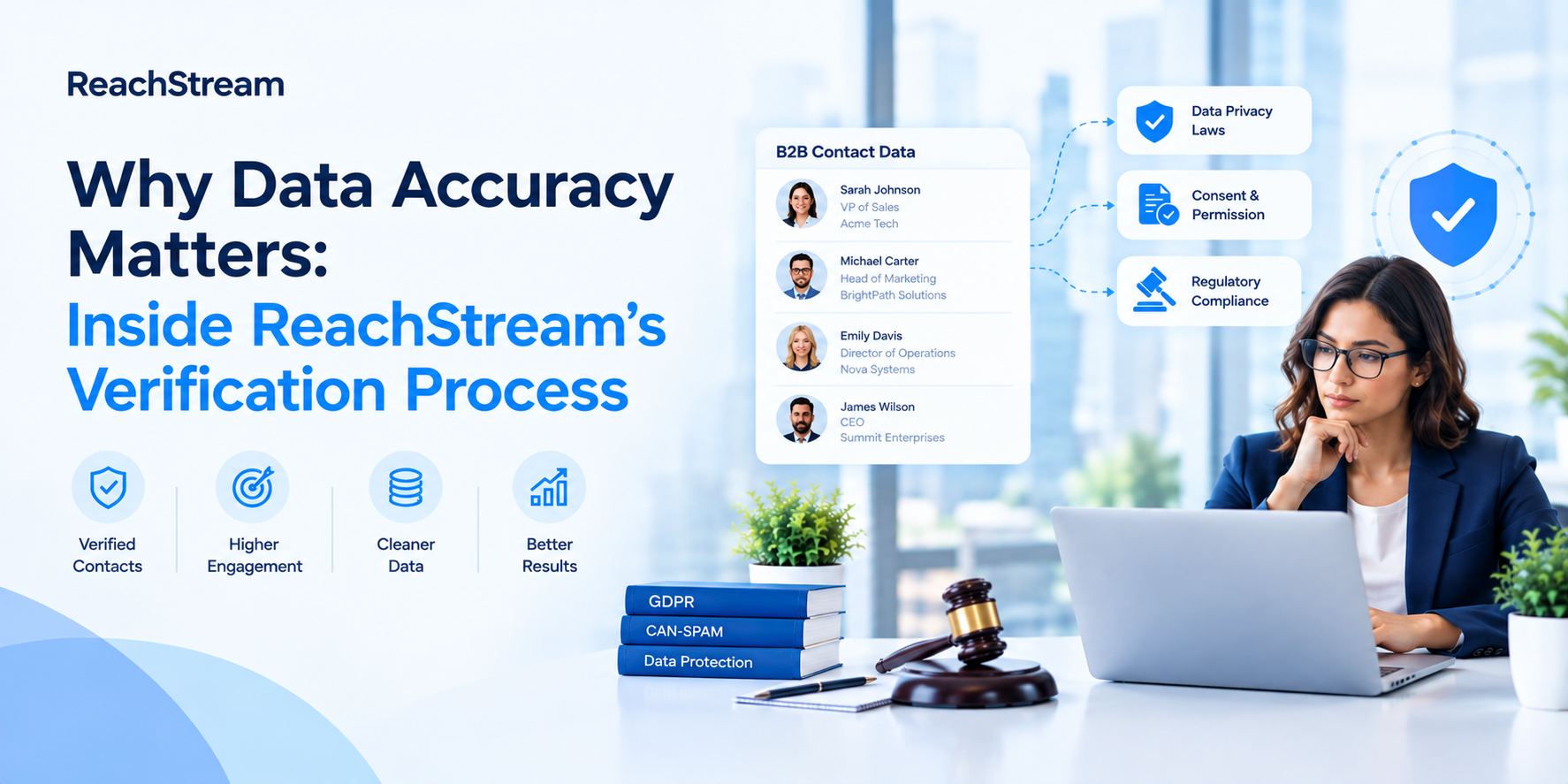

How to Evaluate B2B Data Vendors for Accuracy and Compliance

B2B data accuracy is the degree to which a contact record, an email address, a direct dial, a job title, a company name, matches what is true about that person and company right now. An accurate record is not just correctly formatted. It is current, reachable, and verifiable.
A contact that passes an email syntax check but bounces on send is not accurate. A direct dial that connects to the wrong department is not accurate either. Real B2B data accuracy measurement looks past formatting and checks whether the record still reflects reality.
Every outdated job title sends a message to the wrong inbox. Poor B2B data quality compounds: it does not just waste one send, it quietly degrades every campaign that touches the same contact record afterward. That is the real cost of skipping data governance and data hygiene before a list goes into active use.
Verified-email percentage: the share of records that have passed SMTP check and mailbox verification versus those only patterns matched. Match rate: how many records still resolve to the correct company when cross-checked against a current firmographic source. Decay rate: how quickly a list loses accuracy over time as people change roles, so a provider’s refresh cadence matters as much as its initial accuracy.
SMTP verification opens a partial SMTP conversation with the receiving mail server and asks whether a specific mailbox exists, without actually sending a message. A 250 response to the RCPT command generally means the mailbox is live; a 550 or 551 response means it is not, and the server disconnects before delivery completes. Catch-all detection tests the same domain with an address that should not exist.
If that fake address also returns 250, the domain is accepting everything it receives, and SMTP verification alone cannot confirm any single address on that domain is real. This is a known limitation of the SMTP protocol itself, not a flaw in any one verification tool. Providers handle it differently: some label catch-all results Unknown, others apply secondary confidence signals before including or excluding the address.
The two terms get used interchangeably, but they check different things. Data validation confirms a record’s format, structure, and completeness: does the email have an @ symbol, is the phone number the right number of digits, is a required field blank.
Data verification goes further and confirms the record is true and reachable right now: does that mailbox actually exist, is that phone number currently in service, does that job title still belong to that person. A record can pass validation and still be wrong. Only verification catches that.
| Verification Step | What It Catches | Time per Check | Scalability | Reliability Note |
|---|---|---|---|---|
|
Syntax & MX Check |
Malformed addresses and dead domains |
Milliseconds |
High, runs on an entire list instantly |
Confirms format only, not reachability |
|
SMTP Verification |
Mailboxes that do not exist |
Seconds per address |
High, but rate-limited by receiving servers |
Confirms reachability at the moment checked |
|
Catch-All Detection |
Domains where per-address signals collapse |
Seconds per domain, then cached |
High, one domain-level check covers every address on it |
Needs secondary confidence signals to fully resolve |
ReachStream’s contact database, built from 500M+ verified business emails and 100M+ direct dials 35% connect rates across 50M+ companies, runs new and existing records through layered checks before they surface in a search result or an AI Conversational Search query. Email syntax check and domain/MX record checks happen first to rule out obviously dead addresses.
SMTP check and mailbox verification follow to confirm a given address is actually live rather than just well formatted. Catch-all domains get flagged and handled with additional confidence signals instead of being treated as a simple pass or fail. Records are also re-checked on an ongoing basis rather than verified once and left alone, since contact data decays as people change roles and companies change domains.
Trusting bounce rate as the only signal: a low bounce rate can still hide a high share of catch-all addresses no one has verified individually. Skipping catch-all detection: without it, an entire domain can pass as deliverable when only some addresses on it are real. Treating validation as verification: confirming an email is correctly formatted says nothing about whether the mailbox still exists.
Buying once and never re-checking: a list that was 95 percent accurate at purchase can fall well below that within a few months without ongoing SMTP verification. Ignoring direct-dial and job-title accuracy: most B2B data accuracy conversations focus on email, but phone numbers and titles decay too and deserve the same scrutiny.
ReachStream’s B2B data accuracy approach combines automated email syntax check, domain check, MX record, SMTP check, mailbox verification, and catch-all detection with features like AI Conversational Search and Similar Companies. The goal is a database sales, marketing, RevOps, and lead-generation teams can build outreach on without a second verification pass of their own.
B2B data accuracy is not a single number on a sales page, it is the result of a layered verification process, an email syntax check, a domain and MX record check, an SMTP check, and catch-all detection, applied consistently and refreshed on an ongoing basis.
Whether you are evaluating ReachStream data accuracy or any other best B2B data provider for accuracy, ask for the methodology, the current bounce rate, and the re-verification cadence before you trust the number on the page.
Author

Abdul Kareem is Software Engineering Manager at ReachStream, leading the development of scalable software solutions for B2B sales and marketing teams.
Access 200M+ verified business emails and grow your sales pipeline effortlessly.
Don't forget to share this post!















Check out our other blogs!
What Is B2B Data and Why It Matters for Modern Sales Teams
A Buyer’s Checklist for Evaluating B2B Data Providers
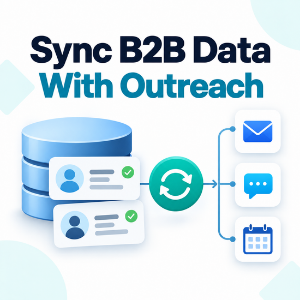
How to Sync B2B Data with Your Outreach Sequences