

How to Evaluate B2B Data Vendors for Accuracy and Compliance
Your B2B database is decaying right now. Industry research suggests contact data degrades at roughly 30% per year—meaning nearly a third of your records become outdated, inaccurate, or completely useless every twelve months.
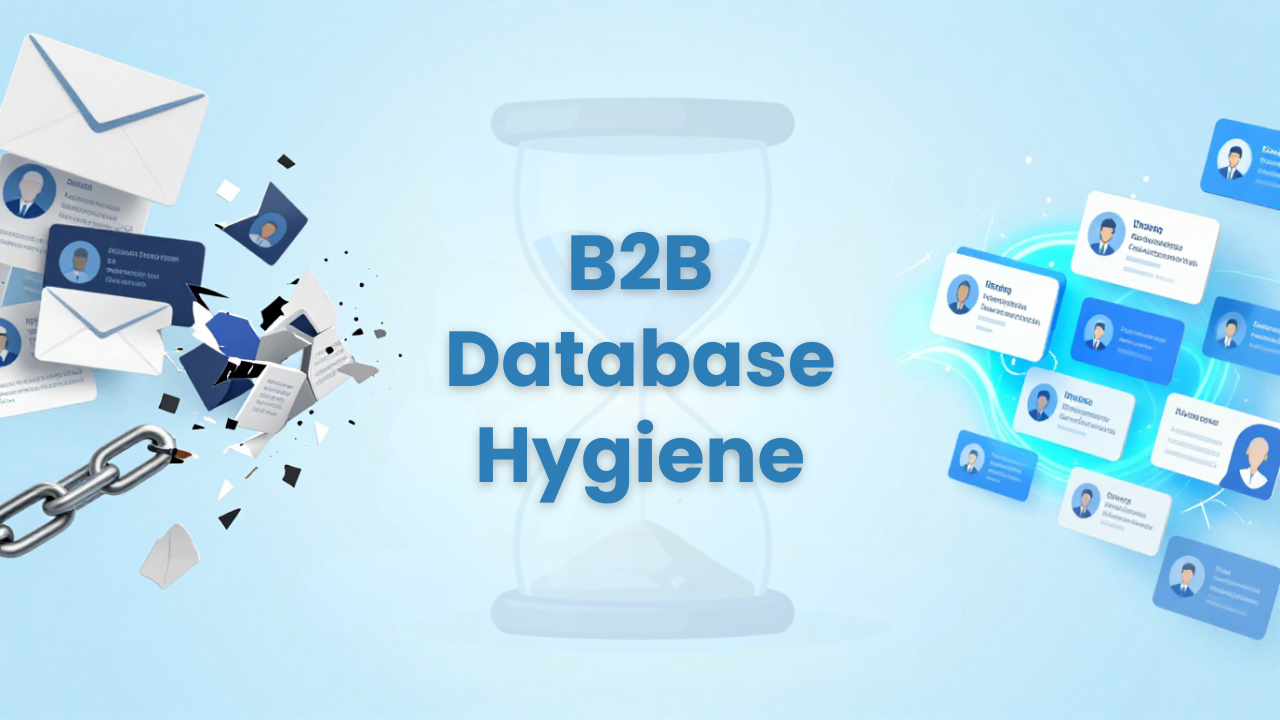
B2B database hygiene is the ongoing process of cleaning, validating, and maintaining your contact and company records to combat that decay. This guide covers what causes data to go stale, how to spot the warning signs, and the specific practices that keep your CRM accurate enough to actually drive pipeline.
B2B database hygiene is the systematic process of cleaning, updating, and maintaining business contact data to remove duplicates, inaccuracies, and expired records. It’s not a one-time cleanup project. It’s an ongoing practice that keeps your CRM and prospect lists accurate enough to actually use.
Here’s what that looks like in practice:
Think of it like maintaining a car. You don’t wait until the engine fails to change the oil. The same logic applies to your contact data.
People use these terms interchangeably all the time. They’re related, but they describe different activities.
Data cleansing fixes what’s broken. Data enrichment fills what’s missing. Hygiene keeps everything from sliding backward over time. Most teams benefit from all three working together.
Data decay is the natural degradation of contact and company information over time. People change jobs. Companies merge or close. Email domains migrate. Phone numbers get reassigned. None of this requires anyone to make a mistake—it just happens.
The primary causes include:
The rate varies by industry, but the pattern is consistent. Your database gets a little less accurate every single day.
Every revenue function depends on accurate data. The pain just shows up differently for each team.
Sales reps waste hours chasing disconnected numbers and bounced emails instead of having conversations. Marketing campaigns miss ideal buyers, and performance metrics become unreliable. RevOps teams find that forecasting and attribution break down when the underlying data can’t be trusted.
You might be thinking this sounds like a nice-to-have. It’s not. Without clean data, even the best targeting logic falls apart before your message reaches anyone.
The real expense of poor data quality often hides in plain sight. It’s not just about bounced emails.
Clean data isn’t just operational hygiene. It’s a competitive advantage that compounds over time.
How do you know when your database has a problem? Here are the warning signs worth watching for.
When hard bounces start climbing, you’re looking at invalid or outdated email addresses. This directly impacts sender reputation and campaign ROI. Most email service providers start flagging accounts when bounce rates climb above a few percentage points.
The same contact appearing multiple times—often with slightly different details—creates confusion and wastes outreach credits. It also makes reporting unreliable because you’re counting the same person twice.
Gaps in job title, phone number, or company data limit your ability to segment and personalize. If you can’t filter by role or industry, your targeting becomes guesswork.
Contacts who have changed roles or companies represent dead ends. Unless records are refreshed regularly, you’re reaching out to people who no longer exist at that company.
When teams disagree about whether leads are “good,” the root cause is often inconsistent or inaccurate data. Clean data creates a shared foundation for qualification that both teams can trust.
Here’s a practical framework you can implement. Platforms like ReachStream combine several of these capabilities in one scalable B2B data platform, though the principles apply regardless of your tooling.
Set a recurring cadence—monthly or quarterly—to review data quality metrics and flag records for review. You can’t fix what you don’t measure, and you can’t measure what you don’t look at.
Consistent field formats prevent fragmentation. Create a style guide for job titles, company names, and phone formats so everyone enters data the same way. This sounds tedious, but it prevents a lot of downstream headaches.
Contacts often enter your CRM from multiple sources: LinkedIn via a Chrome Extension, events, purchased lists, inbound forms. Identify and merge duplicates before they multiply and fragment your view of each contact.
Verification at the point of capture catches bad data before it enters your system. ReachStream’s real-time verification, for example, validates contacts as you add them rather than waiting until you’re about to send a campaign.
Adding company size, industry, revenue, and technology data improves targeting and segmentation. Enrichment turns a name and email into a complete prospect profile you can actually use for personalization.
Automation prevents bad data from entering your CRM in the first place. Catching errors early stops them from compounding into bigger problems later.
Someone has to be accountable for data quality. A data steward—the person or team responsible for maintaining standards—ensures hygiene doesn’t fall through the cracks when everyone assumes someone else is handling it.
Monitoring job changes keeps your database current without manual research. ReachStream refreshes contact data every 45 days to catch job changes, company updates, and contact information shifts automatically.
Manual hygiene doesn’t scale. If you’re managing thousands of contacts, spreadsheet-based cleanup becomes a full-time job that never ends.
Emerging capabilities make it possible to maintain large databases without drowning in manual work:
For teams managing large contact databases, automation isn’t optional. It’s the only way to keep up with the rate of decay.
You can’t improve what you don’t track. Here are the KPIs that matter most:
Consider building a simple dashboard to monitor these over time. Trends matter more than any single snapshot.
Best practices handle the tactical work. Governance makes it sustainable over months and years.
Document what “clean data” means for your organization—required fields, acceptable formats, freshness thresholds. Without a shared definition, everyone operates on different assumptions about what “good enough” looks like.
Distribute ownership so sales, marketing, and ops each have accountability for their data contributions. Shared responsibility prevents finger-pointing when problems surface.
Consent tracking, opt-out management, and data retention policies aren’t optional. Build compliance into your hygiene workflows from the start rather than retrofitting it later.
Build hygiene tasks into your team’s regular rhythm—weekly quick checks, monthly audits, quarterly deep cleans. Consistency matters more than intensity.
ReachStream simplifies everything we’ve covered here. The platform combines real-time email and phone verification, continuous data refresh every 45 days, enrichment with firmographics and job-level data, and CRM integrations for automated workflows.
Database hygiene is the practice of maintaining accurate, complete, and up-to-date records through regular cleaning, validation, and standardization. It prevents errors from compounding and ensures your outreach reaches the right contacts at current, valid addresses.
A B2B database is a structured collection of business contact and company information used for sales, marketing, and outreach. It typically includes names, job titles, emails, phone numbers, and firmographic details like industry and company size.
CRM data hygiene refers specifically to keeping records in your customer relationship management system clean and current. It involves removing duplicates, updating stale information, and ensuring consistent formatting across all fields in your CRM.
Most B2B teams benefit from quarterly audits, with ongoing verification happening in real time as new contacts are added. High-volume outbound teams often find monthly reviews more appropriate given the pace of their data collection.
A healthy B2B email bounce rate typically stays in the low single digits for hard bounces. Rates above that threshold suggest your database needs attention to protect sender reputation and maintain deliverability.
Marketing professional with a Master’s degree in Marketing, specializing in SEO, content strategy, social media, performance marketing, prospecting, and demand generation.
Access 200M+ verified business emails and grow your sales pipeline effortlessly.
Don't forget to share this post!















Check out our other blogs!
How Many Follow-Ups Should a Cold Email Sequence Have?

How a Medical Device Company Can Reach Hospital Decision-Makers
What Data Fields Should a Healthcare Marketing Database Include?
ReachStream Prospect vs Prospeo: Who Delivers Accurate Data?