










Never Run Out Of Buyers To Sell To.
500M+
Contacts
60M+
Mobile Numbers
50M+
Companies

The B2B Data Decay Clock - How Fast Your Contact Data Goes Stale

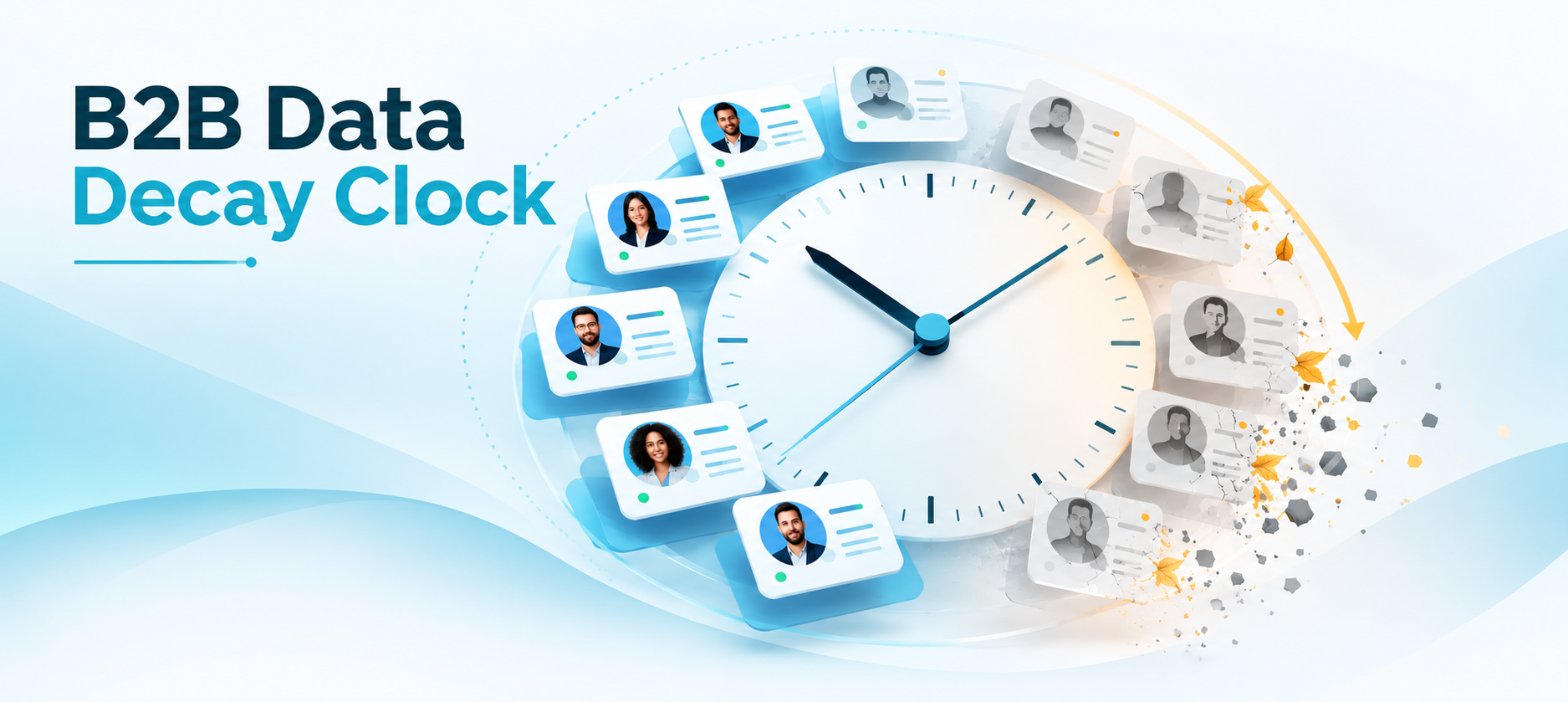
B2B Data Decay Clock

The B2B Data Decay Clock - How Fast Your Contact Data Goes Stale

Summarize this article with AI:

Your Contact Data Has a Shelf Life, and It’s Shorter Than You Think!

Right now, while this page loads, contact records in B2B databases everywhere are quietly going bad. Not from a breach or a system error, just time. According to HubSpot’s Database Decay Simulation, built on long-running MarketingSherpa research, B2B contact data decays at 2.1% every month, compounding to roughly 22.5% within a year.

This is the B2B Data Decay Clock: a way to see decay as it actually happens, continuously, not in the quarterly snapshot most teams rely on.

The B2B Data Decay Clock: One Year of Neglect

Even the best outreach won’t land if it’s sent to a dead end. The shift from a fresh list to a reliable pipeline starts with knowing exactly how fast that list is going stale.

Here’s a five-point breakdown of what happens to a typical B2B contact database over the course of a year with no active verification, using a verified Data Decay Clock by ReachStream.

Mild severity icon showing a clean, uncracked circle representing early-stage B2B data decay

Mild Decay – Month 1: The Clock Starts Ticking

In the first month after a contact list is built or purchased, decay has already begun. According to HubSpot’s Database Decay Simulation, built on long-running MarketingSherpa research, B2B contact data decays at 2.1% every month.
By the numbers: 2.1% of a typical B2B database is already stale after just one month.
Moderate severity icon showing a slightly cracked circle representing month 3 B2B data decay

Moderate Decay – Month 3: The First Real Dent

By the third month, the 2.1% monthly rate has compounded. A database left untouched for one quarter has already lost a meaningful share of its accuracy, well before most teams run their next cleanup.
By the numbers: 6.2% of contact records are stale by month three, compounding from the same 2.1% monthly rate.
Notable severity icon showing a cracked circle representing month 6 B2B data decay

Notable Decay – Month 6: Email Breaks First

Email is the fastest-decaying field in any B2B database. ZeroBounce’s Email List Decay Report for 2026, based on more than 11 billion email addresses verified in 2025, found that at least 23% of an email list degrades within a single year, a pace well underway by the halfway mark. Following consistent email verification best practices is the clearest way to slow this part of the curve.
By the numbers: 12.0% of the overall database is stale by month six, with email addresses decaying even faster than that average.
Significant severity icon showing a heavily cracked circle representing month 9 B2B data decay

Significant Decay – Month 9: The Cost Becomes Real

By this point, decay is no longer a rounding error. Gartner’s research puts the average annual cost of poor data quality at $12.9 million per organization, a cost that accrues continuously, not just at year-end. This is also where unchecked decay starts to reduce email bounce rates and sender reputation together.
By the numbers: 17.4% of contact records are stale by month nine.
Critical severity icon showing a fully fractured circle representing month 12 B2B data decay

Critical Decay – Month 12: A Quarter of the Database Is Gone

A full year with no active verification brings a database to the widely cited industry benchmark of 22.5% annual decay. IBM’s research, cited in a 2016 Harvard Business Review article by Thomas Redman, estimated the cost of poor-quality data to U.S. businesses at $3.1 trillion annually. Understanding how real-time email verification works shows why continuous checks beat a once-a-year cleanup.
By the numbers: 22.5% of a typical B2B database has decayed after 12 months with no active verification.

Reader’s Poll

How often does your team re-verify your B2B contact database?
A) Continuously / in real time
B) Monthly
C) Quarterly
D) Rarely or never

ReachStream Helps You Stay Ahead of Data Decay

Stopping data decay isn’t about one big annual cleanup, it’s about continuous verification. Understanding what data enrichment is helps explain why: ReachStream’s Data Enrichment and built-in email verification keep your contact database accurate as it changes, not just when you remember to check it.

Here’s what sets ReachStream apart:

500M+ Verified Contacts to Draw From

ReachStream gives you access to a database of 500M+ contacts, 60M+ direct mobile numbers, and 50M+ companies. Every record is built to be refreshed, not purchased once and left to decay.

Continuous Verification, Not a One-Time Check

ReachStream’s built-in email verifier checks deliverability before data ever reaches your CRM, and ReachStream’s Data Enrichment keeps existing records current as job titles, emails, and phone numbers change, so your database doesn’t sit still between cleanups. If your list has already drifted, here’s how to clean an email list before turning continuous verification on going forward.

100% Data Compliance and Security

Compliance and security are built into ReachStream’s data infrastructure. Contact data is sourced and verified in line with major data privacy standards, including GDPR and CCPA, so outreach stays safe and lawful across international markets.

Advanced Filtering for Precision Targeting

With ReachStream’s List Builder and advanced filters, you can segment contacts by job title, seniority, department, location, and more, so the data you’re verifying is the data you actually plan to use, not a stale list sitting untouched in a folder.

Affordable Pricing Plans for Every Business

ReachStream’s plans start at $0, so keeping a database accurate doesn’t require a large upfront investment. Start free, and scale verification and enrichment as your outreach grows.

Stop Paying for Stale Data

Data decay isn’t a one-time event, it’s continuous. Treating a contact database as something to verify once a quarter guarantees you’re always working with partially stale data. ReachStream helps B2B teams keep their contact database accurate as it changes, not just when someone remembers to clean it.

Take the Smarter Route with ReachStream

ReachStream helps you stop the clock on contact data with continuous verification, enrichment, and segmentation built into one platform.

Start free with our Free plan and upgrade as you scale, our paid plans Glacier, Ice Floe, Polar Peak, and Frozen Fortune unlock deeper targeting, higher volume, and complete data access.

Stop the Clock on Your Contact Data

Start free with no credit card required, and keep every contact verified continuously instead of cleaned up once a quarter.

FAQs

1. How fast does B2B contact data actually decay?

B2B contact data decays at roughly 2.1% a month, which compounds to about 22.5% a year, according to HubSpot’s Database Decay Simulation based on MarketingSherpa research.
Data decays mainly because people change jobs, switch email addresses, or move to new phone numbers. Email addresses tend to go stale fastest, with ZeroBounce finding at least 23% of a typical email list degrading within a year.
Work email addresses decay fastest since they’re tied directly to employment. Direct dials and job titles also change often, while company-level details like address tend to stay accurate longer.
Gartner estimates poor data quality costs organizations an average of $12.9 million a year. IBM’s research, cited in a 2016 Harvard Business Review article, put the cost of poor-quality data to U.S. businesses at $3.1 trillion annually.
Since decay compounds continuously rather than on a schedule, the safest approach is ongoing verification rather than a quarterly or annual cleanup. At minimum, re-verify before any major campaign.
No, decay is a constant byproduct of people changing jobs and contact details. It can’t be stopped, but continuous verification and enrichment keep a database close to accurate instead of letting it drift.
Yes. A decayed list carries more invalid and risky addresses, which drives up bounce rates and can damage sender reputation over time.
ReachStream offers a Free plan to start, plus paid plans Glacier, Ice Floe, Polar Peak, and Frozen Fortune for teams that need deeper targeting, higher volume, and full data access.
Sign up for the Free plan on ReachStream’s website, no credit card required, and start verifying and building your contact list right away.
Table of Contents
Abdul Kareem

Author

Abdul Kareem
Abdul KareemAuthor

Access 500M+ verified business emails and grow your sales pipeline effortlessly.

Claim Your 100 Free Export Credits Today!

Power Your Sales with Targeted Data
Abdul Kareem
Abdul KareemAuthor
Abdul Kareem writes about B2B sales prospecting, email deliverability, and cold outreach for ReachStream, focusing on practical guidance that sales and marketing teams can put to use right away.

Don't forget to share this post!

Check out our other blogs!