




Unlimited Data.
Infinite Possibilities.

Looking for B2B data? Download Unlimited data using our Chrome extension at just $79/month.

Best B2B Lead Database Providers for 2026

Best B2B Lead Database Providers

Top 5 Plastic Surgeons Email List Providers - Who's the Best?

The quality of your B2B leads database directly determines the success of your sales and marketing efforts. In 2026, with buyers completing 75% of their purchasing journey before engaging with sales teams, having access to accurate, verified contact data isn’t just advantageous—it’s essential for revenue growth. 

Poor data quality costs organizations an average of $15 million per year through wasted sales time, damaged sender reputation, and missed opportunities. Companies using high-quality B2B databases report 32% higher conversion rates and 25% shorter sales cycles. The difference lies not just in having data, but in having the right data at the right time. 

This comprehensive analysis examines the leading B2B leads database providers for 2026, evaluating them across critical factors: data accuracy, coverage depth, compliance standards, and integration capabilities. 

Whether you’re scaling a startup’s outbound efforts or managing enterprise demand generation, this guide helps you choose the database provider that will fuel sustainable revenue growth.

What's changing in B2B data for 2026

Data accuracy separates winners from losers

Sales teams today can’t waste time chasing down bad phone numbers and bounced emails. Poor data quality costs companies an average of $15 million annually through wasted sales time, damaged sender reputation, and missed opportunities. With email algorithms getting smarter, even a few invalid emails can hurt your inbox placement rates. 

The top B2B database providers now deliver 95% accuracy through multiple verification sources and real-time updates. 

User reviews consistently call out problems with outdated, wrong, or duplicate contacts; some providers even include “spam trap” emails that can seriously damage your reputation.

The shift toward verified data represents a major change in the industry, where leading providers focus on data quality and compliance rather than just bragging about database size. 

AI becomes your sales intelligence partner

B2B sales in 2026 are defined by what experts call the “AI-Powered Trust Economy”; success depends on using AI and comprehensive data to create personalized buyer journeys while maintaining customer trust through ethical data practices. By 2026, over 70% of B2B companies will rely on predictive analytics for their lead generation strategies. 

AI has moved beyond simple automation to become a strategic partner. 

Modern platforms use AI as personal data analysts, instantly spotting high-value deals and predicting which opportunities will actually close. This lets sales reps focus on building relationships rather than digging through spreadsheets or conducting manual research.

Privacy laws are changing the game

GDPR, CCPA, and new state privacy laws have made data compliance a top priority for revenue teams. Companies face fines up to €20 million or 4% of global revenue for violations, making compliance certification essential when choosing database providers. 

Here’s a reality check: some providers claiming GDPR compliance have actually been sanctioned by regulatory bodies for data privacy violations. This shows that marketing claims alone aren’t enough. 

Smart companies are turning compliance into a competitive advantage; teams using fully compliant databases build stronger trust with prospects while avoiding legal headaches. 

Buyers prefer digital interactions

Gartner predicts that 80% of B2B sales interactions will happen through digital channels by 2025, with buyers spending only a small fraction of their purchase journey actually talking to sales reps. This means companies need strong self-service options and focus on “buyer enablement”—creating content, tools, and processes that make the buyer’s research and decision-making easier. 

The best B2B databases now combine contact information with behavioral insights and buying signals. AI-powered platforms analyze prospect activity across multiple touchpoints to identify when companies are actively researching solutions so that sales teams can reach out at the right moment with relevant, personalized messages. 

Build a Precise B2B Target List

Filter by job title, seniority, industry, and more to shape a list tailored to your ICP.

What to look for in B2B leads databases

Data verification and accuracy standards

2026 B2B databases use multiple verification methods to ensure contact accuracy because bad data costs way more than just the subscription fee—it hurts sales team morale and productivity. It can seriously damage your brand’s reputation due to email deliverability issues. 

  • Real-time verification checks email addresses and phone numbers when you access them, so teams always work with current information. 
  • Multi-source validation cross-checks contact data across different sources to confirm accuracy and completeness. Some providers explicitly guarantee high accuracy rates, with leading platforms claiming 95% or better deliverability for emails and direct dials. 
  • Human verification processes add another quality layer, with providers offering phone verification and continuous refreshes. 
  • Regular data updates refresh contact information as professionals change roles or companies, with some platforms processing millions of records monthly to stay current. 

The best providers offer data replacement policies for wrong information and maintain solid coverage across your target markets and industries. You should dig into user reviews and accuracy guarantees because some providers’ credit-based systems still charge you for bad data, which adds insult to injury. 

Smart data insights beyond basic contact info

Modern B2B databases provide actionable sales intelligence beyond basic contact lists, helping teams reach prospects when they demonstrate genuine interest.

  • Technographics reveal which software and technologies a company currently uses, enabling sales teams to craft highly relevant pitches for complementary or competitive solutions. This is particularly valuable for tech companies looking for accounts that already use related tools. 
  • Firmographics cover basic company information like industry type, revenue, location, and employee count. This data serves as the foundation for initial segmentation and understanding your target account profiles. 
  • Predictive analytics use AI to forecast buyer behavior, prioritize leads based on how likely they are to convert, and adapt sales strategies in real time. These capabilities help sales managers forecast trends more accurately and assess risk factors for deal closures. 

The effectiveness of these smart insights directly depends on the quality and sophistication of the underlying data and AI models. You need to critically evaluate the methodology behind these “intelligent” features because inaccurate intent signals can be just as harmful as bad contact data. 

Integration and workflow compatibility

The most valuable databases work seamlessly with your existing sales and marketing tools. Native CRM integrations eliminate manual data entry while keeping data consistent across platforms. 

API access enables custom integrations and automated workflows. 

Leading providers offer integrations with major platforms, including Salesforce, HubSpot, Outreach, Salesloft, and marketing automation systems. 

This connectivity ensures teams can access verified data directly within their existing workflows without switching between multiple tools. 

Top B2B leads database providers for 2026: detailed analysis

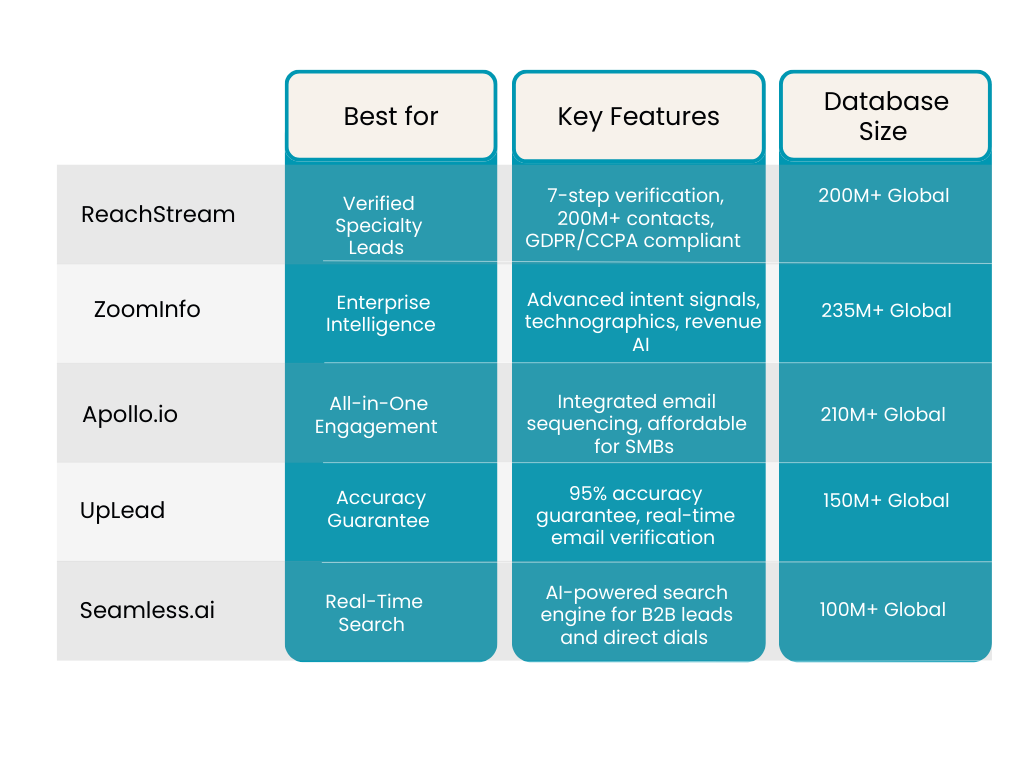
1. ReachStream

Best for: Revenue teams prioritizing data accuracy, compliance, and global coverage across all company sizes.

ReachStream has established itself as the leading provider of verified B2B contact data, focusing on accuracy and compliance rather than pure database size. The platform delivers 95% verified contact data through real-time validation and multi-source verification. 

Key strengths: 

  • Industry-leading accuracy: 95% verification rates through multi-source validation. 
  • Comprehensive compliance: GDPR, CCPA, CAN-SPAM, ACMA, and EDPS certifications. 
  • Real-time data streaming: Fresh contact data delivered directly into existing workflows. 
  • Seamless integrations: Native connections with popular CRMs. 
  • Transparent pricing: Clear costs starting with freemium plans and no hidden fees. 

ReachStream differentiates itself through its commitment to ethical data practices and regulatory compliance. The platform actively notifies data subjects about processing activities and maintains transparent data-collection practices, unlike less-regulated competitors. 

The company’s sales streaming approach delivers verified contact data in real-time rather than relying on static exports that quickly become outdated. This methodology ensures teams always work with the most current information available. 

  • Performance impact: Teams using ReachStream report 40% faster prospecting workflows and 2× higher meeting conversion rates. Companies across the healthcare, SaaS, and tech sectors have seen dramatic increases in open rates and lower bounce rates after implementing ReachStream’s verified data. 
  • Ideal for: Organizations requiring accurate data with strong compliance standards, sales teams focused on quality over quantity, and revenue operations managing data across multiple platforms. 

Build a Precise B2B Target List

Filter by job title, seniority, industry, and more to shape a list tailored to your ICP.

2. ZoomInfo

Best for: Large enterprises requiring massive database coverage despite accuracy concerns. 

ZoomInfo provides access to one of the largest B2B databases available, with over 260 million contacts and comprehensive company information. The platform excels at supporting large-scale prospecting efforts and complex account-based marketing campaigns through sophisticated filtering capabilities. 

Key capabilities: Massive database, AI-powered insights, behavioral intent data, and sales engagement features. 

Limitations: Pricing starts high with frequent complaints about hidden costs, auto-renewals, and data accuracy issues, especially internationally. 

3. Apollo.io

Best for: Small businesses prioritizing database size over data quality. 

Apollo.io offers access to a large B2B database with over 210 million contacts, combining this with integrated sales engagement and pipeline management tools. Its platform is popular among small- to midsize companies seeking an all-in-one prospecting and outreach solution. 

Key capabilities: Large, diverse contact database, sales automation features, AI-powered sales assistants, and a generous free tier providing 100 monthly credits. 

Significant limitations: Users report frequent data accuracy issues, especially with LinkedIn-derived email addresses, resulting in bounces and spam. Intent data reliability is inconsistent. Integration options are less advanced than those of enterprise-grade providers. Pricing and credit systems can be complex and expensive at scale. 

4. D&B Hoovers

Best for: Enterprise organizations requiring comprehensive business intelligence. 

D&B Hoovers delivers extensive business data, including financials, credit risk analytics, organizational charts, and business relationships. It is designed for companies needing in-depth market research and strategic account planning. 

Key capabilities: Rich company profiles with global coverage, detailed financial and risk assessments, and powerful organizational mapping tools. 

Significant limitations: Premium pricing with a steep learning curve. Contact data accuracy varies, and the platform is less suitable for high-volume prospecting. More focused on strategic insights than rapid lead generation. 

5. Leadfeeder (Dealfront)

Best for: Companies combining website visitor identification with outbound prospecting. 

Leadfeeder focuses on identifying companies visiting your website and provides contact details for key decision-makers within those companies. It merges inbound visitor intent data with outbound lead generation. 

Key capabilities: Real-time visitor identification, behavioral tracking, audience segmentation with over 15 filters, intent signal integration, and seamless CRM syncs. 

Significant limitations: Visitor identification rate is low (around 10%). It does not provide person-level contact identification, requiring manual follow-up research. High pricing, especially for high-traffic sites. Limited free tier and mixed customer support experiences. 

How to choose the right B2B database provider

Data quality over data quantity

Data accuracy should be your top priority when choosing a B2B database provider. The real cost of bad data goes way beyond the subscription fee—it hurts sales morale, reduces productivity, and damages brand reputation through email deliverability. 

Verify compliance certifications

Look for providers with demonstrated certifications, such as GDPR, CCPA, and CAN-SPAM. Transparent data practices and audit capabilities ensure you stay on the right side of regulations.

Prioritize integration capabilities

Ensure seamless native integrations with your CRM and sales tools. Look for opportunities to improve API access and automate workflows. 

Analyze total cost and pricing transparency.

Beware of hidden costs, credit-based systems, and complex contracts. Transparent pricing and scalable plans offer the best long-term ROI. 

Test Data Quality Before You Decide

Validate deliverability, segmentation depth, and accuracy—no commitment, no credit card.

Implementation best practices for maximum database ROI

  • Define your target markets and contact criteria clearly. 
  • Monitor data quality continuously and track bounce rates and conversions. 
  • Align database use with marketing automation and sales enablement. 
  • Keep compliance monitoring active and maintain audit trails. 

FAQs

1. What makes a B2B database provider effective in 2026?

An effective provider delivers 95% accurate, verified contacts with real-time updates, strong compliance, and seamless integration into sales workflows.

Providers that balance data accuracy, transparent pricing, and reliable customer support, like ReachStream, offer the best ROI for small businesses.

Database providers focus on accurate contact data, while prospecting tools add engagement features like email automation and multi-channel outreach.

One comprehensive provider ensures data consistency and ease of use; multiple providers may broaden coverage but increase integration complexity.

Budget varies from $29/month for small teams to $15,000+ annually for enterprises, depending on data volume and feature requirements.

Track email bounce rates, phone validity, conversion and response rates, and overall sales pipeline impact to measure provider effectiveness.

Common errors include prioritizing size over accuracy, ignoring compliance, focusing solely on price, and neglecting integration capabilities.

Contact data should be updated in real-time or continuously to maintain high accuracy and maximize outreach effectiveness.

Providers like ReachStream offer strong global coverage and compliance.

Table of Contents
I Pavan

Author

I Pavan
I PavanAuthor

Access 200M+ verified business emails and grow your sales pipeline effortlessly.

Claim Your 100 Free Export Credits Today!

Power Your Sales with Targeted Data
I Pavan
I PavanAuthor

Don't forget to share this post!

Check out our other blogs!