

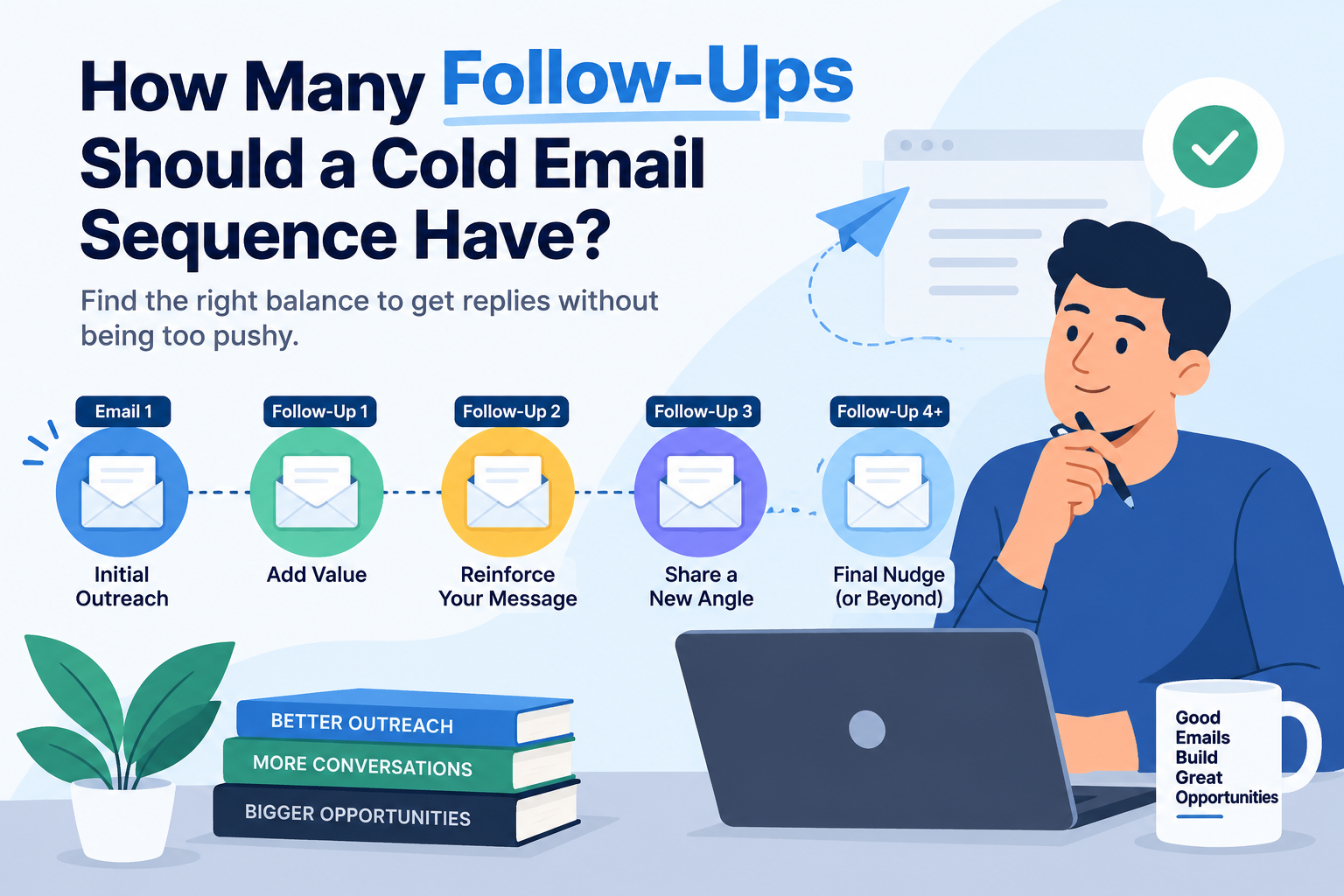

- Most cold email follow-up sequences work best with 3 to 5 total emails, including your first message and 2 to 4 follow-ups.
- Reply rates compound with every follow-up. A single email averages around 4 to 5% replies, while a full sequence can push cumulative replies above 20%.
- Space your first follow-up 2 to 4 business days after the initial email, then widen the gap to 5 or more days as the sequence continues.
- Every follow-up should add a new angle or a piece of value. Never send a follow-up that just says you're checking in.
- Sending too many follow-ups too fast raises spam complaints and hurts your sender reputation and email deliverability.
- Around 80% of B2B leads need five or more touchpoints before they reply, so stopping after one email leaves replies on the table.
- Close the loop with a short breakup email if there is still no response, then move the lead to another channel.
How Many Follow-Ups Should You Send?
What Counts as a Cold Email Sequence?
Why Follow-Ups Get More Replies Than a Single Email
How Many Days Should You Wait Between Follow-Ups?
What Should Each Follow-Up Say?
A well-built cold email follow-up strategy follows a simple arc: Initial Outreach, Add Value, Reinforce Your Message, Share a New Angle, and a Final Nudge. Each step gives the prospect a new reason to reply instead of repeating the same ask. Whichever arc you follow, the goal is the same: add value in every touch instead of just checking in.
Keep it short and sweet. Aim for under 120 words per follow-up, reference the earlier email briefly, and end with one simple, answerable question rather than a long pitch.
When Should You Stop Sending Follow-Ups?
Knowing when to send follow-up email touches is only half the job; knowing when to stop is what protects deliverability long term. Stop the moment a prospect explicitly declines or asks you to stop. Otherwise, most cold email follow-up strategies call for a final breakup email once you hit your planned number of touches, typically somewhere between 3 and 9.
Other good stopping signals: the follow-ups have run out of new information to add, the account fit turns out to be weak, or several well-written follow-ups have gotten no response at all. Before writing a prospect off completely, consider folding in multichannel outreach, a LinkedIn message or a phone call, rather than sending a sixth email into the void.
Short Sequence vs Long Sequence: Which Wins?
A short follow-up sequence of 1 to 2 touches is lower risk and fine for warm referrals or a handful of high-value target accounts, but it leaves replies on the table for cold, unfamiliar lists.
A longer sequence of 6 to 9 follow-ups earns more replies in aggregate, but it needs a warmed-up sending domain, tight list hygiene, and active monitoring of spam complaints and sender reputation. For most B2B outbound prospecting, a balanced 3 to 5 email sequence hits the sweet spot. Getting your email cadence for sales right at this stage saves you from re-testing sequence length later.
| Sequence style | Best for | Number of follow-ups | Total sequence length | Deliverability risk |
|---|---|---|---|---|
|
Minimal sequence |
Warm referrals and high-value target accounts |
1 to 2 follow-ups |
5 to 10 days |
Low, but leaves replies on the table |
|
Balanced sequence |
Most B2B outbound prospecting |
3 to 5 follow-ups |
10 to 20 days |
Low to moderate with proper spacing |
|
Persistent sequence |
High-volume outbound with strong list hygiene |
6 to 9 follow-ups |
20 to 25 days |
Higher, needs active warmup and monitoring |
How to Build a Cold Email Follow-Up Sequence, Step by Step
These are the core cold email sequence steps most B2B teams follow:
- Pick your sequence length first: Decide on 3 to 5 emails for most outbound, or up to 8 to 9 for high-volume prospecting, before you write a single line.
- Write the initial email around one clear CTA: Do not cram multiple asks into the first message.
- Space follow-ups 2 to 4 business days apart early on: Widen the gap to 5 or more days as the sequence continues.
- Add a new angle in every follow-up: A case study, a relevant stat, or a different pain point- never just “checking in.”
- Set a breakup email and a stop rule: Decide in advance what happens after the final touch, whether that is closing the loop or switching to another channel.
Most teams run this cadence through sales automation or email sequence software rather than tracking a follow-up email sequence for B2B accounts by hand.
Cold Email Follow-Up Templates You Can Steal
According to lemlist’s analysis of outbound campaigns, first cold emails capture roughly 41% of total replies, while the remaining 59% come from the follow-ups sent afterward. Most cold email follow-ups fall into two camps: added value follow-ups that offer something new each time, such as a stat, a case study, or a short video, and reminder follow-ups that briefly recap the earlier message and pull the thread back to the top of the inbox.
Here are five cold email follow-up examples you can adapt for your own sequence.
Subject: Same as the first email
“Hi [First Name], wanted to bump this back to the top of your inbox in case it got buried. [One new detail relevant to their role or company]. Worth a quick look?”
Subject: Following up: [original subject line]
“Hi [First Name], quick recap in case this slipped by: [one-line summary of the original ask]. Still relevant on your end, or should I check back later in the quarter?”
Subject: Quick idea for [their initiative or quarter]
“Hi [First Name], following up on my note about [specific pain point]. Thought this might help either way: [a link to a short case study, benchmark, or resource relevant to their role].”
Subject: Pointing me in the right direction?
“Hi [First Name], apologies if this landed in the wrong inbox. If someone else on your team owns [specific area, such as outbound sales or list building], any chance you could point me their way?”
Subject: Gone but not forgotten
“Hi [First Name], I understand the timing isn’t right, or this isn’t a priority for [their team] right now. I’ll step back for now. If anything changes, my inbox is always open.”
A couple of things to avoid across all five: skip guilt-trip lines like ‘Clearly you ignored my first message,’ keep 2 to 5 days between sends, and use images sparingly, since they can trigger spam filters on a cold domain.
Keep follow-ups short and sweet, under 120 words is ideal, and close with one simple, answerable question instead of a long pitch.
Common Cold Email Follow-Up Mistakes to Avoid
- Sending too many follow-ups too fast: Piling on touches within a day or two of each other reads as spam and increases spam complaints; spacing sends out properly helps you avoid being marked as spam.
- Using “just checking in” language: It adds no value and signals you have nothing new to say.
- Skipping email warmup on a new domain: A cold sending domain running a heavy follow-up cadence trips spam filters fast.
- Ignoring reply and bounce signals: Continuing to email a bounced address or a prospect who replied “not interested” damages your sender reputation for no upside.
- Never testing send times or subject lines: A/B testing subject lines and send times is one of the easiest ways to lift your open rate and reply rate across a sequence.
How ReachStream Prospect Supports Better Cold Outreach
ReachStream Prospect feeds your cold email sequence with verified contact and company data, helping your first email land in the inbox instead of bouncing before your follow-ups even start.
Search filters for industry, company size, and seniority- along with firmographic and technographic data-make it easier to build a list your follow-up cadence is actually worth running against. Cleaner data going in generally means fewer wasted touches later in the sequence. For B2B outreach teams, stronger lead engagement usually starts with who you’re emailing in the first place.
Conclusion
Most cold email sequences should run 3 to 5 total emails, spaced 2 to 5 business days apart, with room to extend to 8 or 9 touches for high-volume outbound prospecting. Every follow-up should earn its place by adding something new, and every sequence should end with a clear breakup email.
Get the cadence right and you maximize your reply rate without hurting deliverability. Get it wrong, whether by stopping after one email or hammering a list with ten touches in a week, and you either leave money on the table or land in the spam folder by accident.
Frequently Asked Questions
1. How many follow-ups should a cold email sequence have?
Most cold email sequences work best with 3 to 5 total emails, including the first message and 2 to 4 follow-ups. High-volume outbound can extend to 8 or 9 touches before reply rates plateau, and going beyond that mostly generates spam complaints.
2. How many days between cold email follow-ups?
How often to follow up in cold email outreach matters as much as what you say. Wait 2 to 4 business days before the first follow-up, then widen the gap to 4 to 5 days for the next touches and 5 or more days after that. A full sequence typically runs 10 to 25 days from first send to last.
3. What should a cold email follow-up say?
Each follow-up should introduce a new angle, such as a relevant statistic, case study, or distinct pain point, rather than repeating the same ask. Keep it under 120 words and end with one simple, answerable question.
4. When should you stop following up on a cold email?
Stop immediately if a prospect declines or asks you to stop. Otherwise, send a final breakup email once you reach your planned number of touches, or if several well-written follow-ups receive no response at all.
5. Do more follow-ups always mean a higher reply rate?
No. Reply rates compound with each follow-up, but the benefit plateaus after roughly 8 to 9 touches. Beyond that point, extra follow-ups mostly increase spam complaints instead of generating replies.
6. What is a breakup email in a sequence?
A breakup email is the final message in a follow-up sequence, sent when there has been no response. It closes the loop politely, often by saying you will stop reaching out, which sometimes prompts a reply on its own.
7. How many touchpoints get a B2B reply?
Roughly 80% of B2B leads need five or more touchpoints before they convert, and about 60% of B2B prospects say no four times before saying yes. Despite this, most conversions still happen after the first or second follow-up.
8. Can too many follow-ups hurt email deliverability?
Yes. Sending too many follow-ups too quickly increases spam complaints, which damages sender reputation and email deliverability for every future campaign from that domain, not just the current sequence.
9. Does cadence differ for enterprise vs SMB?
Generally, yes. Enterprise deals often justify a longer sequence with wider spacing between touches to match longer buying cycles, whereas SMB prospects usually respond faster and can work with a shorter, tighter cadence
A single cold email averages roughly a 4% to 5% reply rate. A full cold outreach sequence of 8 to 10 touches can push the cumulative reply rate above 20%, consistent with published cold email response rate benchmarks.
Around 80% of leads need at least five touchpoints to convert, yet most conversions happen after the first or second follow-up. Separately, roughly 60% of B2B prospects say no four times before they say yes, and while most reps quit after one attempt.

Author

Access 200M+ verified business emails and grow your sales pipeline effortlessly.
Don't forget to share this post!















Check out our other blogs!
Email Verification Tools: 15 Ways to Check Business Emails
B2B Data Providers: How to Compare Contact Data Platforms
CRM Data Enrichment: How to Improve Incomplete Contact Records
How to Know Your Sales Team Needs a Better Contact Database