


> Sales
How to Evaluate B2B Data Vendors for Accuracy and Compliance

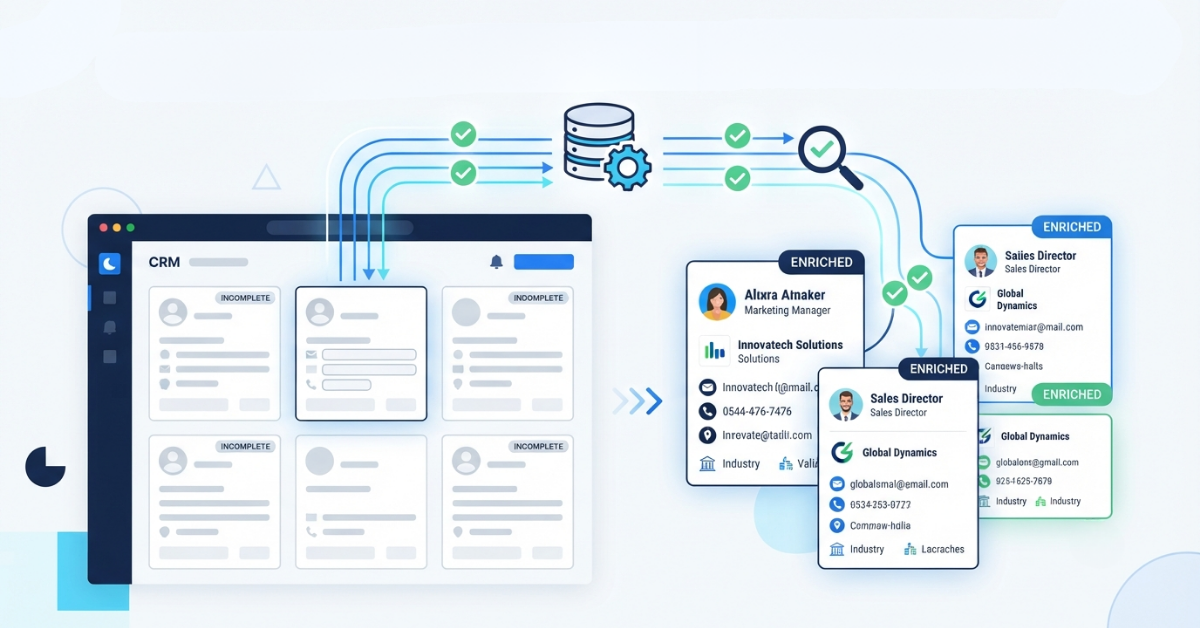
A CRM record can look useful at first glance: a name, an email address, and a company. Then a sales rep opens it and finds no job title, an old phone number, and a company website that no longer works. Marketing has trouble segmenting the contact, sales spends time searching for basic details, and reporting becomes less dependable.
Records lose quality for ordinary reasons. People change roles, companies update their information, leads submit short forms, and teams enter details by hand. CRM data enrichment gives revenue teams a practical way to fill those gaps, verify key fields, and add context to existing records.
This guide explains how enrichment works, what it can add, and how to compare tools and services before bringing them into your CRM workflow
CRM data enrichment is the process of adding, updating, and verifying information in an existing CRM record. It uses approved data sources to improve contact information, company data, and other fields that help sales and marketing teams understand an account.
An enrichment process might add a person’s job title, seniority, department, business phone number, company size, industry, location, or technology details. For campaign planning, targeted marketing teams can use these fields to build more relevant audiences. It can also correct an outdated company domain or flag an email address that should not be used.
Enrichment differs from creating new CRM records. The goal is to improve records you already have, rather than simply increasing the number of names in the database. A larger database is not automatically a better database.
Data quality usually declines through small changes rather than one dramatic error. Common causes include:
The result is familiar to sales operations teams: reps spend time researching records before they can have a useful conversation, and marketing lists need extra manual work before a campaign can be launched.
The right fields depend on your sales process. A company selling enterprise software may need employee count, revenue range, technology use, and seniority. A local services firm may care more about location, company type, and a usable phone number.
Data category | Examples | Why it helps |
Contact identity | Full name, preferred name | Prevents confusion and improves personalization |
Role details | Job title, job level, department | Supports lead scoring and routing |
Company details | Name, website, industry, employee count, revenue range | Helps teams assess account fit |
Location | City, state, country, office location | Supports territory planning and regional campaigns |
Contact information | Business email, phone number, professional profile | Gives sales a better way to connect and verify identity |
Technology data | Tools or platforms used, where available | Helps reps tailor a relevant business case |
Account attributes | Parent company, subsidiaries, growth signals | Improves account planning and prioritization |
Enrichment can improve a record, but it does not make every field certain. A provider may have strong coverage for company information and limited coverage for direct phone numbers in a particular region. Treat verification status, source, and last-updated date as useful parts of the record.
A sound enrichment workflow has eight practical stages. Teams that need a deeper review of email and contact checks can also consult this guide to data verification.
Enrichment, validation, and data cleansing are related but distinct. Enrichment adds context. Validation checks whether a value follows rules or appears usable. Data cleansing corrects formats, removes defects, and handles duplicates. A good CRM program uses all three.
The value appears in daily work, not in the number of fields added to a profile.
Consider a cybersecurity vendor with 8,000 CRM contacts. If job titles and company sizes are missing from a large part of the database, the marketing team cannot build a reliable campaign for IT leaders at mid-sized firms. Enriching those fields can make the audience possible to define, while email verification helps reduce unusable addresses before a campaign is sent.
These processes work together. A form creates a lead, lead enrichment adds context, qualification determines its fit, and account enrichment gives the sales team a clearer view of the organization. A broader CRM prospecting workflow can then keep new and existing records connected. Later, contact enrichment keeps the profile current.
CRM data enrichment tools are software products that find, append, verify, standardize, or synchronize information connected to CRM records. They reduce the need for a rep or operations analyst to research each profile manually.
Common capabilities include:
A CRM data enrichment tool should fit the way your team works. Before comparing individual enrichment tools, map the fields, triggers, and handoffs your team already uses. A small sales team may need a simple lookup and CSV workflow. A RevOps group may need API access, field-level rules, scheduled updates, and controls for duplicate handling.
Manual research still has a place. A rep may review a strategic account personally, or an analyst may verify a senior executive before an important meeting. For a large contact database, however, software is usually easier to repeat and measure. This matters especially when teams are building and maintaining prospect lists at a regular cadence.
Factor | Manual enrichment | CRM data enrichment software |
Speed | Slow for large record sets | Faster for batch and rule-based work |
Scalability | Limited by staff hours | Handles larger volumes with the right plan |
Data consistency | Varies by researcher | Uses shared rules and field formats |
Team effort | Requires repeated research | Reduces routine lookup work |
Automation | Low unless supported by scripts | Supports workflows, integrations, or APIs |
Best use case | Strategic accounts and edge cases | Routine enrichment across a database |
The practical choice is often a combination: automate routine work, then have a person review high-value or ambiguous records.
Use this checklist when comparing CRM data enrichment providers:
The right CRM data enrichment platform depends on database size, CRM, target market, workflow, and the fields that matter to your team. Comparing B2B platforms can help clarify differences in coverage, integrations, and pricing models. Run a sample before selecting a provider for a broad project.
There is no single schedule for every business. New leads may need enrichment as soon as they enter the CRM. Active prospects and high-value accounts deserve refreshes when a role, company, or opportunity changes. Older records can be reviewed quarterly, twice a year, or according to their value and risk.
Three patterns are common:
A blended approach is usually practical. Apply fast checks to new leads, use event triggers for active accounts, and schedule broader maintenance for the rest of the database.
Compare CRM data enrichment services in a controlled sequence:
A small test can reveal regional gaps, title-matching issues, duplicate behavior, and email-status differences before a larger commitment. A side-by-side provider comparison can add context, but your own sample should guide the final decision.
Avoid enriching every available field without a clear purpose. Also avoid skipping duplicate checks, assuming an updated record will remain accurate forever, or selecting a provider based only on database size.
Other frequent problems include failing to verify important email and phone fields, overlooking CRM integration requirements, writing conflicting values over trusted information, and ignoring privacy obligations. Teams also miss an important final step: measuring the result. If enrichment does not improve routing, segmentation, reporting, or sales productivity, the workflow needs adjustment.
ReachStream describes a B2B prospecting and data-quality workflow that combines contact and company records with enrichment and verification features. Teams evaluating contact databases can use the same sample-testing approach to compare coverage. Teams can use its filters for attributes such as role, industry, company size, revenue, and location, then review or build a targeted list.
For an incomplete CRM record, a practical workflow could look like this: identify the person or company, add available contact and company details, verify the business email, and export or sync the resulting record through the supported workflow. ReachStream also describes bulk CSV verification, a Chrome extension for prospect research on LinkedIn, and API capabilities for retrieval, enrichment, asynchronous processing, and webhook-based workflows. Confirm the fit of those capabilities for your CRM and use case before implementation.
The best way to evaluate the service is to test a representative sample from your own database. Compare field coverage, verification statuses, duplicate handling, and the effort required to move clean records into your CRM.
CRM data enrichment improves incomplete records by adding useful contact, company, and verification details to information you already have. For a broader explanation, see this overview of data enrichment. It helps sales teams qualify accounts, gives marketing better segmentation, and reduces time spent researching basic facts.
A strong program begins with an audit, a defined field set, clear data rules, duplicate checks, and a sample test. The right CRM data enrichment software or service depends on your CRM, market coverage, workflow, budget, and compliance needs. Keep monitoring the results because contact and company information changes over time.
If you want to evaluate a B2B enrichment workflow, test ReachStream with a small sample before expanding it across your database.
Access 400M+ verified business emails and grow your sales pipeline effortlessly.
CRM data enrichment adds, updates, and verifies contact or company information in existing CRM records. It can include job titles, company size, industry, phone numbers, business emails, and other fields that support sales and marketing decisions.
A tool matches a CRM record with available data sources, verifies the match, adds approved fields, standardizes values, checks duplicates, and syncs the result back to the CRM. Teams should review ambiguous or high-value records.
Contact enrichment may add a full name, job title, seniority, department, business email, phone number, location, professional profile details, and related company information where available.
They are software products that append, verify, standardize, and synchronize information connected to CRM records. Features often include bulk processing, contact lookup, company enrichment, email verification, integrations, APIs, and duplicate detection.
New leads may be enriched immediately, while active or high-value accounts may need event-based updates. Older records can follow a periodic schedule based on account value, market change, and data risk.
Test a sample from your own database. Compare coverage, verification detail, CRM integration, duplicate handling, refresh practices, compliance documentation, support, and total cost per usable record.
It can be worthwhile when incomplete records slow qualification, segmentation, reporting, or sales research. Measure the effect on those workflows instead of judging the project by the number of fields added.

Author
Marketing professional with a Master’s degree in Marketing, specializing in SEO, content strategy, social media, performance marketing, prospecting, and demand generation.
Access 400M+ verified business emails and grow your sales pipeline effortlessly.
Don't forget to share this post!















Check out our other blogs!
Email Verification Tools: 15 Ways to Check Business Emails
B2B Data Providers: How to Compare Contact Data Platforms
CRM Data Enrichment: How to Improve Incomplete Contact Records
How to Know Your Sales Team Needs a Better Contact Database