

Skip the filters to search leads. Use AI Search to find prospects instantly.
Lifetime access to 200 email views and 100 export credits every single month
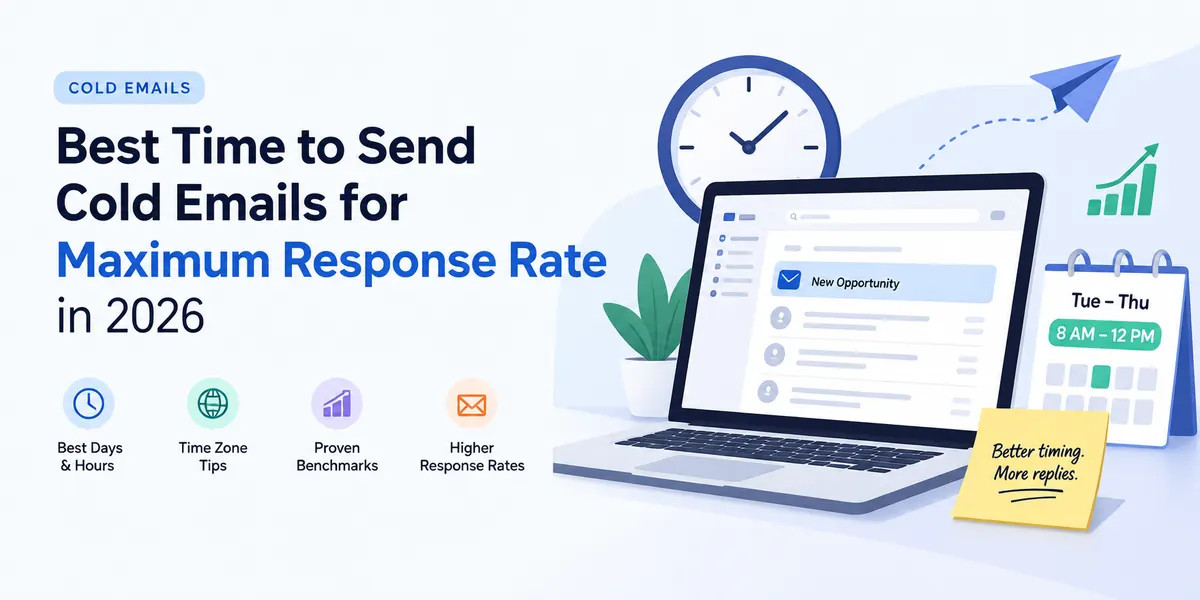
Best Time to Send Cold Emails for Maximum Response Rate in 2026
Written by:
Junaid Hussain Khan

Best Time to Send Cold Emails for Maximum Response Rate in 2026

How to Evaluate B2B Data Vendors for Accuracy and Compliance

TL;DR

What Is the Best Time to Send Cold Emails?

The best day of the week to send cold emails is generally midweek, with Tuesday through Thursday being a strong starting point. When you send cold emails, aim for 8 AM to 12 PM in the recipient’s local time zone.
 
Belkins discovered that Wednesday and Thursday produce the highest reply rate (0.48%), and the 8 AM to 12 PM slot outperforms all other time slots with a rate of 0.54%. It should be regarded as a preliminary test period, not as a guaranteed best time.
 
What about offering a guarantee? Because timing acts as a multiplier, not a magic trick; an email that is well-timed but sent to the wrong person from a domain having a poor sender reputation still achieves nothing. It is only with the correct send time that good targeting, reliable deliverability, and relevant copy are amplified.
 
The guide explains the findings from the 2026 data regarding days, hours, and time zones, tells you which metrics you should trust, and shows you how to carry out an A/B test on your own cold email timing strategy. If you’re new to outbound emailing, begin by reading our full beginner’s guide to cold email outreach and then return to this page to adjust your sending time.

What Does the 2026 Data Say About Cold Email Send Time?

The 2026 data points to Tuesday through Thursday mornings as the strongest starting point for cold email campaigns. Belkins’ analysis of 7.5M+ cold emails found the highest response rate on Wednesday and Thursday at 0.48%, while emails sent between 8 AM and 12 PM achieved a 0.54% response rate. Instantly’s  data also shows Tuesday and Wednesday as strong days.

The takeaway is simple: there is no universal “perfect” send time. Start with 8 AM to 12 PM in the recipient’s local time zone, then test different days and hours based on your audience, industry, and response data.

What Is the Best Day of the Week to Send Cold Emails?

Cold email benchmarks 2026, Here’s what the cold email response rate benchmarks 2026 data shows, The most clear-cut insight available today regarding the best time to send cold email comes from two large datasets: Belkins’ analysis of more than 7.5 million cold emails sent in 2025 and Instantly’s 2026 cold email benchmark report. Although they differ in some details, both point towards the same conclusion.
 
The best day of the week to send email wins on Wednesday and Thursday. According to the Belkins data, Wednesday and Thursday had the highest reply rate, which was 0.48%, while Monday and Tuesday were nearly as high at 0.45% and Friday at 0.44% respectively. Saturday’s rate fell to 0.35%. Although Sunday achieved a reply rate of 0.57%, this was based on a very low volume of responses, so it should be regarded as a narrow experiment rather than a valid strategy.
 
The figure in Instant’s 2026 report shows that Tuesday and Wednesday had the highest response rates, Wednesday in particular excelling. It also suggests that Monday is a suitable day to launch new sequences and states that Friday is when the most auto-replies are received. Although the difference between Monday and Tuesday is minor, Tuesday to Thursday is the more reliable choice.

When is the best time of day to send cold emails?

Morning, according to the recipient’s local time. Belkins discovered that the period from 8 AM to 12 PM gave the highest response rate at 0.54%, while the early morning slot (from 5 AM to 8 AM) came next at 0.52%. The afternoon times (12 PM to 5 PM) dropped to 0.47%, and those sent at night and in the late evening were the lowest at 0.40%.

The gap increases as you go further down the funnel. For morning and early morning, booked meetings account for 0.4% of emails sent, compared to 0.1% for each of the other time windows. This is the figure that shows the best hours to send outbound email in terms of people acting on what is at the top of their inbox when they begin their day.

How Do You Send Cold Emails by Time Zone?

Best time to send cold emails by Time zone segmentation means dividing prospects by local time zone and scheduling each group to receive emails during its working morning; the same recommendation applies here: schedule emails around the prospect’s working day and divide multi-region campaigns by location.
 
It’s the data that determines the right time to send the message; if you don’t know where the recipient works then you can’t send it at 9 AM local time. A contact record that includes the correct city, state, or country enables your sales automation system to apply a best-practice sending window.

Should You Track Open Rate or Reply Rate?

Good fit when explaining why open rate shouldn’t be the only metric. keep an eye on the reply rate. Open rate refers to the proportion of delivered emails that are opened, and privacy features such as Apple Mail Privacy Protection and automatic image loading can increase it, so this figure doesn’t really indicate timing. Reply rate, on the other hand, is the proportion of delivered emails that receive a response, and it is a much stronger indicator of engagement.
 
Go as far as you can in this regard. The fact that people respond positively and that meetings are booked shows your sent time reaches buyers who are genuinely interested, not just those clearing their inboxes.
 
For a fuller breakdown of which numbers matter beyond reply rate, see our guide to B2B email metrics you should track.
Send at the right hour in every time zone

Find verified B2B contacts with location data, so every prospect gets your email during their own working morning.

Does Email Deliverability Matter More Than Send Time?

Yes Certainly. If your email ends up in the spam folder, then the ideal time to send it has no value. Email deliverability refers to the ability to get your message into the inbox rather than the spam folder, and this is largely determined by sender reputation, which is the trust that the mailboxes providers place in your domain based on your previous sending activity.

The sender guidelines issued by Google require that mail be authenticated using SPF, DKIM, and DMARC and that spam rates be kept under 0.10 per cent; new domains also need to undergo email warmup, which involves gradually increasing the daily volume so that spam filters can get used to your sending pattern.

According to Instant’s 2026 data, teams that had stable domain health and consistent sending patterns received 15 to 20 per cent more replies. You should first get the inbox placement right before then adjusting the timing.
Send window What the data shows Best for Watch out for Verdict
Tue to Thu, 8 AM to 12 PM local
Highest reply rate by day (0.48% Wed/Thu) and by hour (0.54%)
Default window for new cold outreach
Busy inboxes, so the subject line has to earn the open
Start here
Monday or Friday
Slightly lower replies (0.45% Mon, 0.44% Fri); Friday brings the most auto-replies
Launching sequences (Mon) and light follow-ups
Weekend backlog and out-of-office replies
Test, don’t default
Evenings and weekends
Night 0.40%, Saturday 0.35%; Sunday 0.57% on very low volume
Niche audiences, like founders who clear email on weekends
Small samples and lower meeting rates
Experiment only

How Do You A/B Test Your Cold Email Send Time?

  1. Set a baseline: Send your current sequence in the Tuesday to Thursday, 8 AM to 12 PM local window for two to three weeks and record email send time, A/B testing, reply rate, positive replies, and meetings booked.
  2. Test one variable at a time: Change only the day or only the hour. If you change copy and timing together, you won’t know which one moved the numbers.
  3. Split by time zone and segment: Compare results by region, seniority, and industry. The best time to email decision makers in finance may differ from IT or healthcare.
  4. Use big enough samples: Aim for a few hundred sends per variant before calling a winner. Small tests produce noise that looks like insight.
  5. Lock in and re-test quarterly: Adopt the winning window, then re-run the test each quarter, since buyer habits and inbox competition shift over time.

Some teams speed up this testing cycle with cold emails that work with AI.

When Should You Send Follow-Up Emails?

Send follow-up emails three to four days apart, and keep them within the same morning time frame as the initial email. According to Instantly’s 2026 data, 58% of the replies were obtained from the first email while 42% came from the follow-ups, with four to seven touchpoints being the usual optimal number. Because Wednesday has the highest engagement, it is particularly suitable for sending follow-ups.
 
Maintaining a consistent follow-up schedule matters more than choosing a single optimal time to send. Since a large number of replies are received on the second or third contact, failing to send a well-timed first email followed by further follow-ups means that leads are lost.
 
For more tactics to tighten this cadence, see how to improve cold email outreach and boost your conversion rate.

What Cold Email Timing Mistakes Should You Avoid?

  1. Sending on your time zone instead of theirs: A campaign scheduled for 9 AM in London reaches New York at 4 AM. Always schedule by recipient location.
  2. Chasing open rates: Privacy features inflate opens. Optimize for replies and meetings, or you’ll pick a send time that only looks good on a dashboard.
  3. Copying someone else’s best time without testing: Benchmarks are averages across many industries. Your audience may behave differently, so treat them as a starting hypothesis.
  4. Ignoring deliverability: No send time fixes a domain with missing authentication, no warmup, or a high spam complaint rate.
  5. Working from outdated contact data: If a prospect changed companies or cities, your timing and your message both miss. Keep records verified and current.

How Does ReachStream Help You Time Cold Emails Better?

Send time optimization only works when you know who you’re emailing and where they are. ReachStream Prospect gives sales and marketing teams verified contact and company data, including location details you can use to group prospects by time zone before a campaign goes out.

Search filters for industry, company size, seniority, and location make it easy to build segments you can A/B test, and built-in email verification keeps bounces from dragging down your sender reputation. The result is simple: the right person, a working inbox, and an email that arrives during their morning, not yours.

If cold calling is also part of your outbound mix, compare timing patterns in our cold calling benchmarks for sales development guide, or see the full B2B sales outreach guide for building the rest of your outbound strategy.

Build a time zone-ready prospect list

Pull verified decision-makers with location data and test your send windows on a real segment.

Conclusion

If you need a single answer, the best day to send cold emails is Tuesday through Thursday between 8 AM and 12 PM in the recipient’s local time. The Belkins and Instantly data both support that window, and it’s the right place to start testing.

The real edge comes from everything around the timing: clean authentication, a healthy sender reputation, accurate prospect data, and a steady follow-up cadence. Measure replies and meetings, test one variable at a time, and let your own results decide your best time to send.

Reach the right inbox at the right time

See how ReachStream Prospect combines verified contacts, location filters, and email verification in one platform.

Frequently Asked Questions

1. What is the best time to send cold emails?

Tuesday through Thursday, between 8 AM and 12 PM in the recipient’s local time zone, is the best starting window in 2026. Belkins’ analysis of 7.5 million+ cold emails found the 8 AM to 12 PM slot had the highest reply rate at 0.54%. Treat it as a test baseline and refine it with your own data.

Wednesday and Thursday tied for the highest reply rate (0.48%) in Belkins’ study of 7.5 million+ cold emails, and Instantly’s 2026 data found Wednesday performed best. Monday and Tuesday are close behind, so any midweek day is a solid default.

Tuesday usually edges out Monday. Belkins recorded a 0.45% reply rate for both days, but Instantly’s 2026 report names Tuesday and Wednesday as peak reply days. Monday works well for launching a new sequence so that follow-ups land midweek.

Always the recipient’s. An email sent at 9 AM Eastern reaches the US West Coast at 6 AM, where it gets buried under overnight mail. Segment your list by time zone so each group receives emails during its own working morning.

Not on their own. Privacy features such as Apple Mail Privacy Protection can register opens that never happened, which inflates open rates. Reply rate, positive replies, and meetings booked are far more reliable signals for judging cold email send time.

Space follow-ups roughly three to four days apart and send them in the same morning window as the first email. Instantly’s 2026 data found 42% of replies came from follow-ups, with 4 to 7 total touchpoints as the typical sweet spot.

No. If an email lands in spam, the send time is irrelevant. Google recommends SPF, DKIM, and DMARC authentication and keeping spam rates below 0.10%, so fix deliverability first and optimize timing second.

Start with a Tuesday to Thursday morning baseline, then change only one variable at a time, such as the day or the hour. Run a few hundred sends per variant, compare reply and meeting rates, and re-test each quarter as buyer habits shift.

Usually not as a default. Belkins found Saturday reply rates dropped to 0.35%, and while Sunday reached 0.57%, that figure came from very low volume. Weekend sends can work for niche audiences like founders, but test them before you scale.

Junaid Hussain Khan

Author

Junaid Hussain Khan
Junaid is Senior Manager – Brand Growth & Strategy at ReachStream, where he drives content, SEO, and growth strategy for B2B sales and marketing teams.
Share
Table of Contents

Access 200M+ verified business emails and grow your sales pipeline effortlessly.

Power Your Sales with Targeted Data
Junaid Hussain Khan
Junaid Hussain KhanAuthor
Junaid Hussain Khan is the Business Development Manager at ReachStream, adept at forging strategic partnerships and identifying new market opportunities to propel ReachStream's growth and strengthen its position in the B2B ecosystem.

Don't forget to share this post!

Check out our other blogs!