



> Best Practice
How to Evaluate B2B Data Vendors for Accuracy and Compliance

A verified B2B email database is a contact list where every address has gone through syntax, domain, and mailbox checks before it ever reaches your CRM, not just a list that was accurate on the day someone first typed it in. That distinction matters because B2B Email Data Accuracy decays fast.
People change jobs, companies merge, old addresses get recycled or shut down, and a database that was 95% accurate in January can be sitting at 80% by June without anyone touching it. This piece walks through how email verification tools actually check an address, what counts as a reasonable accuracy number, and how ReachStream’s database holds up against that bar.
Verification accuracy varies a lot by vendor and by how recently the record was checked, but most verified B2B data providers land somewhere between 90% and 98% at the point of verification. The real question isn’t the number on the sales page, it’s how fast that number decays after the check, since B2B contacts move jobs more often than consumer inboxes close.
A verified B2B email list is only as good as its last re-check. Static lists that were accurate six months ago aren’t the same thing as a database verified this week.
How email verification actually works comes down to a handful of checks run in sequence: syntax, domain, mailbox, and increasingly, a check for disposable or temporary addresses. Each step filters out a different kind of bad data before the next, more expensive, check even runs.
Email Data that fails the first check never reaches the mailbox-level test, which is why verification is usually priced per address rather than as a flat subscription. You’re paying for compute, not just a list lookup.
Syntax validation is the first and cheapest check, confirming an address is formatted the way an email address should be, correct placement of the @ symbol, no illegal characters, a possible domain structure. It catches mistakes but says nothing about whether the mailbox exists.
Domain check comes next, confirming the domain has valid MX records and can actually receive mail. SMTP email verification goes a step further and opens an actual connection to the mail server to ask, without sending anything, whether a specific mailbox would accept a message. Mailbox verification at this stage is the closest you can get to certainty without actually sending an email.
Disposable email detection flags addresses from temporary inbox services, the kind people use to grab a free trial and never check again. These rarely show up on verified B2B email databases, but they matter more on lead-gen forms than on purchased contact data.
Catch-all domains are the trickier problem. Some mail servers accept every address thrown at them, valid or not, which means a mailbox-level check can come back inconclusive even when the server is technically responding. This is one of the main reasons verification accuracy numbers differ so much between vendors, catch-all handling is inconsistent across the industry.
What is a good B2B email database accuracy rate? In practice, anything that keeps your bounce rate under 2% at send time is considered healthy, with sub-1% hard bounces viewed as the modern best practice. Industry-wide, average B2B email bounce rates sit closer to 2.48%, mostly because B2B contacts change jobs and companies restructure faster than verification cadence can keep up with on a stale list.
A list sitting in the 2% to 5% bounce range needs a pause and a re-verify. Above 5%, the data itself is the problem, not your subject lines.
Pull a random sample, not the first 100 rows, of a few hundred records and run them through a separate, independent email verification tool before you commit to a vendor. Comparing the vendor’s own claimed accuracy against an outside check is the only way to know if the number on their website means anything.
Watch what happens over the following 30 to 60 days too. A list that scores well on day one but bounces heavily three weeks later tells you more about verification cadence than the initial accuracy claim does.
A 20-person SDR team pulled a 5,000-record sample from a new data provider and ran it through zerobounce as an independent check before committing to a full export. The vendor claimed 97% accuracy, the independent check came back closer to 91%, mostly from catch-all domains the vendor’s tool had marked as valid. The team renegotiated pricing before buying the full list.
| Metric | Weak | Acceptable | Strong | What It Means |
|---|---|---|---|---|
|
Bounce Rate |
Small list of high-priority accounts |
15 to 20 minutes |
Low, does not scale past a short list |
Low, checked in real time by a person |
|
Inbox Placement |
Building lists at volume |
Seconds to minutes |
High, scales to thousands of records |
Depends entirely on provider refresh rate |
|
Verification Accuracy |
Most sales and marketing teams |
Database for volume, manual for top accounts |
Medium, scales with team size |
Mixed, varies by which method sourced the contact |
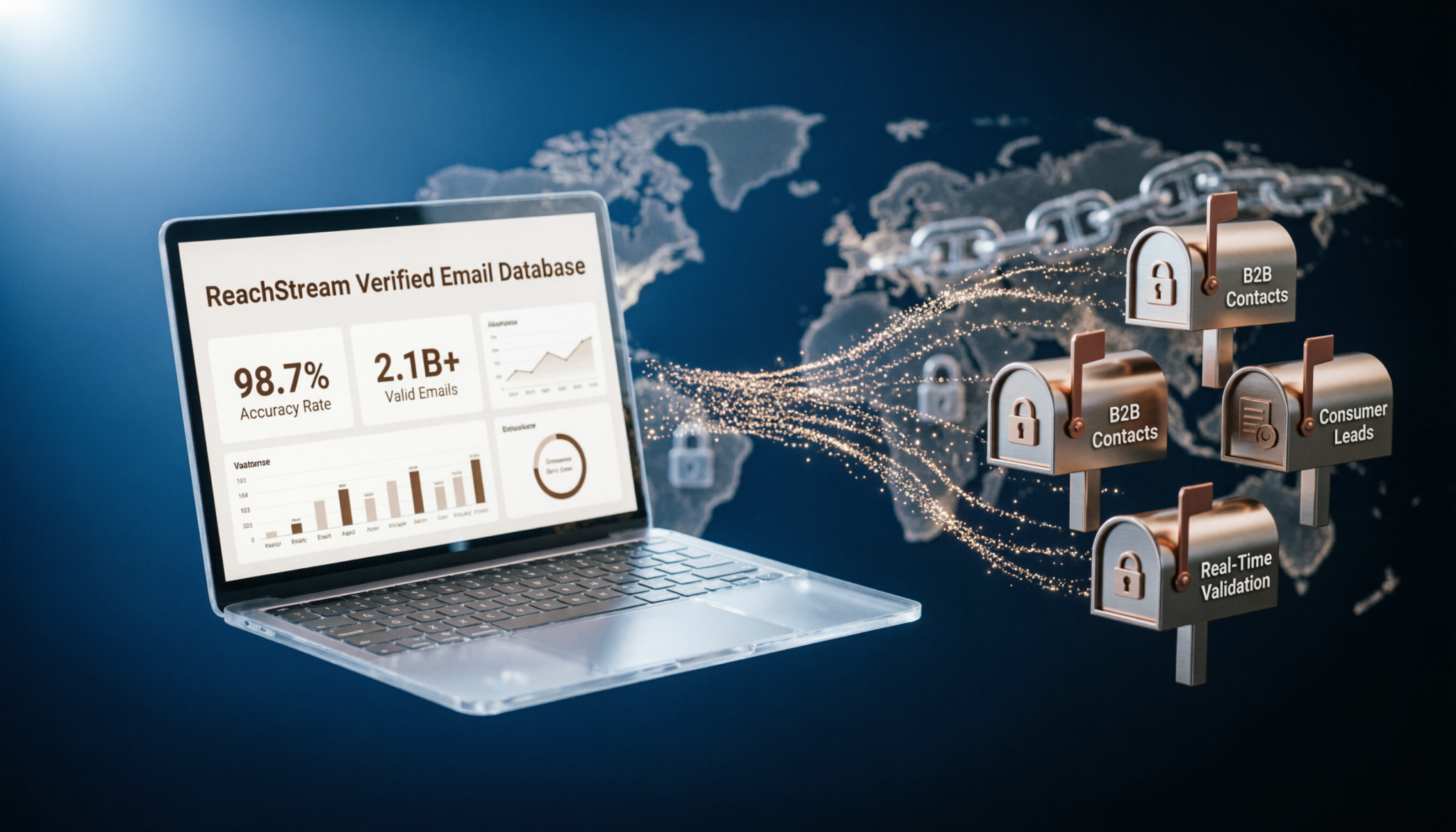
ReachStream runs every address through syntax validation, a domain check for valid MX records, and SMTP-level mailbox verification before it’s added to the database, the same sequence used across the email verification tools space, just run on ReachStream’s own contact records instead of a list a customer uploads.
Real-Time Verification happens again at export, not just when the record was first collected. A contact that was valid when ReachStream first added it but has since bounced gets caught before it reaches a customer’s CRM, which is the main difference between a one-time-verified list and a verification process that actually repeats.
ReachStream positions its contact data at 95% data accuracy, verified through the same syntax, domain, and mailbox sequence most email verification API providers use, re-checked on a schedule instead of once at collection. That’s the number to hold any specific campaign’s bounce rate against, if a send is coming in well above 2%, the issue is usually list segment or send practices, not the underlying data.
Enrichment Data layered on top, firmographic and technographic fields, doesn’t change the email accuracy number, but it does mean a verified contact also comes with enough context to personalize outreach instead of just a name and an inbox. Run that same record through a separate ReachStream email verifier check at export and the result should match, since it’s the same verification pass repeating, not a second opinion.
Most verified B2B data providers quote an accuracy number somewhere between 90% and 98%, and the honest answer is that the gap between vendors matters less than how often each one re-checks its records. A provider sitting at 93% with weekly re-verification often beats one claiming 97% that only checked the list once at collection.
B2B Contact Databases differ more in verification cadence and catch-all handling than in the headline accuracy percentage, so ask any vendor how often records get re-checked, not just what the current claimed accuracy is.
Reduce email bounce rate by treating verification as a recurring check, not a one-time gate at data collection. A record that passes every test today can be dead in three weeks if someone leaves the company, and no vendor’s initial accuracy claim accounts for that.
Email Addresses for Prospecting need a shorter verification cadence than a list sitting untouched in a CRM, since prospecting lists get pulled and used immediately, while a dormant list only needs re-checking before its next campaign.
A verified B2B email database is only as good as its last re-check, not its first one. Look past the headline accuracy percentage any provider quotes and ask about verification cadence, catch-all handling, and how they test their own claims. ReachStream verified email database runs that process on a schedule, which is the part that actually keeps a bounce rate low months after the data was first collected.
Author

Access 200M+ verified business emails and grow your sales pipeline effortlessly.
Don't forget to share this post!















Check out our other blogs!
What Is B2B Data and Why It Matters for Modern Sales Teams
A Buyer’s Checklist for Evaluating B2B Data Providers

How to Sync B2B Data with Your Outreach Sequences