




Unlimited Data.
Infinite Possibilities.
Looking for B2B data? Download Unlimited data using our Chrome extension at just $79/month.


11 Account-Based Marketing Strategies for B2B Growth That Work

Account-Based Marketing Strategies That Drive Real B2B Growth

11 Account-Based Marketing Strategies for B2B Growth That Work

Many B2B teams don’t struggle to generate leads. They struggle to focus on the right accounts. Teams often spend time, budget, and effort chasing prospects that never convert into real opportunities.

Account-based marketing strategies for B2B growth help solve this challenge. Instead of focusing on lead volume, account-based marketing for B2B helps teams target high-value accounts that are more likely to generate revenue. It brings sales and marketing together, improves targeting, and helps teams connect with the right decision-makers.

When businesses apply ABM effectively, they build stronger pipelines and long-term customer relationships.

This guide shows how ABM really works when revenue is the goal. You’ll learn how to build focus without adding complexity and apply 11 practical ABM strategies that scale across teams and accounts. The result? Moving from testing ABM to executing it with confidence and control.

What Is Account-Based Marketing?

Account-based marketing (ABM) is a B2B strategy where sales and marketing work together to target high-value accounts with strong revenue potential. Instead of focusing on lead volume, ABM prioritizes personalized outreach, relevant content, and team alignment to engage the right decision-makers faster and influence complex buying groups.

ABM doesn’t replace traditional demand generation; it complements it. While lead generation brings in potential prospects, ABM helps teams focus on the accounts that truly matter, making it easier to use time, budget, and effort more effectively while building stronger, long-term customer relationships.

Why Account-Based Marketing Works for B2B Growth?

Account-based marketing works because it connects marketing and sales efforts directly to revenue opportunities. Instead of spreading resources across large lead volumes, teams focus on accounts that are more likely to convert.

Research from the CMO shows that 76% of marketers see higher ROI from ABM than from other marketing approaches. Many companies also close larger deals and improve win rates because they engage decision-makers earlier and build stronger relationships.

ABM also helps solve common B2B challenges. It improves lead quality, supports long buying cycles, strengthens sales and marketing alignment, and makes it easier to connect marketing efforts to revenue. When teams focus on accounts instead of leads, results become easier to measure and scale.

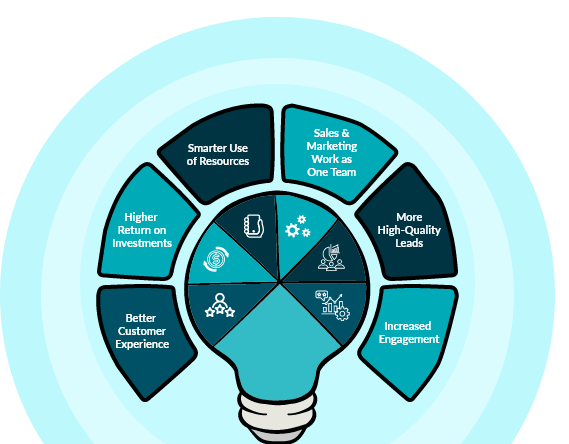
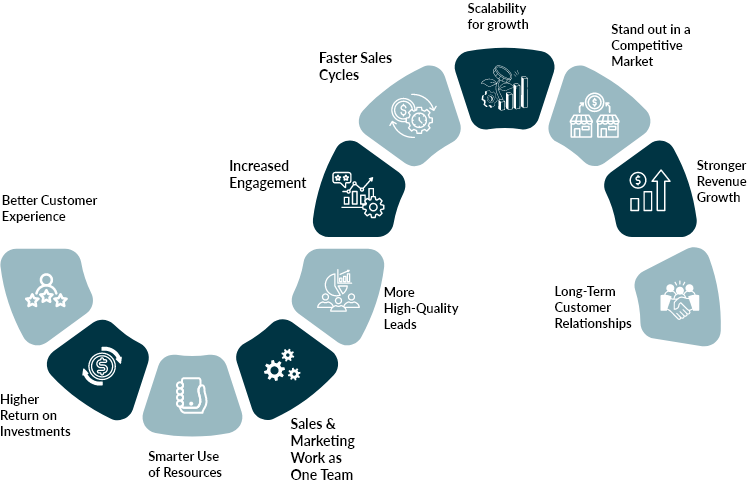
Why ABM Works: The Key to Scalable B2B Growth

How ABM Differs from Traditional B2B Marketing?

Traditional B2B marketing focuses on reaching a large audience and generating more leads. Account-based marketing focuses on engaging the right accounts and building meaningful relationships that drive revenue. Instead of tracking clicks or form fills, ABM measures how target accounts move closer to a buying decision.

Here is the key difference:

When businesses use an account-based marketing strategy, they align messaging, timing, and outreach across sales and marketing. This creates a more consistent experience for target accounts and helps build trust at every stage of the buying journey.

Laying the Groundwork for the 11 ABM Strategies

Before executing ABM, teams need clarity on three things: which accounts to target, how to measure success, and how sales and marketing will collaborate. Without this alignment, even strong ABM tactics can lose effectiveness.

When teams follow a shared plan, ABM becomes easier to scale and improve over time. Tools that support account list building, ICP development, data enrichment, and CRM integration also help streamline the process.

Platforms like ReachStream help teams find verified accounts, enrich contact and company data, and keep CRM records updated, helping outreach begin with accurate and reliable information.

Strategy 1

Define a Revenue-Aligned ABM Framework

Every successful ABM program starts with clarity.

Define how ABM supports revenue by:

Why it is important
According to Gartner, ABM programs tied directly to revenue goals are significantly more likely to scale beyond pilot stages.
When teams agree on what success looks like, leadership observes how ABM directly impacts revenue; not just awareness, it becomes easier to secure buy-in, and long-term support execution becomes faster and more consistent.
Strategy 2

Build a Prioritized Account List from Fit and Interest

Account selection is where ABM either succeeds or fails.

Start with your ideal customer profile—industry, company size, tech stack, and geography. Then layer intent and engagement signals such as content consumption, product interest, or buying activity.

Pro tip
Tools like ReachStream assist by integrating ICP filters, and data enrichment into a single workflow. This allows you to create clean, prioritized ABM lists and import them directly into your CRM; eliminating the need for manual exports or outdated data.
The result? Fewer accounts, better conversations, and higher conversion rates.
ReachStream G2 Review
Strategy 3

Map the Buying Team and Role-Based Goals

Enterprise deals are group decisions. Most B2B purchases involve 6–10 stakeholders, each with different priorities. ABM works when messaging addresses those differences directly—finance wants ROI, IT wants reliability, leadership wants strategic impact.

As one ABM practitioner quoted by The CMO puts it: “Deals stall when one voice isn’t addressed. ABM forces you to plan for every voice upfront.” Mapping buying teams reduces friction and speeds up consensus.

Strategy 4

Create Account-Level Value Propositions

Generic messaging rarely grabs attention. Strong ABM programs focus on value that speaks directly to each account or segment. Identify the problem the company wants to solve, the outcome of leadership expects, and the proof they trust.

Personalized value propositions often improve response rates, especially in outbound ABM. Keep your message clear and simple. Focus on one strong promise supported by one relevant metric or real example.

Strategy 5

Develop Personalized Content Pathways

ABM content works best when it guides buyers instead of overwhelming them. Match your content to where the account stands in the buying journey. Executives usually look for business outcomes, while technical teams want detailed clarity.

Build structured content pathways to move accounts forward. Share insights at the awareness stage, provide proof during evaluation, and deliver confidence-building content before final decisions. This approach keeps engagement relevant at every step.

“In practice, ABM teams that tailor content to the buyer’s stage consistently see stronger account engagement and longer session durations. With platforms like ReachStream, teams can leverage enriched account data and role-specific insights to deliver the right content at the right time—keeping target accounts engaged as they progress through the buying journey.”
Strategy 6

Coordinate Multi-Channel Outreach

ABM rarely succeeds on just one channel. Email, ads, sales outreach, and events should complement—rather than duplicate—each other. Consistent messaging across channels fosters familiarity and trust with buying teams.

Insight: ABM reports that multi-channel ABM programs lead to higher account engagement than single-channel efforts, especially in competitive markets.

Strategy 7

Use Buyer Signals to Prioritize Outreach

Timing plays a big role in ABM, sometimes even more than the message itself. Buyer signals like frequent visits to your pricing page, comparing solutions, or sudden spikes in account activity often indicate that a company is seriously exploring options. These signals help teams focus their efforts on accounts that are more likely to start real conversations.

When teams pair buyer signals with enriched account and contact data, outreach becomes more targeted and timelier.

Pro tip
Platforms like ReachStream help teams find verified decision-makers within target accounts. Responding to intent signals at the right moment helps teams book meetings earlier in the buying journey while keeping outreach relevant and efficient.
Build ABM campaigns on verified account data, not assumptions.
Strategy 8

Combine Programmatic Ads with Precision Targeting

ABM’s advertising isn’t about clicks; it’s about presence.

Account-level ads keep your brand visible across buying committees while the sales team engages in active conversations. The goal is reinforcement: familiar messages, consistent positioning, and steady exposure to everyone involved in the decision.

Research across B2B ABM programs shows that accounts exposed to coordinated sales outreach and targeted advertising generate higher revenue per account than those engaged through outbound methods alone.

When ads and sales touch support the same narrative, trust builds faster—and deals progress more easily.

Strategy 9

Align Sales and Marketing with Shared Playbooks

ABM fails quickly when sales and marketing have conflicting assumptions.

Shared playbooks remove that friction by outlining:

As noted by the CMO, “sales–marketing alignment is one of the most consistently cited drivers of high-ROI ABM programs.” Teams that align early not only move faster—they also save considerable effort.

Alignment isn’t a one-time sync call. It’s a documented, repeatable system that both teams follow.

Strategy 10

Measure Account-Level Impact, Not Just Leads

ABM performance cannot be judged solely by lead counts.

Meaningful ABM metrics include:

Despite ABM’s proven impact, the CMO reports that only about half of organizations regularly measure ABM ROI. That gap makes it harder to justify budgets and expand what’s effective.

When measurement is tied directly to revenue outcomes, ABM shifts from “experimental” to indispensable.

Strategy 11

Scale ABM by Repeating What Delivers Results

ABM doesn’t scale through constant reinvention—it scales through learning.

High-performing teams regularly review closed-won accounts to identify:

Those insights are then documented and reused as playbooks for similar accounts or industries. Over time, this transforms ABM into a reliable growth strategy rather than a series of isolated campaigns.

As many experienced ABM leaders put it:

“The real advantage comes when you stop guessing and start repeating what already works..”

Turning ABM into a Long-Term Growth Strategy

Account-based marketing is effective because it aligns with the way B2B buyers make purchasing decisions.

When teams target the right accounts, engage genuine decision-makers, and measure success by revenue rather than activity, growth becomes intentional instead of accidental.

ABM doesn’t require more noise; it calls for smarter choices, better data, and tighter alignment. With the right framework and support from platforms like ReachStream for account targeting and enrichment, ABM becomes easier to implement and harder to ignore.

Start focused. Measure honestly. Scale what proves itself.

That’s how ABM turns into long-term, compounding growth.

Power ABM with accurate account data to meet the right prospects with ReachStream.

FAQs

1.What is account-based marketing strategies for B2B growth?

Account-based marketing strategies for B2B growth focus on targeting high-value accounts instead of chasing large lead volumes. These strategies help sales and marketing teams align around shared target accounts, use personalized messaging, and drive stronger engagement, pipeline growth, and revenue outcomes.
Account-based marketing for B2B works because it prioritizes quality over quantity. It helps teams focus on accounts with the strongest fit and buying intent, improves relationship building, increases deal size, and shortens long B2B sales cycles.
Teams can implement account-based marketing by defining an ideal customer profile, building targeted account lists, creating personalized content, and aligning sales and marketing outreach. Tracking account engagement and pipeline impact helps improve ABM campaigns over time.
Yes. Our platform helps teams build verified account lists, enrich firmographic and contact data, and improve targeting accuracy. This helps sales and marketing teams execute account-based marketing campaigns with better personalization and stronger engagement.
Our platform offers flexible monthly credit-based plans. The free Icebreaker plan includes 200 email views and 100 export credits each month. Paid plans include Glacier with 5,000 credits, Ice Floe with 10,000 credits, and Polar Peak with 20,000 credits each month with team access, helping businesses scale ABM outreach based on their growth needs.
Table of Contents
Mohammed Younus

Author

Mohammed Younus
Mohammed YounusAuthor

Access 200M+ verified business emails and grow your sales pipeline effortlessly.

Claim Your 100 Free Export Credits Today!

Power Your Sales with Targeted Data
Mohammed Younus
Mohammed YounusAuthor
Mohammed Younus is the Senior Manager of Business Operations with a keen insight into the B2B landscape. Through his contributions to this blog, he aims to share cutting-edge tactics and insights that empower sales and marketing professionals to achieve unparalleled success.

Don't forget to share this post!

Check out our other blogs!