


How to Evaluate B2B Data Vendors for Accuracy and Compliance
Your sales team just spent a week reaching out to 500 contacts—and 200 bounced. Another 150 went to people who left their companies months ago. That’s not bad luck. That’s a low-quality B2B lead platform doing exactly what it was built to do: look impressive on paper while delivering data that wastes your time.
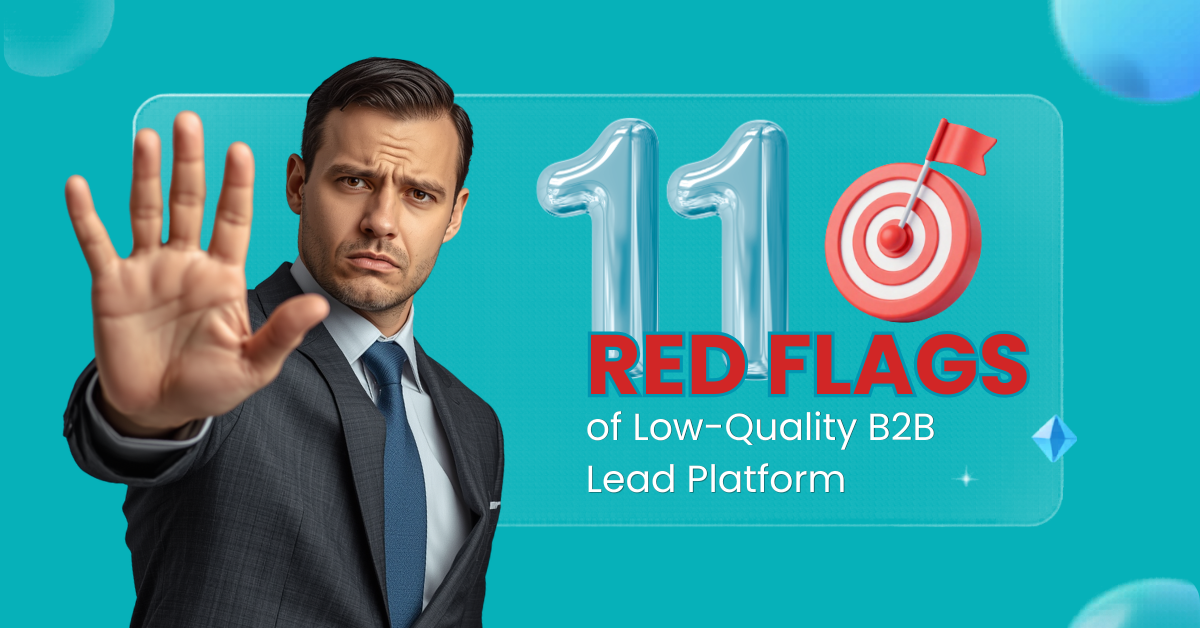
The difference between a platform that accelerates your pipeline and one that drains it often comes down to details vendors don’t advertise. This article breaks down 11 red flags that signal a B2B lead platform will hurt your outreach, plus how to evaluate vendors before you commit.
B2B lead platforms are tools designed to help businesses identify, contact, and qualify potential buyers. They streamline sales pipelines by providing accurate contact data, automating outreach, and tracking buying intent. Think of them as searchable databases packed with company details and decision-maker contact information—emails, direct dials, job titles, and company firmographics all in one place.
The best platforms generally fall into a few categories:
Here’s the thing, though. Not all B2B lead platforms deliver equal value. Some inflate database numbers without rigorous verification. Others lack the filtering capabilities you actually need to target your ideal customer profile. Understanding what separates a quality platform from a poor one can save your team significant time and budget.
Bad data costs more than you might expect. When your contact records are outdated or inaccurate, your outreach bounces, your sender reputation suffers, and your sales team wastes hours chasing leads that go nowhere.
High bounce rates don’t just hurt individual campaigns. They can land your domain on blocklists, reducing inbox placement across all your outreach. Meanwhile, your competitors with cleaner data are booking meetings while your team is stuck researching replacements for dead contacts.
The real cost shows up in missed revenue opportunities. Every hour spent on manual research or re-verifying contacts is an hour not spent having real business conversations with qualified prospects.
The following warning signs indicate a platform may hurt rather than help your prospecting efforts. If you spot several of them during your evaluation, it’s worth looking elsewhere.
Many platforms advertise massive contact counts—50 million, 100 million, even more. Yet when you ask how that data is verified, the answer is vague or nonexistent.
A quality platform can explain its verification methodology step by step. If a vendor can’t describe how they validate emails, phone numbers, and job titles, those impressive numbers likely include outdated or fabricated records. Always ask: “What is your verification process?” If the answer feels evasive, trust your instincts.
People change jobs frequently. A platform that refreshes data once a year (or less) delivers contacts who may have moved on months ago.
Ask vendors about their refresh cadence. Platforms that update records every 45 days or less help you avoid the frustration of reaching out to someone who left the company last quarter. Fresh data means fewer bounces and more conversations.
Bounce rate directly reflects data accuracy. When a platform’s contacts consistently bounce, your sender reputation takes the hit.
Look for platforms with real-time email verification built in. This way, you export lists that are ready for outreach—not lists that require additional cleaning before you can use them. A platform that verifies emails before export saves you time and protects your domain.
Firmographics include company size, revenue, and industry. Technographics reveal the technology stack a company uses—like whether they run Salesforce or HubSpot. Both are essential for precise targeting.
Platforms with limited filtering attributes force you to work with broad, untargeted lists. You end up reaching out to companies that don’t match your ideal customer profile, which lowers conversion rates and wastes outreach capacity. Look for platforms offering 20+ filterable attributes.
Generic company emails and missing phone numbers slow down outreach significantly. If you’re sending messages to info@ addresses, you’re hoping someone forwards your email to the right person. That’s not a strategy—it’s a gamble.
Quality platforms provide verified direct dials and contacts for actual decision-makers by title and role. You can reach the VP of Sales directly, not the company switchboard.
Data privacy regulations carry real consequences. Non-compliant platforms expose your organization to legal risk and potential fines.
Ask vendors for clear documentation on data sourcing and consent practices. If they can’t provide it—or seem evasive—that’s a significant red flag. Compliance documentation protects both you and your prospects.
Data is only useful if it flows into your existing tools. Platforms with limited CRM integrations or unreliable APIs create manual work and data silos.
Before committing, test integrations with your actual stack—whether Salesforce, HubSpot, or other tools. Confirm the API documentation is clear and that syncing works as advertised. A platform that doesn’t connect smoothly to your CRM creates more problems than it solves.
Modern prospecting happens on LinkedIn. Without a Chrome extension that surfaces verified contact data in real time, you’re stuck with manual research or InMail limitations.
A good extension lets you capture prospects, verify their contact details, and add them to your CRM or sequences—all without leaving LinkedIn or Sales Navigator. If a platform lacks this capability, you’re missing a major efficiency gain.
Some platforms hide costs until you sit through a sales call. Others lock you into long contracts before you’ve had a chance to evaluate data quality.
Transparent pricing and flexible plans signal a vendor confident in their product. If you can’t find pricing on their website, ask yourself why. Hidden pricing often means hidden surprises.
ICP-based targeting requires advanced filters. You want to filter by role, industry, location, company size, revenue, technographics, and more.
Platforms with basic filters deliver generic lists. Generic lists mean lower response rates and more time spent qualifying leads manually. The more precise your filters, the more relevant your outreach.
Complex platforms require good support. Slow response times, no dedicated onboarding, or limited documentation signal a vendor that won’t help you succeed.
Ask about onboarding during your evaluation. A platform that invests in your success upfront is more likely to deliver long-term value. Support quality often reflects overall product quality.
Before signing a contract, use the following steps to pressure-test any vendor’s claims. A little due diligence upfront saves a lot of frustration later.
Request a sample list and manually verify a portion. Check email deliverability, phone accuracy, and whether job titles are current. This reveals true data quality faster than any sales deck or demo.
Ask vendors to explain their verification process step by step. Look for multi-step verification combining AI and human review, plus documented refresh frequency. Platforms that refresh every 45 days or less tend to deliver more accurate records.
Test actual integrations with your existing stack. Confirm API documentation is clear and that the Chrome extension works smoothly on LinkedIn and Sales Navigator. Integration quality determines how much manual work you’ll face.
Request compliance documentation. Ask how data is sourced, whether consent is obtained, and how opt-outs are handled. A vendor who can’t answer clearly may not be worth the risk.
Compare published pricing. Ask about monthly vs. annual options, credit structures, and overage fees. Flexibility matters, especially when you’re still evaluating fit.
Now let’s flip the script. Here’s what a reliable platform actually provides—the opposite of the red flags above.
Quality platforms offer large databases with rigorous, multi-step verification combining AI and human review. ReachStream, for example, provides 200M+ contacts with stated 95% accuracy, refreshed regularly to keep records current.
Data enrichment fills in missing fields and updates changed records. Top platforms refresh records frequently and track job changes automatically, so your CRM stays current without manual effort. Enrichment turns incomplete records into actionable intelligence.
Robust filtering by role, industry, company size, revenue, location, and technographics—20+ attributes—lets you build lists that match your exact ICP. Precision targeting translates directly to higher conversion rates and less wasted outreach.
Quality platforms connect directly to your CRM, support API-based automation, and offer Chrome extensions for LinkedIn prospecting. This reduces manual work and keeps data synchronized across your tools.
Platforms like ReachStream combine verified data, continuous enrichment, advanced filters, CRM integration, and a LinkedIn Chrome extension into a single, easy-to-use B2B data platform built for revenue teams.
The right B2B lead platform accelerates prospecting, improves deliverability, and drives conversions. Use the red flags and evaluation criteria from this article to avoid costly mistakes—and to find a platform that actually delivers on its promises.
If you’re ready to see what a high-quality platform looks like, explore ReachStream’s List Builder, Data Enrichment, Chrome Extension, and Reach API.
A quality B2B lead platform typically delivers email deliverability rates around 95% or higher. Look for vendors that state accuracy benchmarks and can explain their verification methodology in detail. If they can’t give you a number, that’s a red flag.
Contact data ideally refreshes every 45 days or less. This frequency accounts for job changes and outdated information that can hurt deliverability and outreach performance. Ask vendors directly about their refresh cadence.
Free platforms can help with initial prospecting, though they typically offer limited data, fewer filters, and no verification. Scaling outreach usually requires a paid platform with higher accuracy and richer features. Some vendors offer 100 free leads monthly so you can test data quality before committing, but free tools alone won’t sustain serious pipeline building.
A B2B lead platform is software you use directly to access contact data and build lists. A lead generation agency is a service provider that handles prospecting and outreach on your behalf—often using platforms like these behind the scenes. One is a tool; the other is a service.
Marketing professional with a Master’s degree in Marketing, specializing in SEO, content strategy, social media, performance marketing, prospecting, and demand generation.
Access 200M+ verified business emails and grow your sales pipeline effortlessly.
Don't forget to share this post!















Check out our other blogs!
What Is B2B Data and Why It Matters for Modern Sales Teams
A Buyer’s Checklist for Evaluating B2B Data Providers
How to Sync B2B Data with Your Outreach Sequences