
Skip the filters to search leads. Use AI Search to find prospects instantly.
Lifetime access to 200 email views and 100 export credits every single month
How a Medical Device Company Can Reach Hospital Decision-Makers
Written by:
Manohar Devadiga

How a Medical Device Company Can Reach Hospital Decision-Makers?

How to Evaluate B2B Data Vendors for Accuracy and Compliance

TL;DR
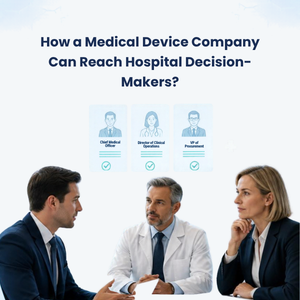
Medical device companies rarely win hospital business by contacting one person with a product pitch. Hospital purchases are usually evaluated by a group of stakeholders who care about different outcomes. A physician may focus on clinical performance. A nurse leader may consider workflow and staff adoption.
 
A procurement team may compare pricing and contract terms. An information technology team may assess interoperability and cybersecurity. Finance and executive leadership may need evidence that the purchase improves value, reduces risk, or supports strategic priorities.
 
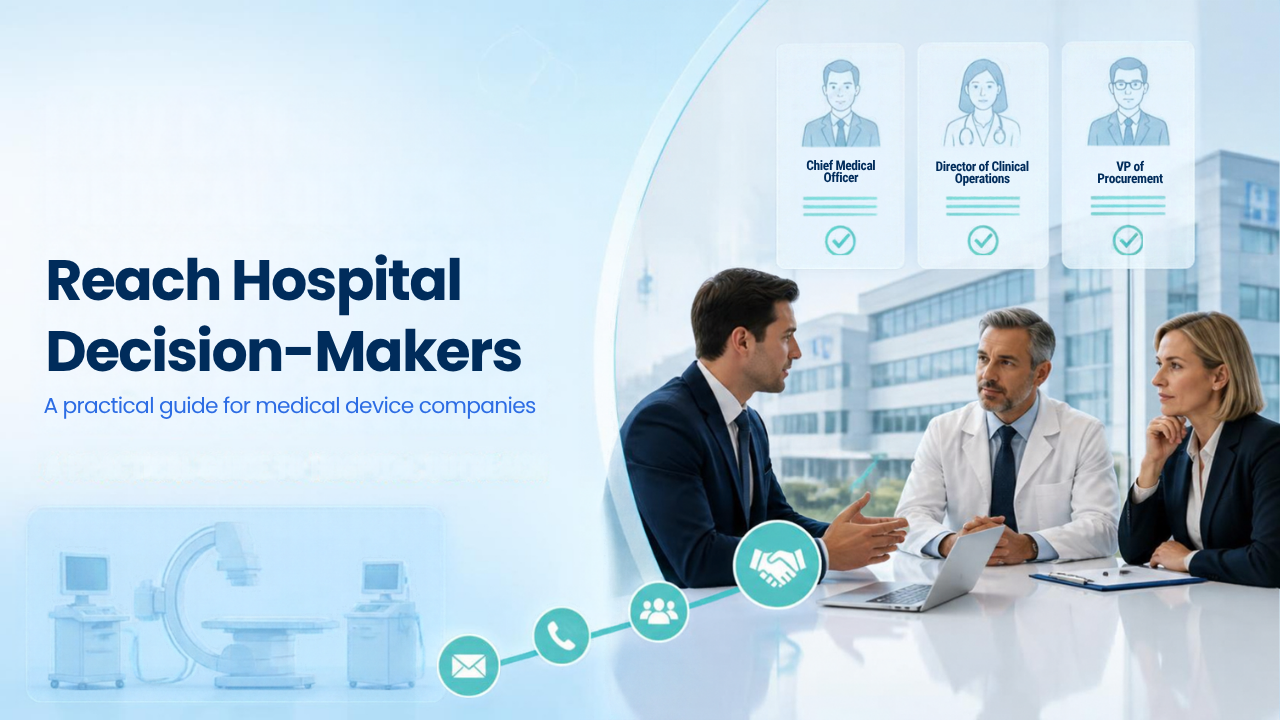
This makes hospital prospecting a stakeholder-mapping problem, not simply an email-list problem. Medical device companies need to identify the right accounts, understand the buying committee, match each message to a stakeholder’s responsibilities, and support every claim with appropriate evidence.
 
This guide explains how to reach hospital decision-makers with a focused, data-informed, and responsible business development process.

Why hospital decision-makers are difficult to reach

Hospitals are complex organizations with multiple facilities, departments, reporting lines, and purchasing processes. The person who uses a device may not approve it. The person who approves it may not control the budget. The procurement team may not evaluate clinical effectiveness, while the clinical team may not negotiate the commercial agreement.
 
A medical device sale may involve some or all of the following groups:
 
  • Physicians and clinical specialists who evaluate clinical usefulness and patient-care implications.
  • Nursing leaders who assess workflow, training, staffing, and adoption.
  • Department directors who own operational performance and service-line priorities.
  • Supply chain and procurement teams that manage sourcing, contracts, pricing, and vendors.
  • Value analysis committees that review clinical, operational, financial, and risk considerations.
  • Information technology, cybersecurity, and biomedical engineering teams that evaluate integration, security, maintenance, and technical requirements.
  • Finance and executive leaders who consider total cost, return on investment, strategic fit, and capital allocation.
 
Because each stakeholder has a different definition of value, a single generic message usually performs poorly. The first step is to understand the hospital account and then identify the people who influence the purchase.

1. Define the ideal hospital customer profile

Before building a contact list, define which hospitals and healthcare systems are most likely to need and adopt the device. This prevents sales teams from spending time on organizations that lack the relevant specialty, facility type, budget, infrastructure, or use case.
 
A medical device ideal customer profile may include:
 
  • Organization type: Academic medical center, community hospital, specialty hospital, outpatient facility, ambulatory surgery center, or integrated delivery network.
  • Clinical specialty: Cardiology, orthopedics, radiology, oncology, neurology, surgery, emergency medicine, or another relevant service line.
  • Facility size: Number of beds, procedure volume, employee range, or number of locations.
  • Geography: State, region, metro area, sales territory, or service radius.
  • Ownership model: Public, private, nonprofit, academic, or government-affiliated.
  • Technology environment: Relevant clinical systems, imaging platforms, equipment, or integration requirements.
  • Growth indicators: New facilities, service-line expansion, acquisitions, hiring activity, or technology investments.
  • Commercial fit: Contract timing, purchasing model, distributor relationships, and ability to support the product.
 
For example, a surgical device company may prioritize hospitals with a strong orthopedic service line, active operating rooms, relevant surgeons, and a procurement process that supports new vendor evaluation. A remote-monitoring company may prioritize hospitals with virtual-care programs, digital-health leadership, and technical infrastructure that supports connected devices. That kind of focused helps teams define the market before they begin outreach.

2. Segment hospitals by use case, not just industry

“Healthcare” is too broad to be a useful segment on its own. A targeted medical device campaign should combine healthcare classification with a specific use case.
 
Useful segmentation dimensions include:
 
Segmentation dimension
Example values
Why it matters
Facility type
Hospital, outpatient center, specialty clinic
Indicates the care environment and buying process
Clinical specialty
Orthopedics, cardiology, radiology
Connects the device to a relevant service line
Facility size
Small, mid-sized, enterprise
Helps estimate complexity, budget, and sales cycle
Geography
State, metro area, territory
Supports field coverage and local outreach
Stakeholder function
Clinical, procurement, IT, finance
Determines message and next action
Account stage
Target, engaged, opportunity, customer
Prevents inconsistent outreach
Buying signal
Expansion, hiring, technology investment
Helps prioritize timing
 
The goal is to create segments that change the message or the sales action. If two segments receive the same message and follow-up, the distinction may not be useful. The audience-first approach used in effective follows the same principle: define the audience, offer, channel, and desired action before launching outreach.

3. Map the hospital buying committee

Once target accounts are selected, map the people who may influence the purchase. Do not assume that the chief executive or department head is the only relevant contact. A strong account map shows how clinical, operational, technical, financial, and procurement stakeholders connect.

Clinical decision-makers

Clinical leaders assess whether the device solves a real care-delivery problem. Depending on the product, this group may include physicians, surgeons, medical directors, department chiefs, nurse practitioners, clinical educators, and service-line leaders.
 
Clinical outreach should focus on intended use, workflow fit, evidence, training requirements, safety considerations, and the patient-care problem the product is designed to address. It should not rely on unsupported superiority claims or vague statements about improved outcomes.

Nursing and operational leaders

Nursing executives, nurse managers, department directors, and clinical operations leaders often understand the practical impact of a new device better than anyone else. They may evaluate training time, staffing requirements, workflow disruption, adoption barriers, and standardization across units.
 
For devices used by nursing teams, a message that discusses implementation and staff efficiency may be more relevant than a message focused only on technical specifications. A focused is one example of how role-specific targeting can help medical device companies reach senior nursing stakeholders with greater precision.

Procurement and supply chain leaders

Procurement professionals care about approved-vendor status, contract terms, pricing, product standardization, supply continuity, service levels, and purchasing policies. They may also coordinate the formal process for product review and negotiation.
 
A procurement message should make it easy to understand the product category, purchasing model, implementation requirements, support structure, and next step. It should not expect procurement to evaluate clinical details without the appropriate clinical materials.

Value analysis and finance stakeholders

Value analysis committees and finance stakeholders often examine the total value of a proposed device.
 
Their questions may include:
 
  • What problem does the device solve?
  • What evidence supports the proposed use?
  • How will the device affect workflow, staffing, supplies, and training?
  • What is the total cost of ownership?
  • Does the product replace an existing cost or add a new cost?
  • What risks, implementation requirements, or contractual obligations apply?
  • Can the hospital measure the expected benefit?
 
Medical device companies should prepare a value narrative that combines clinical evidence, operational impact, financial assumptions, implementation requirements, and risk information. The value narrative should be adapted to the hospital’s priorities rather than presented as a generic brochure.

IT, cybersecurity, and biomedical engineering

Connected devices, imaging systems, software-enabled products, and equipment that integrates with hospital infrastructure may require review by IT, cybersecurity, clinical engineering, or biomedical engineering teams.
 
These stakeholders may ask about interoperability, data flows, authentication, access controls, network requirements, maintenance, service response, device uptime, updates, and integration with existing systems. Identifying these contacts early can prevent late-stage delays after clinical interest has already been established.

4. Build a decision-maker database with the right fields

A useful hospital prospecting database should connect account intelligence with contact intelligence. At the account level, capture organization name, parent health system, facility type, specialty, location, employee range, number of beds or facilities where relevant, website domain, and account tier.
 
At the contact level, capture full name, professional email, business phone, job title, department, seniority, professional profile, facility relationship, buying role, and contact status. Add fields for the source, last verification date, campaign segment, lifecycle stage, suppression status, and next action.
 
The database should also record why the contact matters. A job title is useful, but a buying-role field such as clinical evaluator, economic buyer, procurement contact, technical evaluator, champion, or end user makes the record much more actionable.
 
An industry-specific can help medical device marketers organize professional audiences by specialty and role. However, any external database should be evaluated for accuracy, source transparency, permitted use, verification method, update frequency, and suppression handling before it is used in a campaign.
 
For teams managing several territories or product lines, can make it easier to connect account records, contact roles, campaign segments, and follow-up activity in one prospecting workflow.

5. Use multiple contacts per account without creating message fatigue

Hospital selling often requires multi-threaded outreach, but contacting everyone with the same message can damage the account experience. Build a coordinated sequence in which each stakeholder receives information relevant to their role.
 
For example:
 
  1. Introduce the clinical problem and intended use to the relevant clinical leader.
  2. Share workflow, training, and implementation information with nursing or operations.
  3. Provide technical requirements to IT or biomedical engineering.
  4. Discuss pricing structure, supply continuity, and contracting with procurement.
  5. Present the total-value case to finance or the value analysis team.
 
The account owner should record who has been contacted, what was shared, which objections were raised, and who should receive the next communication. This prevents several sales representatives from sending conflicting messages to the same hospital.

6. Create role-specific outreach messages

Effective outreach starts with the hospital’s problem rather than the vendor’s product catalog. Each message should answer four questions:
 
  • Why is this relevant to the recipient’s role?
  • What operational or clinical problem does it address?
  • What evidence or information supports the claim?
  • What is the low-friction next step?

Example message for a clinical leader

Subject: A focused discussion on [clinical workflow or specialty]
 
Hi [Name],I’m reaching out because [Hospital] supports [relevant service line].
We work with medical teams evaluating [device category] for [specific intended use]. I thought the topic might be relevant because [role-specific reason].Would a brief conversation about current workflow, evaluation criteria, and implementation requirements be useful?
I can also share the available evidence and product documentation before the discussion.
 
Best, [Sender]

Example message for procurement

Subject: Procurement information for [device category]
 
Hi [Name],I’m contacting you regarding [device category] and its potential fit for [Hospital or health system]. We can provide product specifications, supply and service information, implementation requirements, and commercial details for your review.Is [Name of appropriate clinical or procurement process] the right next step for determining whether the product should be evaluated?
 
Best, [Sender]
The purpose of the first message is to begin a relevant conversation, not to include every product detail. Supporting documents can be shared after the recipient confirms interest or identifies the correct evaluation process.

7. Lead with evidence and stay within approved claims

Medical device marketing must align with the product’s intended use, regulatory status, labeling, and available evidence. The FDA explains that devices marketed in the United States are subject to the Federal Food, Drug, and Cosmetic Act and applicable regulations, with marketing pathways and controls based in part on device risk.
 
Before creating campaign copy, confirm:
 
  • The device’s classification and applicable marketing pathway.
  • The intended use and indications for use.
  • Which performance, safety, or outcome claims are supported.
  • Whether comparative claims are backed by appropriate evidence.
  • Which product statements require review by regulatory, medical, or legal teams.
  • Whether local or international requirements differ from U.S. requirements.
 
Avoid turning a technical feature into an unsubstantiated clinical promise. A statement such as “reduces procedure time” requires appropriate evidence and careful qualification. If a claim cannot be supported, do not use it merely because it sounds persuasive.

8. Use an account-based outreach sequence

Hospital sales cycles are often long, so the outreach plan should support education and follow-up rather than depend on one email. A practical sequence may include:

Stage 1: Account research

Review the hospital’s facilities, specialty areas, leadership structure, technology environment, current initiatives, and likely buying process. Record the source and date of important signals.

Stage 2: Stakeholder discovery

Identify clinical, operational, procurement, technical, financial, and executive contacts. Match each person to a likely buying role and avoid assuming that a title alone proves decision authority.

Stage 3: Relevant introduction

Send a concise message that connects the device category to a specific hospital context. Use a professional email address and role-specific language.

Stage 4: Evidence and education

Share approved product documentation, clinical evidence, workflow material, implementation information, or a relevant case study. Keep the content appropriate for the recipient’s role.

Stage 5: Qualification

Ask about current workflow, evaluation criteria, contract timing, stakeholders, budget process, and the appropriate next step. The aim is to learn how the hospital makes decisions.

Stage 6: Committee preparation

When the opportunity is qualified, prepare a complete value package for the relevant stakeholders. Include evidence, pricing assumptions, implementation requirements, training, service, cybersecurity information, and measurement criteria.

Stage 7: Follow-up and account expansion

Track the opportunity in the CRM. Add newly identified stakeholders, update role changes, record objections, and suppress contacts who should not receive further outreach.
 
When the clinical audience is the first entry point, can help the sales team start a relevant conversation. It should remain one part of a broader account strategy that includes procurement, nursing, technical, and finance stakeholders.

9. Use data to prioritize timing

Not every hospital account should receive the same level of sales attention. Prioritize accounts using a combination of fit, access, timing, and engagement.
 
A simple account score may include:
 
  • Fit: Does the hospital match the device’s specialty, facility, geography, and size criteria?
  • Stakeholder coverage: Have the relevant clinical, operational, procurement, and technical contacts been identified?
  • Timing: Is there evidence of expansion, new leadership, hiring, technology investment, or a relevant initiative?
  • Engagement: Has the account responded, attended an event, requested information, or interacted with approved content?
  • Readiness: Is there a defined evaluation process, budget path, or contract window?
 
Intent data should be treated as a signal rather than proof of purchase intent. A job posting or content download may justify research, but it does not establish that the hospital is ready to buy. Store the source, date, and confidence level for each signal.
 
Account prioritization also benefits from understanding current , particularly when deciding which engagement signals deserve follow-up.
 
A is most useful when its records are matched to the campaign’s specialty, geography, stakeholder roles, and verification requirements rather than treated as a one-time download.

10. Protect deliverability and respect communication requirements

Commercial email outreach must be handled responsibly. In the United States, the FTC states that the CAN-SPAM Act applies to commercial messages, including business-to-business email. Requirements include accurate header information, non-deceptive subject lines, a valid physical postal address, a clear opt-out method, and prompt handling of opt-out requests.
 
Medical device companies should maintain a suppression list, honor do-not-contact requests, avoid misleading claims, and coordinate outreach across vendors and internal teams. Other countries and jurisdictions may impose additional requirements, including consent, lawful-basis, transparency, and data-transfer obligations.
 
Healthcare marketing databases should contain business contact intelligence rather than patient-level protected health information. Do not add diagnoses, treatment histories, medical record numbers, insurance claims, or other patient details to a prospecting database simply to improve targeting.

11. Measure the metrics that matter

Open rates alone do not show whether a medical device campaign is working. Track performance at the account, stakeholder, and opportunity levels.
 
Useful metrics include:
 
  • Percentage of target accounts with at least one relevant stakeholder.
  • Percentage of target accounts with clinical, procurement, and technical coverage.
  • Email delivery and bounce rates.
  • Reply and meeting rates by stakeholder role.
  • Qualified opportunities created.
  • Time from first contact to evaluation meeting.
  • Evaluation or value-analysis submissions.
  • Opportunity conversion rate.
  • Sales-cycle length.
  • Revenue and pipeline by segment, source, and territory.
  • Unsubscribe, complaint, and suppression rates.
 
If one segment produces meetings but another produces high bounce rates, the answer may be a data-quality problem rather than a messaging problem. If clinical engagement is high but procurement engagement is low, the team may need a stronger value-analysis or commercial package.

How to reach hospital decision-makers using ReachStream

At the prospect-discovery and data-enrichment stages, helps medical device teams identify companies and professionals using filters such as industry, company size, location, and job role, then enrich contact and company records.
 
The platform is most useful when it is combined with a clear ideal customer profile, a defined stakeholder map, approved messaging, and an operational process for verification and suppression. ReachStream’s is relevant to this workflow because data quality depends on sourcing, validation, refresh practices, and responsible handling. Data should help the sales team make better decisions; it should not replace account research, clinical judgment, regulatory review, or the hospital’s formal purchasing process.
 
Before using any data source, confirm the available fields, source and update practices, verification status, contractual terms, permitted uses, and compliance controls. A good data partner should make it easier to reach relevant professionals while supporting responsible data management.

Conclusion

A medical device company reaches hospital decision-makers most effectively by treating each hospital as a coordinated buying group. Start with the right account profile. Segment by clinical use case and facility characteristics. Map clinical, nursing, operational, procurement, technical, finance, and executive stakeholders. Then create role-specific outreach supported by accurate data and approved evidence.
 
The strongest strategy does not depend on sending more emails. It depends on finding the right hospitals, identifying the right people, understanding the hospital’s evaluation process, and giving each stakeholder a reason to continue the conversation.
 
With a disciplined account-based process and reliable B2B healthcare intelligence from tools such as ReachStream, medical device companies can improve prospecting efficiency, create better-qualified opportunities, and build more credible relationships with hospital buying committees.

Frequently Asked Questions

1. Who are the main decision-makers for medical devices in hospitals?

Hospital medical device decisions may involve physicians, surgeons, nursing leaders, department directors, procurement and supply chain professionals, value analysis committees, finance leaders, IT and cybersecurity teams, biomedical engineering, and executive sponsors. The exact stakeholders depend on the device and the hospital’s purchasing process.
There is no universal first contact. The best starting point depends on the device, the use case, and the hospital’s buying process. Clinical leaders can validate the problem and intended use, while procurement can explain the formal purchasing route. In many cases, medical device companies should map both groups early rather than relying on a single contact.
A hospital prospect database should include account name, parent organization, facility type, specialty, location, size, website, relevant technology environment, contact name, job title, department, professional email, business phone, buying role, source, verification date, lifecycle stage, and communication status.
Personalize outreach by connecting the device to the recipient’s role and the hospital’s context. Clinical leaders may value evidence and intended use. Nursing leaders may prioritize workflow and training. Procurement may focus on contract and supply information. IT may need integration and cybersecurity details.
ReachStream provides B2B data and prospecting capabilities that can help teams identify and enrich company and professional contact records using filters such as industry, location, company size, and job role. Companies should verify the data and review permitted uses before launching campaigns.
Start with the clinical problem and identify the people who use, evaluate, approve, purchase, implement, maintain, and fund the device. A typical map may include a physician or clinical champion, a nursing or operations leader, procurement, value analysis, finance, IT or cybersecurity, biomedical engineering, and an executive sponsor. Record each person’s likely buying role and relationship to the account.
Prepare a concise package that explains the intended use, supporting evidence, workflow impact, training requirements, implementation plan, service model, cybersecurity or integration requirements, pricing assumptions, total cost of ownership, and proposed success measures. The package should answer the committee’s clinical, operational, financial, and risk questions without making claims beyond the product’s approved use.
The first message should be short, relevant, and specific to the recipient’s role. Explain why the hospital or department appears relevant, identify the operational or clinical problem the device addresses, mention the type of evidence or documentation available, and ask for a low-friction next step such as a brief discovery call or guidance on the correct evaluation process.
Manohar Devadiga

Author

Manohar Devadiga

Manohar Devadiga is a marketing professional specializing in SEO, content strategy, social media, performance marketing, prospecting, and demand generation.

Share
Table of Contents

Access 200M+ verified business emails and grow your sales pipeline effortlessly.

Power Your Sales with Targeted Data
Manohar Devadiga
Manohar DevadigaAuthor

Don't forget to share this post!

Check out our other blogs!