



> Sales
A Practical Guide to Turning B2B Sales Data Into Real Pipeline

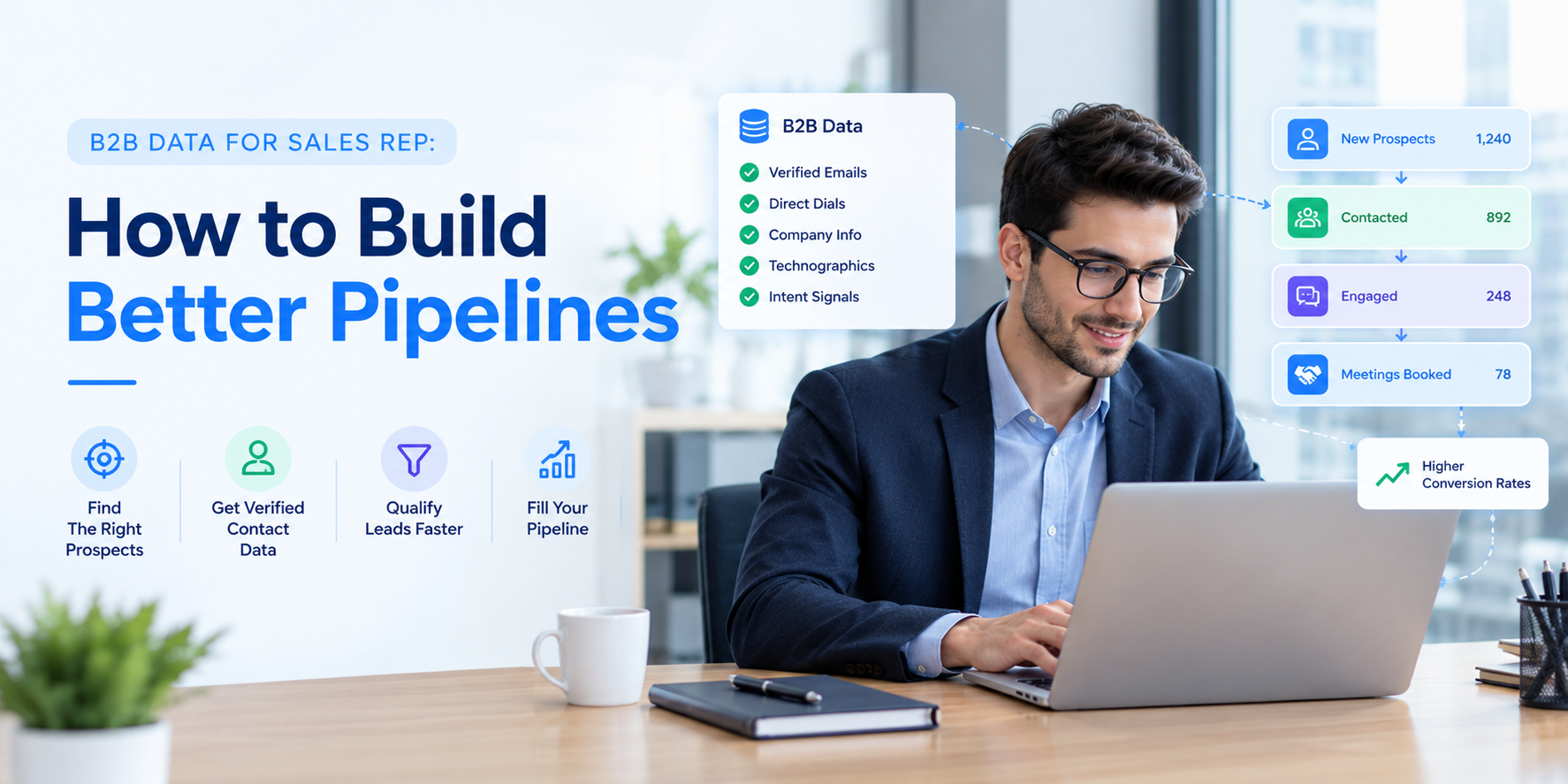
The B2B data available to sales representatives includes all the information they need in order to find, qualify, and contact the correct buyer such as firmographic details like the company’s size and industry, technographic indicators that show which tools the company is already using, verified contact information, and intent signals that indicate the company is carrying out buying research.
Although none of these elements is anything new by itself, the change is that a greater amount of the representative’s pipeline now relies on having all this data in a single location rather than having to assemble it from a dozen different tabs.
A sales pipeline based on fragmented and unverified data comes to a standstill early on. Salespeople end up making calls to contacts who have already left the company, emails bounce before the email sequence even starts, and territory planning becomes nothing but a guess.
When B2B sales data is handled correctly, this situation is reversed: sales reps spend their time on accounts that actually match, dealing with contacts who are still with the company and sending emails that successfully deliver. For SDRs in territories with a high volume of prospects, B2B data is what makes one list convert while another merely appears to be large.
Pipeline management is really just data management with a quota attached. Every stage, from first touch to closed-won, runs on information: who to contact, when, and why they’d care. Weak B2B prospect data shows up as a pipeline that looks full on paper but collapses the moment reps try to move deals forward.
Companies that follow a formal and data-supported sales process earn up to 28% more revenue than those who rely on instinct, and about 40% of businesses fail to meet their revenue targets simply due to inadequate pipeline management. This shortfall generally comes down to the same reason: sales reps are using contact lists and account data that were accurate six months ago and have since become outdated.
It’s tempting to treat a bigger database as a better one. In practice, a list of two million contacts with a 15% bounce rate does less for your pipeline than two hundred thousand verified ones. Every bounced email trains your sending domain to look spammy, and every stale contact is a call a rep makes for nothing.
A sub-2% bounce rate is the general bar for a healthy sending reputation, with sub-1% as the target serious B2B teams aim for. The industry average sits around 2.48%, which means a lot of sales orgs are quietly burning deliverability without realizing it. Before you judge a B2B database provider on record count, ask how often they verify, and what their actual bounce rate looks like in practice.
The three data types carry out different functions and are often mixed up as a result of pipelines performing below expectations.
The Firmographic data (such as industry, number of employees, revenue, and location) allows you to carry out account-based targeting and ensures that your ideal customer profile remains accurate. Technographic data shows you what technology stack a company is currently using, which is helpful for positioning and for timing your outreach to coincide with renewal or migration periods.
B2B intent data provides the forward-looking component since it identifies buying signals for example, a company researching a particular type of solution before the company has submitted a single form. When used together, those three features transform a flat contact list into account intelligence, which is what distinguishes a pipeline based on real signals from one based on a bought list and hope.
It is here too that contact enrichment proves its value by providing the details which enable ICP targeting to be precise rather than only approximate.
The stages of a sales pipeline (prospecting, qualification, meeting, proposal, close) each lean on a different slice of data. Prospecting works off firmographic and technographic filters to build a list that actually matches your ICP. Qualification leans on intent and engagement signals to decide who’s worth a rep’s time first.
Contacting a prospect within the first hour makes qualification roughly 7 times more likely to succeed, while waiting even a day lets that signal go cold. Once a deal reaches proposal stage, account intelligence (who else is involved, what they’ve engaged with) shapes how personalized that proposal can be, and tailored proposals see close rates as high as 90%.
Most deals also need five to twelve touchpoints before they close, and a lot of reps give up after the first attempt. Good data doesn’t fix persistence, but it does make every one of those touchpoints more relevant, which is often what keeps a rep in the game long enough to close. At the top of the funnel, B2B data for sales prospecting is really just account prioritization with better inputs the same, worked in a smarter order.
A sales intelligence platform does the work a rep used to do manually: scoring leads, enriching records, and surfacing accounts worth prioritizing today instead of next quarter. The shift toward AI in this role has moved fast. Teams using AI-assisted prospecting are about 1.7 times more likely to be high performers than aren’t, and companies layering AI into their sales process have experience cycles shrink in lead quality.
None of this replaces a rep’s judgment. What it does is clear the noise, so instead of scrolling through a spreadsheet of five hundred leads, a rep opens their day with the twenty that are actually worth a call. The better B2B prospecting tools now fold this scoring directly into a single B2B sales intelligence workspace, so reps aren’t stitching data together from five different tabs.
| Approach | Best For | Time per Verified Contact | Scalability | Data Freshness Risk |
|---|---|---|---|---|
|
Manual research |
A short list of strategic target accounts |
15 to 20 minutes |
Low, does not scale past a short list |
Low, checked by a person in real time |
|
Database search |
Building pipeline at volume |
Seconds to minutes |
High, scales to thousands of records |
Depends entirely on provider refresh rate |
|
Hybrid |
Most sales reps and teams |
Database for volume, manual for top accounts |
Medium, scales with team size |
Mixed, varies by which method sourced the contact |
Work out your ideal customer profile using specific firmographic and technographic criteria rather than having a vague idea of what ‘mid-size companies’ means. Obtain a list of accounts from a B2B data provider, filtering it to match your criteria and making sure to verify the contacts before you send out any emails. Use intent data to prioritize, as opposed to beginning with the accounts at the top of an alphabetical list.
Skipping verification and trusting a provider’s accuracy claim at face value, then finding out from a bounce report. Building lists purely from firmographic filters and ignoring intent data, so every account gets the same generic outreach regardless of where they are in their own buying process.
Letting CRM data management slide until duplicate and dead records out number live ones. And treating enrichment as a one-time project instead of an ongoing part of pipeline generation, which means the data that was accurate at import is stale within a quarter.
ReachStream Prospect is built around the parts of this process that cost reps the most time: finding verified contacts, layering in firmographic and intent signals, and keeping that data current instead of letting it decay in a spreadsheet.
For sales teams, that means spending less time confirming whether a contact still works somewhere and more time on the calls that move a pipeline forward. Built specifically as B2B data for sales teams, it keeps that information current instead of letting it decay in a spreadsheet.
B2B data for sales reps isn’t about owning the biggest list. It’s about having verified, current information at the moment a rep needs it, so pipeline building stops being a guessing game and starts being a repeatable process. Teams that treat data quality as part of their sales process , consistently build pipeline that converts better and burns less of a rep’s day on dead ends.
Author

Access 200M+ verified business emails and grow your sales pipeline effortlessly.
Don't forget to share this post!















Check out our other blogs!
What Is B2B Data and Why It Matters for Modern Sales Teams
A Buyer’s Checklist for Evaluating B2B Data Providers
How to Sync B2B Data with Your Outreach Sequences