



How to Evaluate B2B Data Vendors for Accuracy and Compliance
Picking a B2B data platform may seem straightforward at first. Choose a provider, find a few contacts, and start prospecting. The problems usually become obvious later, when SDRs are stuck calling outdated numbers or watching emails bounce back.
B2B data has a shelf life. At a decline rate of roughly 2.5% a month, nearly 30% of a contact database can become unusable over the course of a year. People move to new jobs, companies change their names, and email addresses get replaced.
The cost of choosing the wrong provider can go well beyond the subscription fee. A 12-month contract can put your sender reputation at risk, frustrate the sales team, and push customer acquisition costs (CAC) higher.
You might be trying to build a steadier pipeline, evaluate a B2B data platform’s API, or find a dependable B2B sales intelligence platform that works with your current stack. Whatever the reason, it is worth knowing what to check before signing a contract. This guide walks through those checks.
When comparing B2B Data Providers, large database numbers can be tempting. A vendor might advertise “100+ million contacts,” but the headline figure tells you little if a large share of those records is outdated, incomplete, or unverified.
A careful review of a B2B database platform matters because poor-quality data tends to create the same three problems:
Paying for a B2B marketing database without testing the data first can lead to weaker deliverability, wasted SDR time, and a higher bill than you planned for
Before you start booking demos, use these five areas to guide the evaluation. They make it easier to compare data quality, coverage, pricing, integrations, and compliance without getting pulled too far into the sales pitch.
A B2B database should not be treated like a snapshot that stays accurate for a year. A reliable B2B lead database should maintain Data Accuracy through regular automated checks, including Email Service Provider (ESP) ping testing, so addresses are tested close to the point of export.
More records do not necessarily make a database more useful. The bigger question is how closely those records match your ICP (Ideal Customer Profile). Look at coverage in the industries and markets you actually target. Ten thousand accurate contacts in your niche may be much more useful than 100,000 broad records that are a poor fit.
Check for:
Most B2B data subscriptions fall into one of three common pricing models:
The advertised price is only part of the picture. Check whether the provider adds export limits, mandatory onboarding fees, or separate charges for company-level firmographic data.
Your B2B customer data platform should work with the tools your team already relies on, not add another manual task. Look for B2B data platform integrations with CRMs such as HubSpot and Salesforce, outbound platforms such as Outreach and Salesloft, and browser extensions that support LinkedIn prospecting.
The B2B data platform API is worth testing as well. Do not assume that webhooks and bulk enrichment work smoothly just because they appear on a feature list. Test those capabilities for yourself.
Privacy requirements differ by market, but the risks around scraped or non-compliant contact data are worth taking seriously. Before you sign up, check how the provider handles:
A polished demo can make a database look better than it feels in everyday use. Reps may arrive with a few carefully chosen sample accounts. A more useful test is to give them your own criteria and see what the platform can return on the spot.
The questions below can help you get past the prepared demo and see how the platform handles real-world requirements.
The Live Interrogation Checklist
Red Flags to Watch Out For
Platform | Data Freshness | Integration Capability | Pricing & Free Tier |
ReachStream | Continuous / Real-Time | Native CRM, API & Chrome Extension | Starts $29/mo (Flat Rate); Free Plan available |
Apollo.io | Automated / Daily | Native CRM, Outreach, Salesloft, API | Free Tier; Paid starts at $49/user/mo |
ZoomInfo | Dynamic / Daily | Enterprise Native CRM, MAP, API | Custom ($10,000+/yr); No Free Tier |
Cognism | Real-Time / On-Demand | Salesforce, HubSpot, Outreach, API | Custom ($12,000+/yr); No Free Tier |
UpLead | Real-Time / On-Export | Salesforce, HubSpot, Zapier, API | Starts $99/mo; 7-Day Free Trial |
Lusha | Daily Updates | Salesforce, HubSpot, Pipedrive, API | Free Tier (5 credits/mo); Paid from $36/user/mo |
Seamless.ai | Real-Time AI Search | Native CRM, Salesloft, Outreach | Free Tier (Free credits); Paid starts $147/mo |
Demandbase | Daily / Account Intent | Enterprise CRM, MAP, ABM Tools | Custom Enterprise Pricing; No Free Tier |
Clearbit (HubSpot) | Real-Time Dynamic | Native HubSpot Sync, Custom API | Custom Add-on Pricing; Free Web Tools |
Bright Data | Custom / As Scraped | Custom API, Webhooks, Cloud Storage | Pay-As-You-Go ($0.001/record); Free Trial |
Let’s cut through the noise. Here is how the top 10 platforms stack up on features, pros, cons, and pricing to help you decide.
ReachStream is a B2B sales intelligence platform that focuses on prospect data and business intelligence for small and medium-sized businesses and growth teams.
Apollo brings a large B2B contact database together with sales engagement features in one platform. Built-in email sequencing means teams can manage prospecting and outreach without needing as many separate tools.
ZoomInfo is an enterprise-focused data intelligence platform with broad coverage of businesses across North America.
Cognism puts a strong focus on compliance and is aimed at sales teams working across European, UK, and global markets.
UpLead places a strong emphasis on email verification, checking addresses when users are ready to export their data.
Lusha is designed for a quick, browser-based prospecting workflow, with its browser extension at the center of the experience.
Seamless.ai is built more like a real-time search engine for contact data, pulling information from live web sources as people search.
Demandbase brings account-based marketing (ABM), intent intelligence, and targeted advertising together in one platform.
Clearbit focuses on lead enrichment and visitor intelligence and is closely integrated with the HubSpot platform.
Bright Data provides web data extraction tools and structured datasets, with much of its offering aimed at technical and engineering teams.
Moving away from an expensive legacy vendor does not automatically mean settling for unreliable data. A B2B data platform migration is easier when the provider matches your team’s needs, workflow, and budget.
ReachStream is positioned as a unified B2B customer data platform for small and mid-market growth teams that need clean, real-time verified contact data without multi-year contracts or complicated per-seat pricing.
What Makes ReachStream Different:
Ready to compare ReachStream with another B2B Data Provider? Explore the dedicated resource on B2B company data platforms or sign up for a free plan to test live records for your target industry.
A B2B data platform collects business contact information, verifies it, and organizes it so sales teams can find new prospects and move those records into their CRM.
Pricing can range from about $29/month for flat-rate SMB plans to more than $15,000 a year for enterprise platforms. The final cost often depends on factors such as user seats and export limits.
A CRM is primarily used to manage existing customers and contacts. A B2B data platform, on the other hand, helps teams find new prospects and update contact information that has gone stale.
Providers may combine real-time ESP email checks, automated web scraping, human verification, and export-time checks to validate contact records.
B2B data can decline by around 2.5% each month. Verifying records close to when you use them can reduce invalid addresses, help protect sender reputation, and support lower bounce rates.
Start with the data already in your CRM. Audit what is there, map the firmographic fields correctly, test the API and CRM integrations, and review export-credit limits before moving records in bulk.
Look closely at direct-dial accuracy, real-time email verification, clear pricing, dependable CRM integrations, and privacy requirements such as GDPR and CCPA.
Useful integrations let reps send verified leads straight to the CRM or sequencing tool instead of entering everything manually. That cuts down on repetitive work and can help prevent duplicate records.
Marketing professional, specializing in SEO, content strategy, social media, performance marketing, prospecting, and demand generation.
Access 200M+ verified business emails and grow your sales pipeline effortlessly.
Don't forget to share this post!















Check out our other blogs!
How a Medical Device Company Can Reach Hospital Decision-Makers
What Data Fields Should a Healthcare Marketing Database Include?
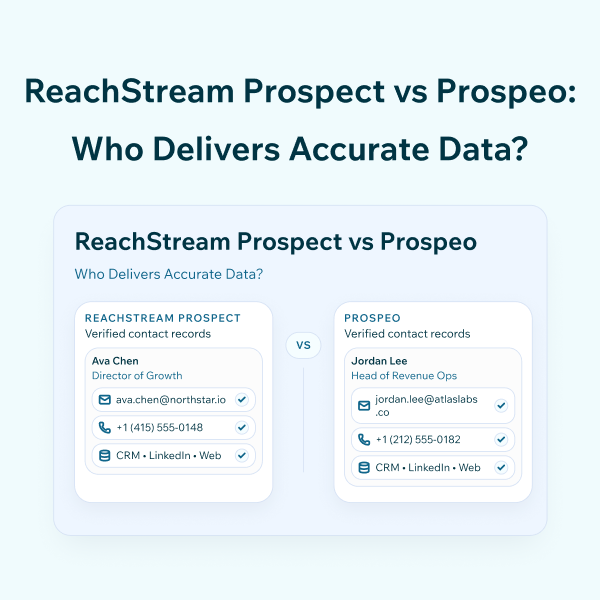
ReachStream Prospect vs Prospeo: Who Delivers Accurate Data?

How to Evaluate B2B Lead Generation Platforms: 7 Non-Negotiable Criteria