




BLACK FRIDAY
SALE IS LIVE
50% OFF
On All ReachStream Products
Limited time · Ends Nov 30, 2026
Ends Nov 30
candidate sourcing
Written by:
Junaid Hussain Khan
Junaid Hussain Khan

Candidate Sourcing: How Recruitment Agencies Scale With ReachStream

A practical look at strategies, techniques, tools and the process

Key takeaways lightning icon
TL;DR

What Is Candidate Sourcing in Recruitment?

Candidate sourcing is finding and attracting potential candidates before, or without, a job application. Candidate sourcing is the work of finding and engaging people who could fill a role before they apply. For a recruitment agency it sets the pace of the whole recruitment process, because a healthy candidate pipeline is what lets you submit strong profiles quickly.

This can help you get a explination how agencies can scale their sourcing with ReachStream Prospect, a B2B contact database that helps you reach professionals by job title, company and location, and it covers the main strategies, techniques and steps along the way.

Which Candidate Sourcing Strategies Work Best?

The best candidate sourcing strategies start from the role, not the tool. Write down the title, seniority, location and must-have skills, then decide where those people spend their time. Some roles are filled from active job seekers on job boards. Harder roles need a search for passive candidates, who respond better to a short, specific message than to a job advert.

A sound candidate sourcing strategy for recruiters usually mixes three things: inbound applications, referrals and outbound search. Outbound search is where a contact database helps most, because you can build a talent pool of people in the right jobs at the right companies and approach them directly. Our guide to recruitment data sources compares the options.

Candidate Sourcing Techniques Recruiters Use

Candidate sourcing techniques fall into a few families. Boolean search for recruiters combines keywords with AND, OR and NOT to narrow results on search engines and networks. LinkedIn candidate search lets you filter by title, company and location, though connection limits and message caps slow volume work. Referral programs, community groups and past applicants add warm leads for approach.

Contact-led techniques add another layer. With a database of work contacts, you can search by job title and seniority, find the right business email or direct dial, and reach people outside the networks you already use. Whatever you pick, keep notes on which techniques produce replies, because results differ by role and market.

How Does the Candidate Sourcing Process Work?

A repeatable candidate sourcing process keeps a team from starting over on every role. It begins with a clear job brief, then moves through search, outreach, screening and hand-off to the recruiter or hiring manager. Each stage has one owner and one number to watch, such as profiles found, replies received and candidates submitted.

Agencies that write the process down tend to onboard new sourcers faster and spot weak stages sooner. Track the recruitment process in your recruitment CRM or applicant tracking system (ATS) so notes, consent and status stay in one place. Our guide to B2B data for recruitment agencies shows how contact data fits the early stages.

                    Candidate sourcing process: job brief, search, outreach, screening and hand-off

Active vs Passive Sourcing: What Is the Difference?

Active candidate sourcing means reaching out yourself: you search, shortlist and send the first message. Passive candidate sourcing is the quieter side, where you build a talent pool and let your employer brand, job adverts and referrals bring people to you. Many teams use both, because active job seekers respond fast while the best passive candidates may only listen to a well-timed, personal message.

The practical difference is effort and speed. Outreach to passive candidates takes more messages and more patience, so keep each one short, honest about the role and easy to decline. Our guide to B2B contact data for recruiters covers how to find contact details responsibly.

Which Candidate Sourcing Tools Do Agencies Need?

Candidate sourcing tools range from job boards and professional networks to contact databases, browser extensions and research assistants. A resume database holds CVs people have uploaded. An applicant tracking system (ATS) manages applications and stages, and a recruitment CRM keeps relationships with candidates and clients warm.

Candidate sourcing platforms and candidate sourcing software that combine search with outreach can save time, but check how each one handles consent and data protection. Most agencies end up with a small stack rather than one product. A contact database finds people, an ATS records the process and a CRM keeps relationships current.

ReachStream does not include a native ATS integration, so teams usually move shortlists through CSV export or the Reach API. Our guide to tech recruitment tools lists more options.

Source more candidates with ReachStream
Search by job title, seniority and location, then export verified contacts.

How Do Common Sourcing Channels Compare?

The table compares common sourcing channels. Most agencies use more than one, so treat it as a starting point and adjust it to your own roles.

Channel Best for Strength Watch-outs What to measure
Job boards
Active job seekers
Fast applications
Crowded, with mixed quality
Qualified candidates per advert
Professional networks
Passive candidates by title
Rich profiles
Message limits slow volume
Reply rate
B2B contact database
Outreach by role and company
Direct emails and dials
Not a resume database
Verified contacts per search

How Do You Source Candidates Step by Step?

  1. Write the brief: Define title, level, location and must-haves.
  2. Build a search: Filter a database or network by role.
  3. Shortlist: Check profiles against the brief.
  4. Reach out: Send a short, personal message.
  5. Screen: Hold a quick call to confirm fit.
  6. Hand over: Log the person in your ATS.

How to source candidates step by step: write brief, build search, shortlist, reach out, screen and hand over

Candidate Sourcing Best Practices for Agencies

Candidate sourcing best practices are mostly about consistency. Keep messages short and specific, mention the role and the reason you picked the person, and make it easy to say no. Record consent and opt-outs, follow the data rules in each country you recruit in, and never use a list without checking how the data was collected. Ongoing talent acquisition work, such as staying in touch with past candidates, also pays off when a similar role opens later.

Measure what you do. Useful numbers include reply rate, interview rate and time from brief to first submission. Our guide to how agencies use ReachStream describes a related workflow, and our recruitment database guide covers the data side.

Candidate Sourcing Methods: Which Fit Your Agency?

  1. Job boards: Reach active job seekers fast.
  2. Professional networks: Find passive candidates by title and company.
  3. Referrals: Ask clients and past placements for introductions.
  4. Talent communities: Keep a warm talent pool in your CRM.
  5. Contact databases: Search by role and company, then reach out directly.
  6. Events and groups: Meet people in industry communities.

How Does ReachStream Support Sourcing?

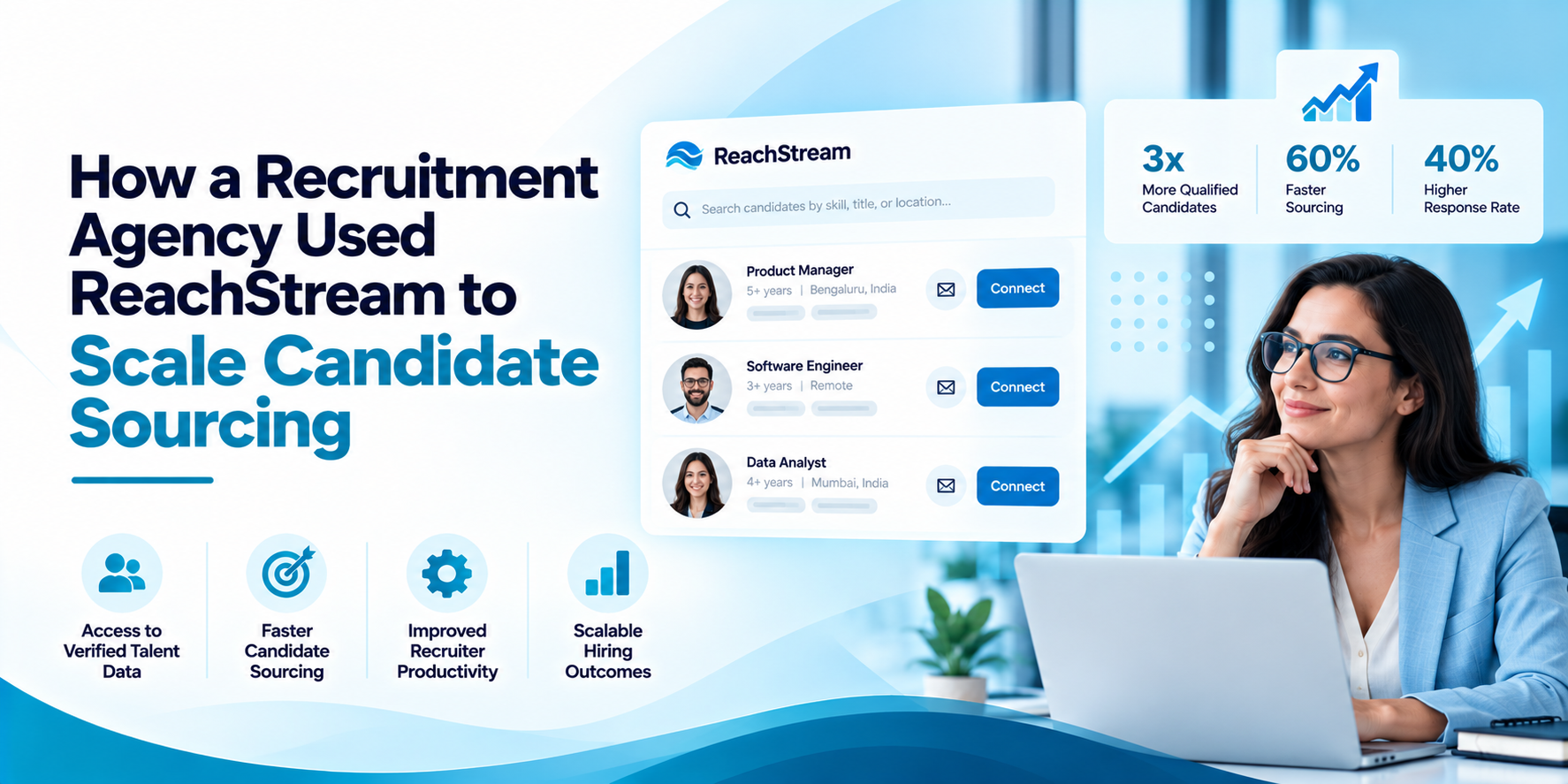
ReachStream Prospect helps recruitment agencies identify professionals and connect with hiring managers using business contact and company data. Its database includes 500M+ contacts, 50M+ companies, and 60M+ direct-dial numbers. Recruiters can use available filters to narrow searches by job title, industry, location, company size, and technologies used, helping them identify relevant professionals and contacts.

Features such as dynamic lists, email verification, data enrichment, CSV exports, ReachAPI, and native Salesforce and HubSpot integrations help teams organize contact information and incorporate it into their existing workflows. Agencies can also use business contact data to identify decision-makers at client companies and support employer outreach.

ReachStream is a business contact data platform, not a replacement for an applicant tracking system (ATS) or a resume database. It works best as a complementary sourcing tool for finding professional contacts and building outreach lists. Since data coverage varies by role and region, test your most common searches using the Free plan before committing to a paid subscription.

ReachStream states that its platform is ISO 27001:2022 certified and has completed a SOC 2 Type II attestation. It also identifies GDPR, CCPA, PIPEDA, and DPDPA among its privacy and compliance frameworks. These standards support its data protection practices, but recruitment agencies should still assess their own obligations when processing candidate and professional contact data.

Explore the ReachStream Prospect platform to see how it can support your sourcing workflow.

Start with 100 free export credits a month
No credit card needed. Test searches for the roles you fill most.

Candidate Sourcing: The Short Version

The short version: candidate sourcing means finding people before they apply. Write a clear brief, mix active and passive channels, follow a written process and measure replies. ReachStream offers 500M+ contacts, 50M+ companies and 60M+ direct dials, with a Free plan so you can test coverage for the roles you fill.

For your next read, see B2B contact data for recruiters and recruitment data sources.

Find a plan that fits your agency size

Compare and Explore ReachStream’s Pricing plans.  

Frequently Asked Questions

1. What is candidate sourcing in recruitment?

Candidate sourcing is the practice of finding and attracting people who could fill a role, often before they apply. It builds the talent pool and candidate pipeline that recruiters later screen and interview. It is one stage of the wider recruitment process.
A recruiter or sourcer starts from a job brief, searches networks, job boards and databases for matching profiles, and sends personal outreach. Replies are screened and passed to the recruiter. The work repeats until the candidate pipeline is full.
Strong sourcing gives recruiters more qualified candidates to choose from and shortens the time to fill a role. It also reaches passive candidates who never see a job advert. Agencies that source well can respond faster when a client needs a hire.
The main types are active and passive sourcing, plus inbound, outbound and referral-based approaches. Channels include job boards, professional networks, talent communities, contact databases and events. Most teams mix several types depending on the role.
Sourcing is finding and engaging potential candidates, while recruitment covers the whole hiring cycle, including screening, interviews, offers and onboarding. Think of sourcing as filling the top of the funnel. Recruitment turns that funnel into a placement.
Recruiters find qualified candidates by writing a clear brief, then searching job boards, professional networks and databases with filters or Boolean strings. They also use referrals and past applicants. A short, personal message and a quick screening call confirm fit.
Active sourcing targets people who are applying now, usually through job boards. Passive sourcing reaches employed people who are not looking but may be open to the right role, so it takes more outreach and patience. Many agencies run both at the same time.
The main steps are the job brief, search, shortlist, outreach, screening and hand-over to the recruiter. Each step needs an owner and a number to track. Writing the steps down makes the work repeatable.
Junaid Hussain Khan
Junaid Hussain Khan

Author

Junaid Hussain Khan
Junaid Hussain Khan
Junaid Hussain Khan is the Business Development Manager at ReachStream, adept at forging strategic partnerships and identifying new market opportunities to propel ReachStream’s growth and strengthen its position in the B2B ecosystem.
Share
Table of Contents
Access 500M+ verified business emails and grow your sales pipeline effortlessly.
Power Your Sales with Targeted Data
Junaid Hussain Khan
Junaid Hussain KhanAuthor
Junaid Hussain Khan is a Senior Manager, Business Development at ReachStream. He leads strategic partnerships, uncovers new market opportunities, and helps drive ReachStream's growth and its position in the B2B ecosystem.

Don't forget to share this post!

Check out our other blogs!