Written by:

Junaid Hussain Khan
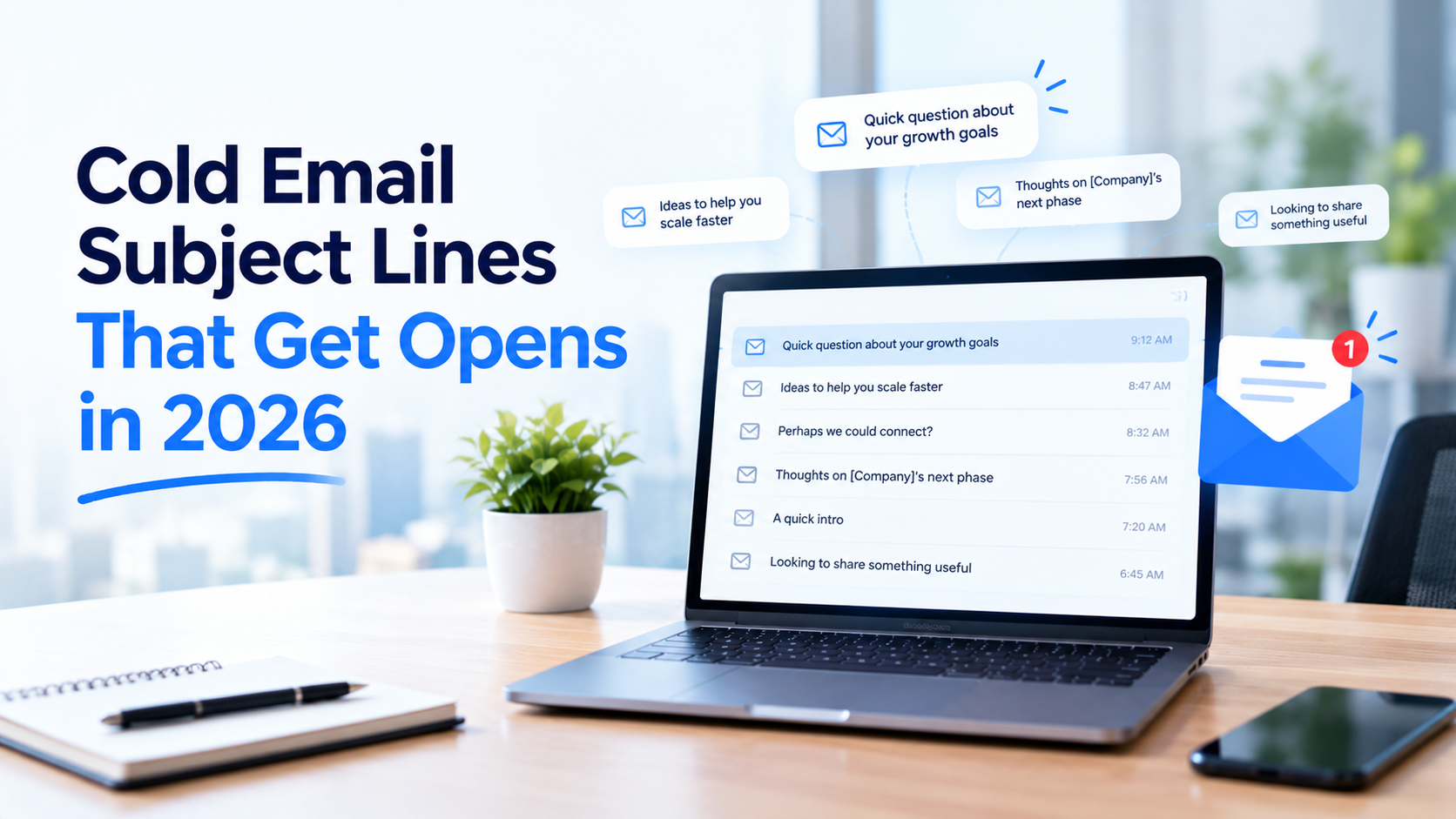
Best Cold Email Subject Lines That Get Opened in 2026
How to Evaluate B2B Data Vendors for Accuracy and Compliance

TL;DR
- A cold email subject line has one job: get the email opened. The body of the email does the selling.
- Subject lines that get opened in B2B inboxes are usually short and plain, because most emails are first read on a phone where long lines get cut off.
- Personalization helps when it is relevant. A first name or company name works best alongside a real reason for reaching out.
- Simple questions, outcomes, growth signals, trigger events, and specific pain points are all reliable starting points.
- Curiosity is fine, but the email has to deliver on it. A subject line that overpromises usually costs you the reply.
- Overused phrases like "quick question" read as cold outreach to experienced buyers and tend to lose impact over time.
- A/B testing on your own audience, measured by replies, beats any list of examples, including this one.
What Makes Cold Email Subject Lines Work?
The best cold email subject lines are short, specific, and clearly about the person receiving them. Their job is to get the email opened, not to sell your product in eight words. If the subject line gives a busy prospect a believable reason to click, it has done its part. The rest belongs to the email itself.
That sounds simple, and in a way it is. Where teams go wrong is asking one line to carry too much: the offer, the value proposition, a little urgency, maybe a discount. Buyers notice the effort and move on.
This guide covers what tends to work for cold email subject lines in 2026, the approaches worth testing, the mistakes that quietly hurt your open rate, and how to find what works for your own audience instead of borrowing someone else’s list.
What Should a Good Subject Line Include?
Most cold email subject line best practices come back to four things: length, personalization, honest curiosity, and relevance. You will find plenty of cold email subject line tips online that contradict each other, but these four hold up across most B2B audiences.
Is a Shorter Subject Line Always Better?
Usually, though not always. Most B2B emails are first seen on a phone, and mobile mail apps tend to cut subject lines off somewhere between 30 and 43 characters, according to a 2026 review of B2B email data by Zeliq. Anything past that point may never be read.
That is why short cold email subject lines of roughly three to seven words make a sensible default. One aggregate study of more than five million cold emails sent in 2025 and 2026 found that lines between 21 and 40 characters had the highest average open rate. The exact cold email subject line length matters less than the idea behind it. Say one thing, and put the most important word first.
How Much Personalization Is Enough?
Enough to show the email was written for this person, and not much more. Snov.io’s 2026 analysis found that personalized subject lines averaged a 20.79% open rate, compared with 14.96% for generic ones.
A first name on its own carries little weight now, since every sequencing tool can insert one. Personalized cold email subject lines land better when the detail is something the prospect would recognize as theirs: their company name, a product they just launched, a project their team is known for, or the city where they are opening an office. If you cannot find a detail like that, a clear and relevant line without personalization beats a forced one.
Can a Subject Line Create Curiosity Honestly?
Yes, as long as the email answers the question the subject line raises. Curiosity works because people like to close an open loop. It stops working the moment they open the email and realize the loop was a trick.
A line like “Idea for {Company}’s onboarding flow” makes the reader wonder what the idea is, and a good email tells them within two sentences. Compare that with “Did you see this?” It creates curiosity too, but it says nothing about why the email matters to them, and skeptical buyers have learned to ignore it.
Why Does Relevance Matter More Than Cleverness?
A relevant subject line connects to something the prospect already cares about, such as a goal they own, a problem their team is working through, or a change happening at their company. Clever wordplay rarely does that. It might earn a smile, but it does not give anyone a reason to open an email from a stranger.
Relevance starts before you write a word. If you know the prospect’s role, industry, and current situation, the subject line is half written already. If you do not, no amount of polishing will cover the gap.
WHAT THE DATA SAYS
Instantly’s 2026 Cold Email Benchmark Report, based on billions of cold email interactions, puts the average reply rate at 3.43%, with the top 10% of senders reaching 10.7% or higher. The same report found that 58% of all replies came from the first email in a sequence, which makes that first subject line one of the most important lines in your campaign. For more context on reply and open rate trends, see these 2026 cold email benchmarks.
Good subject lines need the right recipients
Find decision-makers by role, industry, and company size, so every subject line reaches someone it actually applies to.
Which Subject Line Approaches Work Best?
Most sales email subject lines that work fall into a handful of patterns. None of them is a shortcut, and all of them depend on having a genuine reason to reach out. Treat them as starting points for your own cold email subject line formulas rather than lines to copy word for word. Good subject lines are only one part of effective cold email outreach.
The table below compares five approaches that hold up well with B2B buyers, from question-based cold email subject lines to ones built around a specific pain point, along with where each fits and what can go wrong.
| Approach | Example subject line | Works best when | What the email must deliver | Watch out for |
|---|---|---|---|---|
|
Simple question |
Still hiring SDRs in Austin? |
You have a clear, specific reason to ask |
A direct follow-on to the question in the first line |
Yes-or-no questions that feel like a setup |
|
Relevant stat or outcome |
Shorter ramp time for new AEs |
You can back the outcome with a real example |
Where the result came from and why it applies to them |
Numbers that sound inflated or cannot be verified |
|
Company growth signal |
{Company}’s new Denver office |
They recently expanded, raised funding, or grew headcount |
A link between that growth and a problem it creates |
Sounding like you are watching them too closely |
|
Recent trigger event |
Your new VP Sales role, {First name} |
A role change, launch, or announcement is only weeks old |
Why the event makes your email timely |
Triggers that are several months old |
|
Specific pain point |
Lead routing delays at {Company} |
You know a problem common to their role or industry |
Proof you understand the problem, not an instant pitch |
Guessing at a pain they do not actually have |
How Do You Write a Cold Email Subject Line?
- Write the email first: It is far easier to sum up a message you have already written than to build a message around a subject line you happen to like.
- Pick one reason the prospect should care: A trigger event, a problem, or an outcome. One is enough.
- Draft several versions: Try four or five options in different styles, such as a question, a specific detail, and a plain statement. The first idea is rarely the strongest.
- Cut until only the useful words are left: Put the key word near the front so it survives mobile truncation, and drop filler like “just” or “checking in.”
- Check that it matches the email: Read the subject line, then the first two sentences. If the opening does not deliver what the subject line suggested, rewrite one of them.
BEFORE YOU HIT SEND
Send the email to yourself and open it on your phone. Look at where the subject line cuts off and what the preview text says. If the preview reads “Hi {First name}, I hope this finds you well,” you are wasting the second line a prospect sees.
How Should You A/B Test Subject Lines?
A/B testing tells you what works for your audience instead of leaving you to guess. A subject line that does well with IT directors may fall flat with finance leaders, and the only way to know is to try both on real prospects.
For cold email subject line A/B testing, change one thing at a time, keep the email body identical, and send each version to a similar segment. Judge the result mainly on replies. Apple Mail Privacy Protection preloads tracking pixels, and roughly 49% of tracked opens in 2026 data come from Apple Mail, so an open rate can look healthy even when few people read the email. The cold email subject lines that get replies are the ones worth keeping.
QUICK CHECKLIST
- Test one variable per round, such as length, personalization, or a question against a statement
- Keep the email body, send time, and audience segment the same for both versions
- Wait for a meaningful sample, ideally a few hundred sends per version, before calling a winner
- Track replies and positive replies, not just open rate
Which Mistakes Hurt Cold Email Open Rates?
- Leaning on overused phrases: Lines like “quick question” or “touching base” once felt casual. Experienced buyers now see them constantly, and many read them as a sign of a cold email template, so they tend to lose impact over time.
- Promising what the email does not deliver: Clickbait may get an open, but it costs you trust. A fake “Re:” or “Fwd:” on a first-touch email is the most common version, and it usually annoys prospects more than it helps.
- Using spam trigger words: Spam filters weigh sender reputation and list quality far more heavily than any single word, but heavy punctuation, all caps, and stacked trigger words like ‘free’ or ‘act now’ are still a contributing signal, especially for a domain that hasn’t built up reputation yet.
- Selling in the subject line: Product names, discounts, and feature lists turn a conversation starter into an ad. Save the pitch for the email, if it belongs there at all.
- Ignoring deliverability: The best subject line does nothing in a spam folder. Email warmup, a healthy sender reputation, and consistent list hygiene decide whether your subject line is seen in the first place.
How Does Contact Data Affect Your Open Rate?
Subject lines get most of the attention, but inbox placement is decided earlier. Sending to outdated or invalid addresses pushes up your bounce rate, and repeated bounces can damage your sender reputation until even well-written emails start landing in spam. Relevance depends on data too. You cannot reference a prospect’s role or company accurately if the record behind it is wrong. Regular verification is one of the more reliable ways to cut bounce rates before they compound.
ReachStream Prospect is designed to help with this part of prospecting. It gives teams access to 450M+ contacts across 35M+ companies, with search filters for industry, company size, seniority, and location, plus technographic data for narrowing a list to your ideal customer profile. Its AI Conversational Search lets you describe the people you want to reach in plain language instead of stacking filters one by one.
A better list will not write your subject lines for you. It can, however, make relevant ones easier to write, because you know more about the person on the other end.
Put your subject lines in front of the right people
Build a list of decision-makers for your next campaign and test your subject lines on the prospects who matter most.
Conclusion
Good cold email subject lines are rarely clever. They are short, clear, and specific to the person reading them, and they lead into an email that keeps the promise the subject line made.
Start with a real reason to reach out, whether that is a question, a trigger event, a growth signal, or a problem you know the prospect is dealing with. Write a few versions, keep the one that sounds most like a person, and let testing on your own audience tell you what to keep. Over time, that process will usually teach you more than any list of examples, including the ones in this guide.
Build a prospect list worth writing for
See how ReachStream Prospect helps sales and marketing teams find the right contacts before the first email goes out.
Frequently Asked Questions
1. What is a cold email subject line?
A cold email subject line is the line a prospect sees before opening an email from someone they have not heard from before. Its main job is to earn the open, not to explain the whole offer. The email body handles the rest.
2. How long should cold email subject lines be?
Most cold email subject lines work well at around three to seven words, or roughly 30 to 50 characters. Mobile mail apps often cut off longer lines, so the key word should appear early. Testing with your own audience is the most reliable way to settle on a length.
3. Is "quick question" still a good subject line?
It can still work, but it has become very common in cold outreach. Many experienced buyers recognize it as a template phrase and skip past it. A short, specific question about their company or role usually says more.
4. What are the best subject lines for sales emails?
The best subject lines for sales emails are relevant to the recipient and honest about what is inside. Simple questions, recent trigger events, growth signals, and specific pain points are all good starting points. No single line works for every audience, so test before you commit.
5. Should cold email subject lines use a question?
Questions can work well because they feel conversational and invite a response. Keep them specific and easy to answer, and avoid questions that are obviously a setup for a pitch. Testing a question against a plain statement will show which one your audience prefers.
6. How do I keep my subject line out of spam?
Skip heavy punctuation, all caps, and pushy phrases like “act now” or “guaranteed.” Keep the line plain and conversational. Inbox placement also depends on sender reputation, domain authentication, and a clean list, so the subject line is only one part of it.
7. What subject lines work for follow-up emails?
Many teams keep follow-up email subject lines in the same thread, as part of one broader cold email sequence, so the prospect sees the earlier context. If you start a new thread, add a new angle instead of repeating the original line. Follow-ups are worth the effort, since Instantly’s 2026 report found that 42% of replies came after the first email.
8. How do I A/B test cold email subject lines?
Send two versions of the subject line to similar segments, keeping the email body and send time the same. Change one variable at a time and wait for a meaningful sample before picking a winner. Measure replies alongside opens, since open tracking is less reliable in 2026.
Junaid Hussain Khan
Author
Junaid Hussain Khan

Junaid is Senior Manager – Brand Growth & Strategy at ReachStream, where he drives content, SEO, and growth strategy for B2B sales and marketing teams.
Share
Table of Contents
Access 450M+ B2B contacts and build targeted prospect lists for your next campaign.
Power Your Sales
with Targeted Data
Junaid Hussain Khan is a Senior Manager, Business Development at ReachStream. He leads strategic partnerships, uncovers new market opportunities, and helps drive ReachStream's growth and its position in the B2B ecosystem.
Don't forget to share this post!















Check out our other blogs!