How to Evaluate B2B Data Vendors for Accuracy and Compliance
Bad data costs agencies twice: once when campaigns underperform, and again when clients lose trust. When you’re managing outbound for multiple clients with different ICPs, CRMs, and compliance requirements, the wrong enrichment platform creates problems that compound fast.
This guide compares the top B2B data enrichment platforms for agencies, breaks down what to look for in each, and covers the pricing models and pitfalls that matter most when you’re billing clients for results.
What is B2B data enrichment for agencies
The right B2B data enrichment platform for your agency depends on a few things: whether you want bulk waterfall enrichment that pulls from dozens of providers for maximum accuracy, AI-driven workflow automation, or all-in-one outreach tools with built-in sequences. Your choice also hinges on whether you focus on inbound lead enrichment or outbound prospecting, how many records you enrich each month, and which CRMs you work with.
So what is data enrichment, exactly? It’s the process of taking incomplete contact or company records and filling in the gaps. You might start with just a name and company. Enrichment adds the verified email, direct dial, job title, seniority, and firmographic details that make outreach actually work.
Agency workflows look different from in-house sales teams. You’re juggling multiple clients with different ideal customer profiles, separate CRMs, and distinct compliance requirements. Volume runs higher, and when enrichment fails, it’s your client’s sender reputation taking the hit.
A few terms worth knowing before we go further:
- Firmographics: Company-level details like industry, headcount, revenue, and location
- Contact enrichment: Adding verified emails, phone numbers, titles, and seniority to existing records
- Data refresh: Updating stale records on a regular cycle to keep information current
Why agencies need a dedicated B2B data enrichment platform
In-house teams serve one company. Agencies serve many. That difference creates complexity that general-purpose tools often handle poorly.
Picture this: you’re running outbound campaigns for a fintech startup and an enterprise healthcare company at the same time. Each has a different target audience, different CRM, and different compliance rules. A platform built for single-team use can create data bleed between clients, billing confusion, and workflow headaches that slow everything down.
Here’s what agencies typically look for that in-house teams don’t:
- Multi-client workspace separation: Keeping prospect data isolated so Client A’s leads never mix with Client B’s
- Scalable pricing: Credit-based or volume-based models that don’t punish you for growing your team
- Deliverability protection: Maintaining sender reputation across multiple client domains
- Compliance flexibility: Meeting GDPR for EU clients and CCPA for US clients from one platform
What to look for in a B2B data enrichment platform for agencies
Not every enrichment platform fits agency workflows. Before you commit, it helps to evaluate a few key criteria against your actual use cases.
Data accuracy and refresh cycles
Accuracy affects your agency’s reputation directly. When emails bounce or phone numbers fail, clients notice. Platforms that verify data through multiple methods and refresh records every 45 to 90 days tend to deliver better results than those with longer or undefined refresh cycles.
Contact and firmographic coverage
Coverage refers to how many contacts and companies a platform can enrich across different regions, industries, and company sizes. There’s often a trade-off here: some platforms excel in North America but have gaps in EMEA or APAC. Others go deep in certain industries but shallow elsewhere.
CRM and outreach tool integrations
Agencies typically work across multiple client CRMs like HubSpot, Salesforce, and Pipedrive, plus outreach tools like Outreach or Salesloft. Native integrations save hours of manual data transfer and reduce the errors that come with copy-paste workflows.
API and bulk enrichment support
API enrichment lets you programmatically update records in your own systems without manual intervention. Bulk enrichment handles large list uploads for CRM hygiene projects. If your agency runs regular data cleanup for clients, both capabilities matter.
Multi-client workspaces and seat flexibility
Per-seat pricing multiplies costs as your team grows. Platforms that offer workspace separation per client and pricing models that scale with usage rather than headcount tend to work better for agencies.
GDPR and CCPA compliance
GDPR governs data privacy in the EU. CCPA covers California residents. Agencies serving international clients benefit from platforms that verify compliance and provide audit trails for both.
Transparent credit-based pricing
Enrichment credits are the currency most platforms use to charge for data. Opaque or per-record pricing creates budget surprises when you’re billing clients on retainer. Transparent credit systems make it easier to forecast costs and pass them through accurately.
ConclusionBest B2B data enrichment platforms for agencies compared
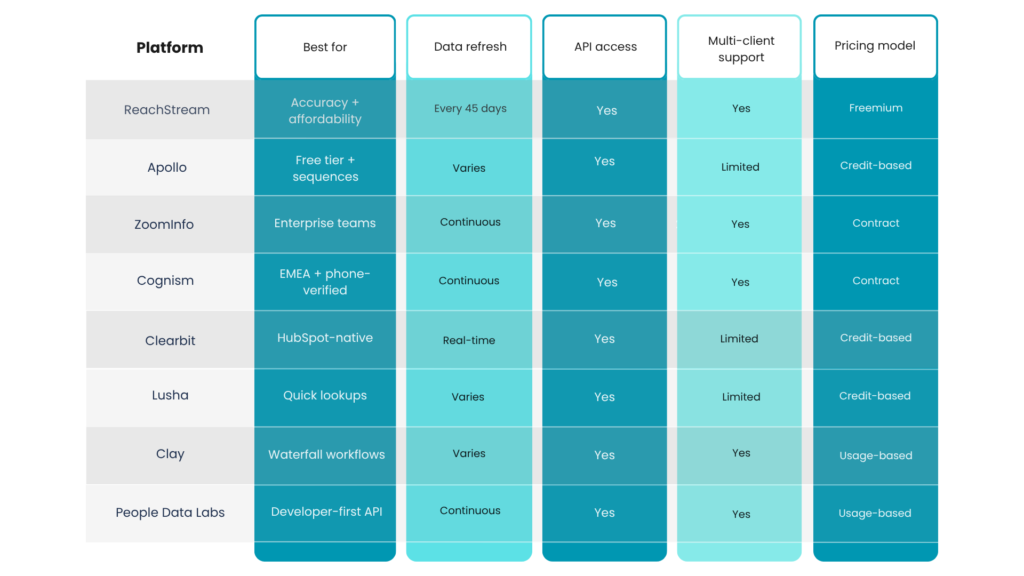
This table summarizes key differences to help you shortlist options quickly.
Top B2B data enrichment platforms for agencies reviewed
Each review below covers key features, ideal agency use case, and trade-offs.
ReachStream
ReachStream combines verified contact and company data with a 45-day refresh cycle, a Chrome extension for LinkedIn prospecting, and API access for CRM integrations. The credit-based pricing scales with agency growth without per-seat penalties, and a free tier lets you test before committing.
- Best for: Agencies that want accurate, conversion-ready data at scale
- Key features: List Builder, Chrome Extension, Reach API, email verification
- Trade-offs: Works well for agencies prioritizing data accuracy and predictable costs over enterprise-level intent data
Apollo
Apollo offers a generous free tier with built-in email sequences and a large contact database. Data accuracy can vary depending on the segment, and advanced features require paid plans. It works well for agencies starting outbound programs on a budget, though agencies weighing Apollo against ReachStream should compare enrichment depth and API capabilities.
ZoomInfo
ZoomInfo provides enterprise-grade data with intent signals and continuous refresh. Contract costs run high, making it better suited for agencies with large budgets or enterprise clients who can absorb the expense.
Cognism
Cognism excels in EMEA markets with phone-verified mobile numbers and strong GDPR compliance. Pricing is contract-based, so it fits agencies with predictable European client volume.
Clearbit
Clearbit integrates natively with HubSpot through Breeze Intelligence, enriching inbound leads in real-time with firmographic and contact attributes. It works best for agencies already running client campaigns in HubSpot.
Lusha
Lusha offers quick contact lookups via Chrome extension. It’s better for individual lookups than bulk enrichment, making it useful for targeted research rather than large-scale campaigns.
Clay
Clay enables waterfall enrichment by querying multiple data providers in sequence. The learning curve is steep, but technical teams comfortable building custom workflows can maximize coverage across providers.
People Data Labs
People Data Labs provides a developer-first API for custom integrations. It requires technical resources to implement, so it suits agencies with engineering support building proprietary data pipelines.
Waterfall vs real-time enrichment for agency workflows
Waterfall enrichment queries multiple data providers in sequence until a match is found. Real-time enrichment performs instant lookups as records enter your system. Each approach fits different situations.
- Waterfall enrichment: Best for maximizing coverage on large lists. Slower, but often more complete because it pulls from multiple sources.
- Real-time enrichment: Best for instant lead qualification. Faster, but may have coverage gaps if the first provider doesn’t have a match.
For agencies, waterfall works well for batch CRM hygiene projects where completeness matters more than speed. Real-time fits live prospecting where you want to qualify leads the moment they come in.
How agencies can price and budget data enrichment
Passing enrichment costs to clients or building them into retainers requires understanding how platforms charge.
- Credit-based: Buy credits in advance for predictable costs
- Per-record: Pay per enrichment, which can spike unexpectedly with large campaigns
- Subscription: Flat monthly fee that may include unused capacity
Estimating monthly enrichment volume per client before committing helps avoid surprises. A trial period lets you benchmark actual usage against projections.
Common data enrichment pitfalls agencies avoid
Agencies face unique risks when enrichment goes wrong because client reputation is on the line, not just your own.
The credit trap
Testing and onboarding new clients can burn through credits quickly. Setting usage alerts and testing on small batches first helps avoid running out mid-campaign.
Bounce rates that hurt client domains
Sending to unverified emails damages sender reputation. Verifying emails before outreach, even if the platform claims verification, protects client deliverability.
Per-seat costs that scale poorly
Per-seat pricing multiplies costs as your team grows. Evaluating total cost for projected headcount, not just current team size, gives a clearer picture.
Stale records across client CRMs
Outdated data accumulates when enrichment is a one-time event. Scheduling regular re-enrichment cycles, often quarterly, keeps records current.
How to choose the right B2B data enrichment platform for your agency
- Define client ICPs: Identify the industries, regions, and company sizes your clients target
- Estimate enrichment volume: Calculate monthly records across all clients
- Audit current tools: List existing CRMs, outreach platforms, and integrations you work with
- Shortlist by compliance: Eliminate platforms that don’t meet GDPR or CCPA requirements for your clients
- Test with real data: Request trials and run accuracy tests on a sample list before committing
Conclusion
ReachStream addresses the agency-specific challenges covered above: verified data refreshed every 45 days, flexible credit-based pricing, API access for CRM sync, and a Chrome Extension for LinkedIn lead capture.
- Verified contact and company data refreshed regularly
- Chrome Extension for LinkedIn lead capture
- Reach API for CRM sync and workflow automation
- Credit-based pricing that scales with agency growth
Ready to Supercharge Your Agency's Outreach?
Frequently asked questions
1. Can agencies resell or white-label B2B enrichment data to clients?
Most platforms prohibit reselling raw data, but agencies can use enriched data to power client campaigns. Reviewing each platform’s terms of service before offering data as a standalone deliverable helps avoid compliance issues.
2. How many enrichment credits does a typical agency need per client per month?
Credit needs vary by campaign volume. Agencies typically estimate based on list sizes, re-enrichment frequency, and number of active clients. Starting with a trial helps benchmark actual usage.
3. Is free B2B data enrichment accurate enough for agency client work?
Free tiers are useful for testing, but accuracy and coverage often lag behind paid plans. Agencies risk client deliverability issues when relying solely on free tools for production campaigns.
4. What is the difference between a B2B data enrichment platform and a contact database?
A contact database provides raw prospect lists. An enrichment platform updates and verifies existing records. Many platforms, including ReachStream, offer both capabilities.
5. How often do agencies re-enrich client CRM records?
Re-enrichment frequency depends on data decay in your clients’ industries. B2B contact data changes frequently due to job moves, so quarterly re-enrichment is a common baseline.
Manohar Devdiga
Marketing professional with a Master’s degree in Marketing, specializing in SEO, content strategy, social media, performance marketing, prospecting, and demand generation.
Share
Table of Contents
Access 200M+ verified business emails and grow your sales pipeline effortlessly.
Power Your Sales
with Targeted Data
Don't forget to share this post!















Check out our other blogs!
How to Build a Targeted Prospect List Using Filters
October 21, 2026

B2B Data for Ed-Tech Companies: Reaching School Decision-Makers
October 21, 2026

Direct Dial Numbers Explained: A Guide for Sales Reps
October 19, 2026