
Unlimited Data.
Infinite Possibilities.
Infinite Possibilities.
Looking for B2B data? Download Unlimited data using our Chrome extension at just $79/month.

Best Tips on Lead Generation for Technology Companies
Your outbound campaign has the perfect message, the ideal target account, and a rep ready to close. None of it matters if the contact left the company six months ago.
Data accuracy in B2B prospecting determines whether your sales efforts reach real buyers or disappear into the void of bounced emails and disconnected numbers. This guide breaks down the hidden costs of bad data, the revenue gains from getting it right, and practical steps to evaluate providers and maintain accuracy over time.
Data accuracy measures how closely your contact and company information reflects true, real-world values. In practical terms, accurate B2B data means the email address you’re sending to actually exists, the person still works at that company, and their job title matches what’s in your CRM.
Here’s the thing: without accurate data, your outreach never reaches the right person. You might have the perfect message and the ideal target account, but if the VP of Marketing left six months ago, none of that matters.
The difference between teams that hit quota and teams that struggle often comes down to data quality rather than sales skill. When reps work with verified, current contact data, they spend time selling instead of chasing dead ends.
Bad data creates problems that don’t show up on a dashboard until real damage is done. The costs compound quietly over time, affecting everything from budget to brand reputation.
Every bounced email represents money spent with zero return. If 15% of your purchased contacts are invalid, you’re effectively paying 15% more per usable lead than you thought.
Some providers charge credits regardless of whether an email actually works. Others, like ReachStream, only deduct credits for verified, valid addresses. That distinction matters when you’re running campaigns at scale.
Your sender reputation is a score that email service providers assign based on your sending behavior. High bounce rates from bad data trigger spam filters and lower this score.
Once damaged, a sender reputation takes months to rebuild. Meanwhile, even your emails to valid contacts start landing in spam folders instead of inboxes.
Regulations like GDPR, CCPA, and CAN-SPAM impose strict requirements on commercial communications. Contacting outdated records or people who’ve opted out can trigger violations.
Beyond financial penalties, compliance failures create legal exposure and reputational damage that’s difficult to quantify.
When your data shows the wrong person in a buying role, you miss the actual decision-maker entirely. Your competitor with accurate data reaches them first, builds the relationship, and wins the deal.
This opportunity cost is invisible but substantial. You can’t measure deals you never had a chance to pursue.
Data decay refers to the natural rate at which contact information becomes outdated. B2B data degrades continuously due to job changes, company restructuring, and contact updates.
B2B email data typically decays at roughly 2-3% per month. Email addresses become invalid when employees leave companies, organizations rebrand, or domains change.
A list that was 95% accurate six months ago might be below 80% today. That’s why continuous verification matters more than one-time validation.
Direct lines and mobile numbers change frequently with role transitions, office relocations, or phone system updates. A direct dial that bypassed the gatekeeper last quarter might now ring to a disconnected line.
Even when contact details remain technically valid, the person may no longer hold decision-making authority. Average tenure in B2B roles continues to shrink, meaning your “VP of Marketing” contact might now be an individual contributor or working somewhere else entirely.
Firmographics, which include company size, revenue, industry classification, and location, change through mergers, acquisitions, layoffs, and relocations. A company that fit your ideal customer profile last year might no longer qualify after a major restructuring.
Bad data creates time drains across your entire sales workflow. Every hour spent on data problems is an hour not spent selling.
Sales reps forced to manually verify, update, or replace bad records are doing administrative work that adds nothing to pipeline. Research suggests reps spend up to 30% of their time on data-related tasks rather than actual selling activities.
Calls to disconnected numbers and emails to invalid addresses waste effort and delay pipeline generation. Each failed touchpoint represents time that could have been spent engaging a real prospect.
Reaching the wrong contact forces reps to restart discovery and qualification from scratch. What could have been a two-week sales cycle stretches to six weeks as you work backward to find the actual buyer.
Prioritizing data accuracy delivers measurable business outcomes that directly impact your bottom line.
Verified emails land in inboxes, not spam folders. Teams using ESP-verified data, where emails are validated before sending, typically see deliverability rates above 95%. Compare that to 70-80% for unverified lists.
Reaching the right decision-maker with accurate context from the start improves qualification rates. You’re not wasting discovery calls on people who can’t buy. Instead, you’re engaging stakeholders with actual authority.
Accurate data enables reps to engage the right stakeholders immediately. This reduces the back-and-forth that extends deal timelines. Teams working with verified contact data often report sales cycles 25% shorter than those using unverified lists.
ABM strategies depend on accurate firmographic and contact data to execute personalized, multi-threaded engagement. Without it, your “targeted” campaigns are really just spray-and-pray with better branding.
For outbound success, specific data fields carry more weight than others. Here’s what matters most and why:
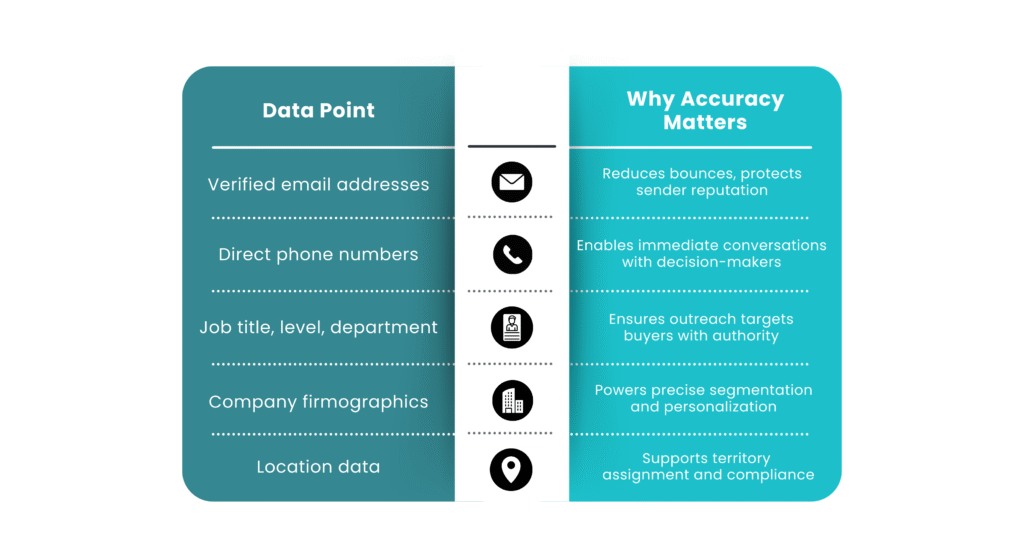
ESP verification confirms an email address is deliverable before you send to it. This protects your sender score and ensures credits aren’t wasted on invalid contacts.
Direct dials and mobile numbers bypass gatekeepers and reach decision-makers directly. A verified direct line is worth significantly more than a generic company switchboard number.
Accurate role data ensures your outreach targets the right members of the buying committee. These are the people with authority and influence over purchase decisions.
Firmographics cover company size and revenue. Technographics reveal the technologies a company uses. Together, they power precise audience segmentation and highly personalized outreach.
Geographic accuracy matters for territory alignment, regional compliance, and localized messaging. Incorrect location data can route leads to the wrong rep or trigger compliance issues.
Use this framework to assess prospecting data vendors before committing budget.
Look for clear accuracy SLAs with stated thresholds like 95%+ and policies where credits are only charged for valid emails. Ask specifically how verification works and what happens when data proves inaccurate.
Continuous updates outperform quarterly refreshes. Ask providers how often records are verified and what triggers a re-verification.
Ensure uniform data quality across all your target segments. Some providers excel in tech but struggle with healthcare or manufacturing.
Look for GDPR, CCPA, CAN-SPAM, and ACMA adherence. Transparency about data sourcing indicates a provider takes compliance seriously.
Evaluate API access, native CRM integrations, and browser extensions. Data that flows directly into your existing workflows delivers more value than data trapped in a separate platform.
Even the best data degrades. These practices help you stay ahead of decay.
Schedule quarterly audits to identify decay, duplicates, and incomplete records before they impact campaigns.
Verify emails at export or just before sending, not only at initial capture. This catches decay that occurred since the record was created.
Automated enrichment fills gaps and updates changed fields like job titles or phone numbers without manual intervention.
Data governance means creating clear ownership, standards, and processes for managing quality. Without it, accuracy improvements don’t stick.
Some providers offer free lifetime contact renewals for ABM lists. ReachStream, for example, includes this feature to reduce the long-term burden of data maintenance.
Accurate prospecting data connects every theme covered here: it reduces wasted spend, boosts productivity, improves conversions, and enables scalable growth.
Teams that treat data quality as a strategic priority consistently outperform those that don’t. The investment in accurate data pays dividends across every metric that matters.
Accurate prospecting data isn’t just a hygiene factor, it’s a revenue engine. When emails are verified, job titles are current, and firmographics are precise, sales teams reach real decision-makers faster and convert more opportunities with less effort. The organizations that treat data accuracy as an ongoing process, not a one-time purchase—protect deliverability, reduce wasted spend, and build a predictable pipeline that scales.
Filter by job title, seniority, industry, and more to shape a list tailored to your ICP.

Industry-leading providers deliver accuracy rates above 95% for verified emails, with credits charged only for valid contacts. Anything below 90% introduces meaningful risk to campaign performance and sender reputation.
Continuous or monthly updates are recommended given natural decay rates of 2-3% per month. Static databases refreshed quarterly will contain a significant portion of outdated information.
Compare cost per valid contact against pipeline value generated from outreach campaigns. Factor in time savings from reduced manual research and lower bounce-related deliverability costs.
Negotiate for credits or refunds on invalid contacts, minimum accuracy thresholds in writing, and clear definitions of what constitutes a “valid” record. The best vendors only charge for emails that pass ESP verification.
The rule of 7 suggests prospects typically encounter your brand at least seven times before taking action. Accurate contact data ensures each touchpoint reaches the right person and counts toward building familiarity.
The 5 P’s typically refer to Purpose, Preparation, Personalization, Persistence, and Practice. Accurate prospecting data underpins each element by ensuring outreach is targeted, relevant, and reaches actual decision-makers.
Access 200M+ verified business emails and grow your sales pipeline effortlessly.
Claim Your 100 Free Export Credits Today!
Don't forget to share this post!















Check out our other blogs!