

Unlimited Data.
Infinite Possibilities.
Looking for B2B data? Download Unlimited data using our Chrome extension at just $79/month.
Top 12 Industry-Specific B2B Contact Data Solutions for Sales Teams
Written by: Manohar Devadiga
.

Top 12 Industry-Specific B2B Contact Data Solutions for Sales Teams

>5 Revenue Growth

How to Evaluate B2B Data Vendors for Accuracy and Compliance

Generic B2B databases give you millions of contacts—and leave you to figure out which ones actually matter. For sales teams targeting specific verticals, that’s a recipe for wasted hours and bounced emails. 

Industry-specific B2B contact data solves that problem by pre-filtering contacts by vertical market, so every lead you export already fits your ideal customer profile. This guide covers what industry-specific data includes, how to evaluate providers, and the top 12 platforms worth considering for your sales stack. 

What is industry-specific B2B contact data

Industry-specific B2B contact data is verified business contact information—names, direct emails, phone numbers, and company details—that’s been organized by vertical markets like healthcare, SaaS, manufacturing, or financial services. Rather than giving you a massive list of every business contact available, this type of data lets you filter by the exact industries you sell into. 

The practical difference matters more than you might expect. A generic database hands you 10,000 contacts and leaves you to figure out which ones actually fit your target market. Industry-specific data does that filtering upfront, so every contact you export already matches your vertical criteria. 

Most industry-specific databases include a few core data points: 

  • Verified emails and direct dials: Contact details that have been validated to reduce bounce rates 
  • Job titles and seniority levels: Filters for identifying decision-makers like directors, VPs, and C-suite executives 
  • Firmographic attributes: Company size, revenue, employee count, and location—all filterable by industry 

Why sales teams need industry-specific B2B contact data

The difference between wasted outreach and winning deals often comes down to how well you understand—and target—your specific market.

Higher conversion rates through vertical targeting

When you reach out to prospects in your target industry, they already understand the problems you solve. A cybersecurity vendor contacting IT directors at healthcare companies doesn’t have to explain HIPAA compliance concerns—those prospects deal with that reality every day. This shared context creates warmer conversations from the first touchpoint. 

Reduced time spent on unqualified prospects

Generic databases force sales reps to manually check each contact, scrolling through LinkedIn profiles and company websites to confirm whether someone actually fits the ideal customer profile. Industry-specific data removes that step entirely. You export a list, and everyone on it already meets your vertical criteria. 

Faster sales cycles in niche markets

Deals tend to move faster when you speak directly to industry pain points. Instead of spending discovery calls explaining general concepts, you can jump into specific challenges your prospects are already trying to solve. This compresses both the qualification and negotiation stages of your sales cycle. 

Better personalization using industry context

Industry-specific data makes it possible to reference sector trends, regulatory requirements, or common operational challenges in your outreach. A generic “improve your efficiency” pitch doesn’t land the same way as “reduce claim processing time by 40%”—and that level of specificity only works when you know exactly who you’re talking to. 

What to look for in an industry-specific B2B data provider

Choosing the right B2B data provider goes beyond list size—it’s about accuracy, relevance, and how well the data aligns with your target market.

Data accuracy and verification methods

The best providers use multi-step verification that combines SMTP checks, AI validation, and human review. Ask how frequently records are refreshed, since B2B data decays at roughly 2-3% per month as people change jobs and companies restructure. 

Industry and vertical coverage depth

Not all providers cover all industries equally. Some excel in technology and SaaS but lack depth in manufacturing, construction, or healthcare. Before committing, confirm the provider has sufficient contact volume in your specific verticals. 

Advanced filtering for decision-makers and niches

Basic industry filters aren’t enough on their own. You want the ability to filter by job title, department, seniority level, and sub-industry. The difference between “healthcare” and “medical device manufacturers with 50-200 employees” is the difference between a useful list and a frustrating one. 

Direct dial and verified email availability

Direct dials improve connect rates significantly compared to general company lines. When evaluating providers, verify that they offer phone numbers alongside email addresses—not just one or the other. 

Firmographic and technographic enrichment

Beyond basic contact info, data enrichment helps you prioritize accounts and personalize outreach. Look for revenue ranges, employee counts, funding status, and technology stack information. 

CRM and sales stack integrations

Native integrations with your CRM (Salesforce, HubSpot) and sales engagement tools save hours of manual work. API access matters if you’re building custom workflows or syncing data across multiple systems. 

GDPR and CCPA compliance

Providers that source data ethically and comply with privacy regulations protect you from legal exposure and sender reputation damage. This is especially important if you’re targeting European markets. 

Pricing models and credit structures

Pricing varies widely—some providers charge per seat, others use credit-based systems, and a few offer unlimited access at higher tiers. Match the model to your team’s outreach volume to avoid overpaying or running out of credits mid-campaign. 

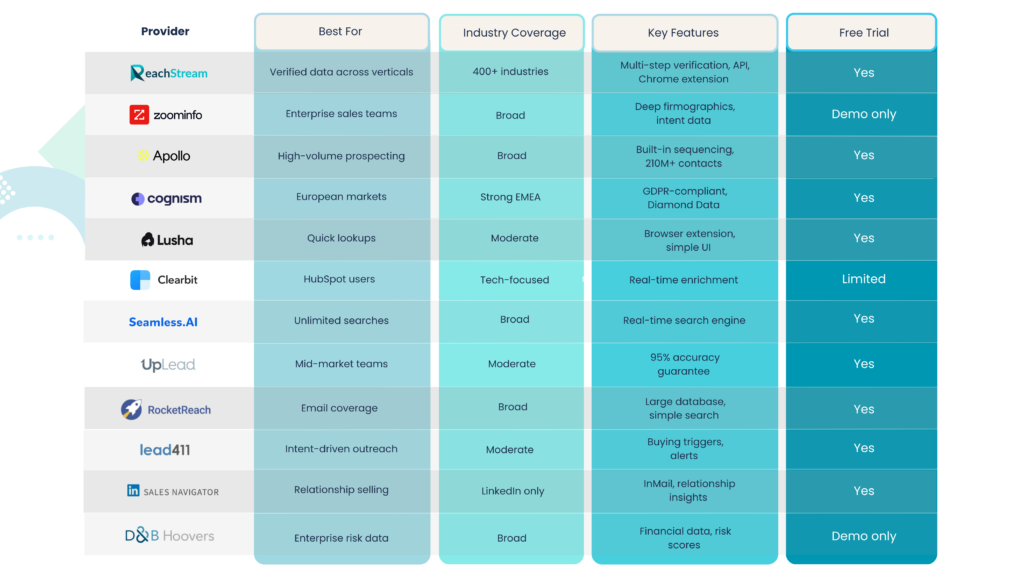
Top 12 industry-specific B2B contact data providers compared

Top 12 industry-specific B2B contact data providers compared

Best B2B contact databases for industry-specific sales prospecting

The right B2B contact database can transform your prospecting efforts by helping you identify and engage high-value prospects within your target industries.

ReachStream

ReachStream provides access to 200M+ verified B2B contacts across 400+ industries, with filtering by SIC/NAICS codes, job title, seniority, and company size. The platform uses multi-step email verification to maintain 90% deliverability and 95% data accuracy. 

  • Industry filtering: Search by specific verticals using standardized industry codes 
  • Verification: Emails validated through SMTP checks, AI analysis, and human review 
Find Your Best-Fit Leads Faster

ZoomInfo

ZoomInfo offers enterprise-grade data with deep firmographic and technographic coverage. The platform provides organizational charts and intent signals, though pricing typically starts higher than mid-market alternatives. 

Apollo.io

Apollo combines a 210M+ contact database with built-in email sequencing and a dialer. It works well for high-volume outreach, though industry-specific filtering isn’t as granular as some specialized providers. 

Cognism

Cognism stands out for European market coverage and GDPR compliance. Their Diamond Data feature provides human-verified mobile numbers, which is particularly valuable for phone-first sales teams operating in EMEA.  

Lusha

Lusha offers a lightweight browser extension for quick contact lookups. It’s straightforward to use but lacks the advanced filtering and enrichment capabilities of more comprehensive platforms. 

Clearbit

Now part of HubSpot as Breeze Intelligence, Clearbit excels at real-time enrichment. It’s best suited for teams already using HubSpot who want seamless data flow between systems. 

Seamless.AI

Seamless.AI positions itself as a real-time search engine for B2B contacts, with unlimited searches on higher-tier plans. Data quality can vary, so verification before outreach is worth the extra step. 

UpLead

UpLead emphasizes accuracy with a 95% data guarantee and real-time email verification. Transparent pricing makes it a solid option for mid-market teams. 

RocketReach

RocketReach offers broad email coverage across a large database. It’s useful for general prospecting but provides less industry-specific depth than specialized providers. 

Lead411

Lead411 includes intent data triggers that identify companies actively researching solutions in your space. This helps with timing outreach to coincide with buying signals. 

LinkedIn Sales Navigator

Sales Navigator excels at relationship-based selling and provides insights into prospect activity. However, it doesn’t export verified contact data on its own—pairing it with a data provider’s Chrome extension fills that gap. 

D&B Hoovers

D&B Hoovers leverages Dun & Bradstreet’s firmographic data, including financial health and risk scores. It’s designed for enterprise teams that factor financial stability into account prioritization. 

Industry-specific contact data vs. generic B2B databases

Generic databases offer volume—millions of contacts across every industry and role. Industry-specific databases offer relevance—contacts pre-filtered to match your target verticals. 

Here’s how they compare in practice: 

  • Generic databases: Broad coverage, requires manual filtering, often higher bounce rates when targeting niche markets 
  • Industry-specific databases: Pre-segmented by vertical, faster list building, better deliverability for targeted campaigns


If you’re selling a horizontal product to any business, generic data might work fine. But if you have a defined ideal customer profile with specific industry criteria, generic data typically leads to wasted spend and lower conversion rates. 

How to choose the right B2B contact data provider ?

Choosing the right B2B contact data provider for your vertical requires a clear understanding of your target market, data needs, and growth goals.

Define your target industries and buyer personas

Start by documenting which verticals you sell into and which job titles you target. This determines which providers can actually serve your needs—there’s no point evaluating a provider that lacks coverage in your space. 

Test data quality with a free trial

Most providers offer free credits or trial periods. Export a sample list, run the emails through a verification tool, and check accuracy before committing to a paid plan. 

Tip: ReachStream’s IceBreaker plan includes 100 free export credits—enough to test data quality in your target verticals before scaling. 

Verify coverage for your specific verticals

Ask providers directly about contact volume in your target industries. Request sample counts filtered by your exact criteria—industry, job title, company size, and geography. 

Confirm integration with your sales and marketing stack

Check for native CRM integrations and API access. Data that doesn’t flow into your existing tools creates manual work and increases the risk of records falling out of sync. 

Compare pricing against your outreach volume

Calculate cost per contact based on your monthly prospecting needs. Credit-based models often work better for teams running 500-1,000 contacts per month, while unlimited plans make more sense for high-volume operations. 

Build your industry-specific sales pipeline with verified B2B data

The right industry-specific data provider eliminates the guesswork that slows down pipeline building. Instead of manually filtering generic lists or chasing bounced emails, you start with verified contacts who actually match your ideal customer profile. 

ReachStream gives you access to 200M+ contacts across 400+ industries, with the filtering depth and verification accuracy that sales teams depend on. Start with the free IceBreaker plan to test industry-filtered contact data in your target verticals—then scale your outreach with confidence

Start Prospecting with Precision

Frequently asked questions

1. How do B2B contact data providers classify contacts by industry?

Providers typically use SIC codes, NAICS codes, or proprietary classification systems to tag companies and contacts by industry vertical. 

Quarterly at minimum. B2B data decays at 2-3% per month due to job changes, promotions, and company restructuring.

Yes. Most advanced B2B contact database platforms allow filtering by sub-industry, department, seniority, technology stack, and company size. 

Technology, finance, and healthcare typically have the deepest coverage. Niche manufacturing and local services may have gaps depending on the provider. 

Free tools work for initial testing, but typically offer limited credits, lower accuracy, and restricted filtering compared to paid plans. 

Manohar Devdiga

Digital Marketing Specialist skilled in SEO, Content, Social Media, Performance Marketing, Prospecting, and Demand Generation, with a Master’s degree in Marketing.

Share
Table of Contents

Access 200M+ verified business emails and grow your sales pipeline effortlessly.

Power Your Sales with Targeted Data

Don't forget to share this post!

Check out our other blogs!