



> Sales
How to Evaluate B2B Data Vendors for Accuracy and Compliance

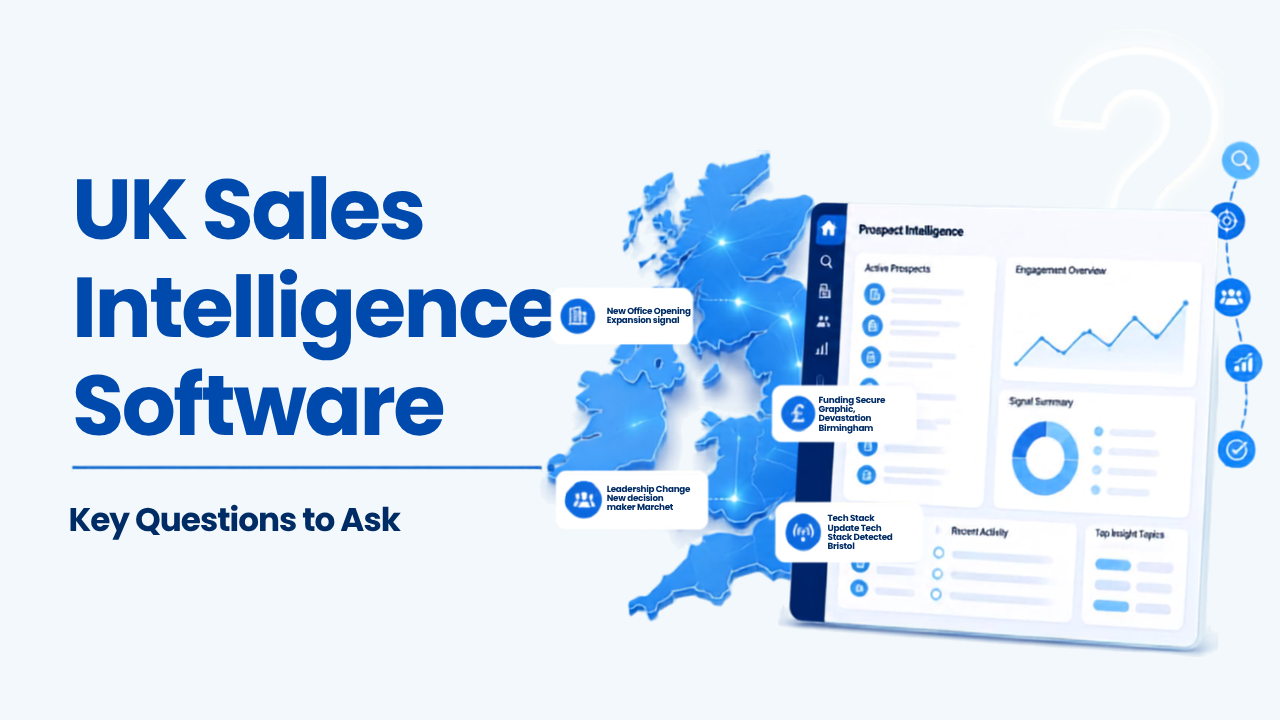
Choosing UK sales intelligence software is not simply a database comparison. The right platform
should help a revenue team identify the companies most likely to buy, find the people involved in
the decision, verify the information before outreach, and work within the team’s compliance and
operational processes.
This guide explains the questions buyers should ask before selecting a platform. It focuses on the
practical issues that determine whether sales intelligence becomes a useful part of a sales process
or remains an expensive list of names.
Before comparing vendors, define the commercial problem the software must solve. A useful
evaluation starts with five questions:
These questions keep the evaluation centred on outcomes rather than feature count. They also
make it easier to compare a specialist tool with a broader sales or marketing platform.
Data quality should be tested with a sample that reflects the buyer’s real market. Ask the vendor for a trial or evaluation process, then measure the results instead of relying only on a stated accuracy percentage.
A practical test can include the following steps:
The result should be judged by usable records, not raw database size. It is also worth checking whether the platform makes it easy to exclude unsuitable accounts, remove duplicates and document the source or status of a record.
GDPR is not a feature that a vendor can simply switch on. It is a legal framework that requires the organisation using personal data to have a lawful basis, respect people’s rights, limit data to what is necessary, protect it appropriately and avoid keeping it longer than needed.
The software can support responsible processes, but it does not remove the buyer’s obligations. Before choosing a provider, ask:
A buyer should review the vendor’s privacy documentation and obtain legal advice where the intended use is complex. In practice, compliance is strongest when good data governance, clear targeting and respectful messaging are built into the workflow from the beginning.
The value of sales intelligence increases when the data can move into the systems the team already uses. Buyers should review integrations with their CRM, sales-engagement tools, marketing automation platform and reporting process.
Do not stop at the question, “Does it integrate with our CRM?” Ask what the integration actually does. Can users import selected records rather than entire lists? Are field mappings clear? Can the team prevent duplicates? Are changes synchronised? Can source, verification status and consent-related notes be retained? Can managers see which data contributed to a meeting or opportunity?
A simple workflow is often more valuable than a long integration catalogue. For example, a team might identify target accounts, find relevant contacts, verify the addresses, enrich the CRM and assign an owner. The platform should make that sequence easy to control and audit.
Good sales intelligence improves relevance; it should not be used as a reason to send more messages to more people. The team should define its audience carefully, use business context to make outreach useful, and provide a clear way for recipients to opt out.
Sales and marketing leaders should also set internal rules for list ownership, data retention, suppression and review. A shared process prevents one person’s prospecting activity from creating duplicate outreach or conflicting records elsewhere in the organisation.
The strongest results usually come from combining data with human research. A platform can shorten the time needed to find a likely account and contact, but the seller still needs to understand the company’s situation and decide whether a conversation is appropriate.
ReachStream is one option for teams that want company and contact discovery, list building and email verification in a connected prospecting workflow. Its B2B prospecting platform can be assessed against the same criteria outlined in this guide: target-market coverage, filtering, contact fields, verification, workflow fit and data governance.
For buyers who want to understand how the data is assembled and maintained, ReachStream provides an overview of its company and contact data. Teams can also review the Email Verifier when deliverability and address validation are central to the buying decision.
These pages are useful starting points, not a substitute for testing. A UK buyer should still run a sample against its own ideal customer profile, inspect the records, verify the workflow and confirm that the product supports the organisation’s privacy and outreach requirements.
Before selecting a platform, document the answers to these questions:
The answers should be written into a scoring sheet before product demonstrations. This prevents the most polished presentation from outweighing the requirements that matter in day-to-day use.
The best UK sales intelligence software is the platform that makes a sales process more focused, accurate and measurable. It should help teams define the right accounts, reach the right people, verify information before outreach and operate within a responsible data process.
ReachStream may be worth including in a shortlist when a team wants prospect discovery, list building and email verification in one workflow. The final decision, however, should follow a practical test against the buyer’s own market, CRM process, compliance requirements and commercial goals.
A disciplined evaluation will produce a smaller and better-supported decision than a database-size comparison. It will also give the sales team a clearer answer to the question that matters most: can this software help us create more relevant conversations with the right UK buyers?
Sales intelligence software brings together information about companies, contacts, and buying context to help sales and marketing teams identify target accounts, find relevant decision-makers, verify contact information, and decide what action to take next. Unlike a static database, it supports a broader prospecting and sales workflow.
UK businesses should evaluate company and contact coverage, data accuracy and freshness, email verification, filtering and enrichment capabilities, CRM integrations, GDPR-related controls, and reporting. The software should also be tested against the company’s actual ideal customer profile rather than judged only by database size.
The most practical approach is to test a representative sample of your target UK market. Check whether the platform finds the right companies and contacts, manually review roles and duplicate records, verify email addresses, identify outdated or missing information, and compare the time required to create a usable prospect list.
Sales intelligence software itself does not automatically make a company GDPR compliant. The organisation using personal data still needs an appropriate lawful basis, must respect data-subject rights, limit data collection to what is necessary, protect the information, and follow appropriate retention practices. Buyers should review the provider’s privacy documentation and data-handling processes before implementation.
A useful platform should provide company data, contact data, contextual or enrichment information, and verification or freshness indicators. Depending on the platform, this can include industry, location, company size, revenue indicators, job title, seniority, department, work email, technology information, growth indicators, and hiring activity.
Email verification helps determine whether an address is valid and deliverable before it is used for outreach. Verification can reduce the risk of relying on outdated or undeliverable addresses and helps teams maintain a more usable prospect database.
Sales intelligence platforms can connect prospect and company data with a CRM so teams can identify accounts, find contacts, enrich records, and assign prospects without manually transferring information. Buyers should check whether the integration supports field mapping, duplicate prevention, synchronisation, source and verification information, and controlled record imports.
Start by defining the companies and decision-makers the team needs to reach, then compare providers based on UK market coverage, data quality, verification, workflow and CRM fit, privacy controls, and measurable sales outcomes. A representative trial using the company’s own target market is more useful than choosing solely on database size or the number of features.
Author

Manohar Devadiga is a marketing professional specializing in SEO, content strategy, social media, performance marketing, prospecting, and demand generation.
Access 200M+ verified business emails and grow your sales pipeline effortlessly.
Don't forget to share this post!















Check out our other blogs!
How a Medical Device Company Can Reach Hospital Decision-Makers
What Data Fields Should a Healthcare Marketing Database Include?
ReachStream Prospect vs Prospeo: Who Delivers Accurate Data?
How to Evaluate B2B Lead Generation Platforms: 7 Non-Negotiable Criteria