How to Evaluate B2B Data Vendors for Accuracy and Compliance
Bad data doesn’t just slow campaigns down—it burns budget, damages sender reputation, and makes your team look unprepared. When 30% of B2B contact data decays every year, the provider you choose determines whether outreach lands or bounces.
This guide breaks down what marketing data providers actually do, the main types available, and how to evaluate the vendors worth considering in 2026.
What Is a Marketing Data Provider
Marketing data providers are platforms that supply verified contact information, firmographics, and buyer intent signals to fuel outreach, lead generation, and account-based marketing. In plain terms, they’re the companies that help you find the right people to talk to—and give you the details you need to actually reach them.
Instead of manually researching prospects one by one, you get structured contact and company data ready for activation. The data typically includes:
- Contact data: Verified emails, direct dials, job titles, and seniority levels
- Company data: Industry, revenue range, employee count, and headquarters location
- Behavioral signals: Intent data and technographics that reveal when accounts are actively researching solutions
Types of Marketing Data Providers
Not every provider offers the same thing. Some specialize in contact lookups, while others focus on company intelligence or buying signals. Understanding the main categories helps you match the right vendor to your specific problem.
Contact Data Providers
Contact data providers specialize in verified emails, direct dials, and decision-maker information. Without accurate contact data, even the best messaging goes nowhere.
Firmographic Data Providers
Firmographic providers supply company-level attributes like industry classification, headquarters location, revenue range, and employee count. This data powers account-based targeting and helps teams prioritize accounts that match their ideal customer profile.
Intent Data Providers
Intent providers track online research behavior to identify accounts actively exploring solutions. When a prospect visits competitor websites or consumes content related to your category, intent data surfaces that signal.
Technographic Data Providers
Technographic data reveals which technologies a company uses—CRM systems, marketing automation platforms, cloud infrastructure. This information helps teams craft competitive positioning and identify compatibility with their own product.
Signal and Event Data Providers
Signal providers surface real-time triggers like funding rounds, leadership changes, or hiring surges. These events often indicate buying readiness and give sales teams a timely reason to reach out.
Benefits of Using a Marketing Data Provider
Why invest in a data provider at all? The short answer: better outcomes with less manual work.
Higher Email Deliverability and Lower Bounce Rates
Verified contact data means fewer bounced emails. High bounce rates damage sender reputation, which can land your entire domain in spam folders. Pairing clean data with email verification protects deliverability over time.
Sharper Audience Segmentation
Rich firmographic and technographic attributes let teams build precise segments. Instead of spraying generic campaigns, you can tailor messaging to specific industries, company sizes, or technology stacks.
Faster Pipeline and Campaign Velocity
Pre-built, outreach-ready data eliminates manual research time. Campaigns launch faster when you’re not hunting for email addresses one by one.
Cleaner CRM Records and Less Manual Work
Data enrichment keeps records current and reduces time spent chasing outdated information. When contacts change jobs or companies grow, your CRM reflects reality.
Stronger Compliance and Reduced Risk
Reputable providers handle GDPR and CCPA compliance, reducing legal exposure. You’re not guessing whether your data was sourced ethically—the provider has already done that work.
Best Marketing Data Providers and Vendors to Know
Here’s a look at the providers worth evaluating in 2026. Each serves different use cases, so the right choice depends on your team size, budget, and workflow.
1. ReachStream
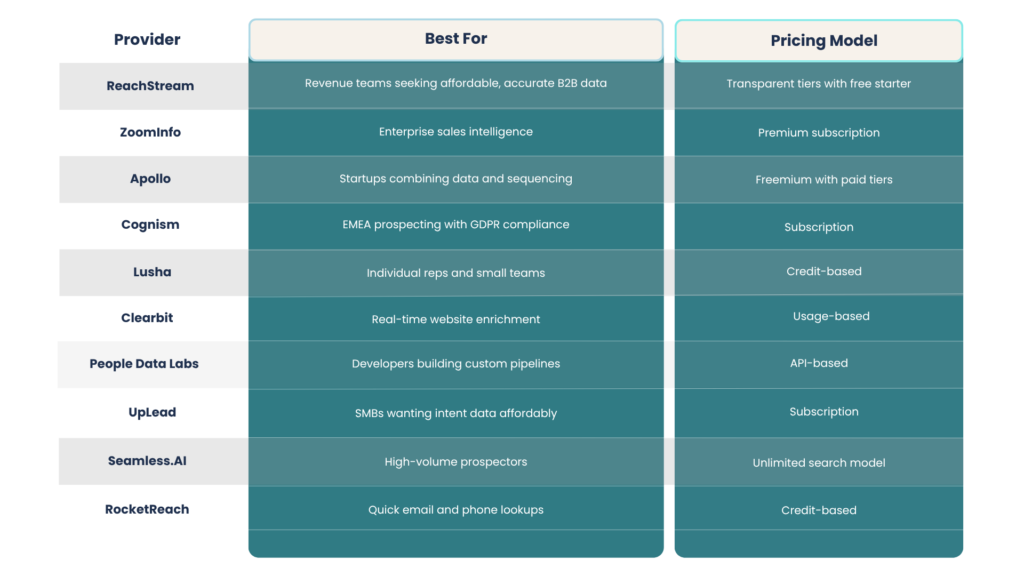
ReachStream offers a unified B2B data platform with List Builder, Chrome Extension, Data Enrichment, and API access in one system. The platform uses a multi-step verification process and refreshes data regularly to maintain accuracy. Pricing is transparent with a free starter option, making it accessible for solopreneurs through enterprise teams.
2. ZoomInfo
ZoomInfo is an enterprise-grade sales intelligence platform with deep company and contact coverage, particularly strong in North America. Intent data and org charts are standout features. That said, the price point reflects its enterprise positioning.
3. Apollo
Apollo combines a large contact database with built-in sales engagement tools like email sequencing. It’s popular with startups and SMBs looking for an all-in-one platform at a lower price than enterprise alternatives.
4. Cognism
Cognism focuses on EMEA markets with strong GDPR compliance and mobile-verified phone numbers. If your team relies heavily on phone outreach in Europe, Cognism is worth evaluating.
5. Lusha
Lusha is a lightweight browser extension for quick contact lookups. It’s best suited for individual reps and small teams who want fast access without complex workflows.
6. Clearbit
Now part of HubSpot as Breeze Intelligence, Clearbit excels at real-time enrichment for website visitor identification and form shortening. It’s particularly useful for marketing teams focused on inbound conversion.
7. People Data Labs
People Data Labs is an API-first provider for developers and data teams building custom enrichment pipelines. If you’re comfortable with technical implementation, PDL offers flexibility at scale.
8. UpLead
UpLead provides real-time email verification and intent data at a price point accessible to SMBs. It’s a solid middle-ground option for teams that want more than basic contact data without enterprise pricing.
9. Seamless.AI
Seamless.AI uses an AI-powered search engine model with unlimited searches on certain plans. High-volume prospectors who prioritize quantity may find this model appealing.
10. RocketReach
RocketReach offers straightforward email and phone lookups with broad coverage across industries. The interface is simple, making it useful for quick, ad-hoc searches.
How to Choose the Right Marketing Data Provider
Selecting a provider involves more than comparing database sizes. Here’s what to evaluate.
Data Accuracy and Refresh Frequency
Ask how often the provider updates records. Stale data leads to bounces and wasted spend. Providers that refresh monthly or more frequently typically deliver better results than those with quarterly or annual updates.
Coverage Across Geographies and Industries
Not all providers have equal depth globally. If you’re targeting EMEA or APAC, verify the provider has meaningful coverage in those regions before committing.
Compliance With GDPR and CCPA
Verify the provider’s data sourcing practices and compliance certifications. Non-compliant data exposes your organization to legal risk.
CRM and Martech Integrations
Check native integrations with your existing stack—Salesforce, HubSpot, Outreach, and similar tools. Manual data transfers create friction and slow down campaigns.
Pricing Model and Scalability
Understand whether pricing is credit-based or subscription-based. Consider how costs scale as your team grows and usage increases.
Match Rate and Free Trial Testing
Run a sample file through the provider’s enrichment before signing a contract. Match rate—the percentage of your records the provider can enrich—reveals how well their data aligns with your ICP.
Common Mistakes to Avoid When Buying Marketing Data
- Choosing based on database size alone—larger databases don’t guarantee accuracy or relevance to your ICP.
- Ignoring data freshness—providers that don’t refresh regularly deliver outdated contacts.
- Skipping trial testing—always test match rates with your own data before committing.
- Overlooking compliance—non-compliant data exposes your organization to legal risk.
- Underestimating integration effort—confirm the provider integrates with your CRM natively.
Best Practices for Using Marketing Data
Marketing data delivers the greatest value when it’s actively maintained, strategically segmented, and continuously measured. The following best practices can help you improve data quality, campaign performance, and overall marketing ROI.
Refresh and Enrich Your CRM Regularly
Treat data as an ongoing investment, not a one-time purchase. Schedule recurring enrichment to keep contact and company records current.
Segment Audiences Before Activation
Use firmographic and intent filters to build targeted segments before launching campaigns. Broad, unsegmented lists waste budget and hurt engagement rates.
Monitor Email Deliverability and Bounce Rates
Track bounce rates by data source to identify quality issues early. If one source consistently underperforms, you’ll know where to adjust.
Track ROI by Source and Campaign
Attribute pipeline and revenue back to specific data sources. This measurement reveals which providers deliver real value versus vanity metrics.
Conclusion
Accurate, continuously refreshed B2B data is the foundation of effective marketing. ReachStream brings List Builder, Chrome Extension, API access, and Data Enrichment into one platform—so teams can operate from a single system of record with transparent pricing.
Ready to improve your marketing results with accurate, verified data?
Frequently asked questions
1. How accurate is data from marketing data providers?
Accuracy varies by provider and depends on verification methods and refresh frequency. Look for providers with multi-step verification processes and regular data updates—monthly or more frequent refreshes typically indicate higher quality.
2. How much do marketing data providers cost?
Pricing models range from per-credit charges to flat-rate subscriptions. Costs vary based on data volume, features, and contract length. Many providers offer free trials or starter tiers for evaluation.
3. What is the difference between a marketing data provider and a sales intelligence platform?
Marketing data providers focus on supplying raw contact and company data. Sales intelligence platforms layer on engagement tools, intent signals, and workflow automation. Some platforms combine both capabilities.
4. Are marketing data providers GDPR and CCPA compliant?
Reputable providers maintain compliance with major privacy regulations. However, teams can verify sourcing practices and certifications before purchasing—compliance is the provider’s responsibility, but due diligence is yours.
5. How often should marketing data be refreshed?
Best practice is to refresh data at least quarterly. Leading providers update records monthly or more frequently, which helps maintain accuracy as contacts change jobs and companies evolve.
6. Can marketing teams buy data lists for one-time use?
Some providers offer one-time list purchases. However, subscription models typically provide better long-term value with ongoing updates and enrichment—especially for teams running continuous campaigns.
Manohar Devdiga
Marketing professional with a Master’s degree in Marketing, specializing in SEO, content strategy, social media, performance marketing, prospecting, and demand generation.
Share
Table of Contents
Access 200M+ verified business emails and grow your sales pipeline effortlessly.
Power Your Sales
with Targeted Data
Don't forget to share this post!















Check out our other blogs!
How to Build a Targeted Prospect List Using Filters
October 21, 2026

B2B Data for Ed-Tech Companies: Reaching School Decision-Makers
October 21, 2026

Direct Dial Numbers Explained: A Guide for Sales Reps
October 19, 2026