


> Sales
How to Evaluate B2B Data Vendors for Accuracy and Compliance

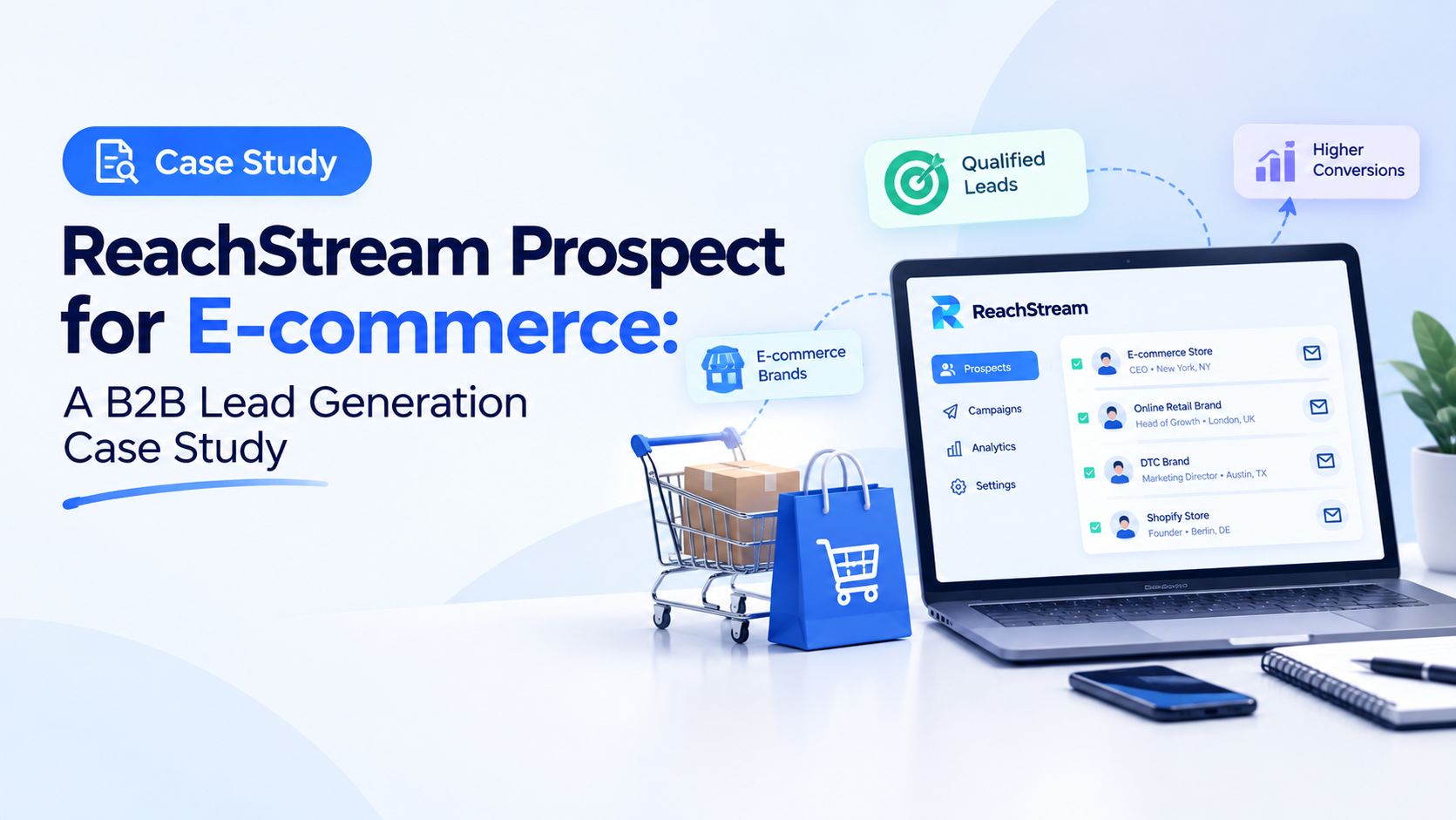
ReachStream Prospect for E Commerce brands is a B2B contact and company database designed to help ecommerce founders and sales teams connect with the right retail buyers, distributors, and wholesale decision-makers.
With ReachStream Prospect for ecommerce, you can filter by industry, company size, seniority, and location, then export verified B2B contact data for ecommerce outreach, making manual research and guessing a thing of the past.
Outbound prospecting means you’re taking the first step by reaching out to potential buyers instead of hoping they come to you. In this ecommerce outbound case study, let’s walk through one real-world path from DTC storefront to wholesale conversations, step by step.
The reality is that paid social channels are crowded, customer acquisition costs keep rising, and there’s a ceiling to what you can drive through email and repeat buyers. Ecommerce brand lead generation focused on retailers and distributors opens a new sales channel that isn’t dependent on ever-changing ad auctions.
Making the jump, known as DTC to B2B expansion, reshapes your margins, but gives you access to bigger order volumes, shelf credibility, and a new audience of shoppers you’d likely never reach on your own. In 2025, U.S. DTC ecommerce was a $239.75 billion market (about 19.2% of retail ecommerce), according to Swell. It’s a massive space, and competition is fierce.
But going wholesale means you’re not talking to everyday shoppers anymore. Buyers aren’t just scrolling. They want a relevant email, proof you’ve done your homework, and a reason to reply. That’s what gets you a seat at the table.
You’re not pitching to a single type of buyer. Boutique owners read almost every message. At regional chains, category managers are sifting through dozens of pitches a week. Distributors, their purchasing managers are focused on logistics: case packs, lead times, reorder rates. Knowing these differences is the heart of effective retail buyer prospecting.
Successful wholesale buyer outreach depends on tailoring your pitch to who’s on the other end. Whether you’re talking to an owner, buyer, category manager, or purchasing lead, your message should match what matters to them. The same product might need three different angles.
Every bounce counts against you. Mailbox providers notice how much of your mail goes to dead addresses, and a rising bounce rate is an early sign that a list was not checked. Many teams aim to keep bounces under about 2%.
That’s why verified B2B contact data for ecommerce outreach is about more than just convenience. Taking the time to verify leads means your emails actually land, and you’re not risking your sender reputation or wasting time on dead ends. Often, a smaller, high-quality list of real buyers outperforms a massive list of unverified contacts.
Email deliverability is about whether your message lands in the inbox or gets lost in spam. Gmail, Outlook, and Yahoo track your list quality, complaint rates, and how consistent your sending behavior is. It’s all built on things you can control, starting with your list.
Google tells bulk senders to keep reported spam rates under 0.10% and to avoid ever reaching 0.30%, as summarized by MarTech. The formal bulk sender rules start at 5,000 messages a day, which most young brands will not reach, but SPF, DKIM, and DMARC are sensible at any volume. The ReachStream guide to improving email deliverability rates walks through the setup.
Start with industry and company size, because a local boutique and a national retailer need very different approaches. Add seniority and job function to focus on buyers and merchandising roles, not marketing. Use location filters for regional targeting or to match your shipping capabilities.
List segmentation comes next, which means splitting the list into groups that get different messages, such as independents, chains, and distributors. ReachStream Prospect includes Similar Companies, which is designed to help you grow a list from accounts that already fit, and AI Conversational Search, which can make it faster to describe a buyer in plain language than stacking filters by hand.
Digital Commerce 360 figures, as reported by Xorosoft, put U.S. B2B ecommerce at about $2.93 trillion in 2025, up roughly 13% year over year. That is the backdrop for B2B sales for ecommerce 2026. Survey data compiled by Swell also suggests 61% of B2B buyers prefer a rep-free buying experience, so many buyers will look you over quietly before replying. Your site, wholesale terms, and product pages should be ready when your email lands.
Focus your retail buyer prospecting by starting narrow. Chasing every retailer at once spreads your efforts too thin and makes your outreach generic. Instead, pick two or three segments, such as boutiques, regional chains, or distributors. Craft a message for each and measure what works before scaling up.
The table further down sums up how those groups differ. Treat it as a starting point, then adjust it to your category, your price point, and what your own DTC data says about who already loves the product.
| Buyer type | Typical titles | What they care about | Best opening angle | Common pitfall |
|---|---|---|---|---|
|
Independent retailers and boutiques |
Owner, store manager |
Fit with their shoppers, margin, low minimums |
A short note on why the product suits their customers, plus a clear starter order |
Sounding like a big chain: too formal and too long |
|
Regional and national chains |
Buyer, category manager, merchandise manager |
Sell-through, margin, reliable supply |
Proof of traction such as reviews and repeat purchases, then a small pilot |
Writing to a general inbox or the wrong category |
|
Distributors and wholesalers |
Purchasing manager, sourcing manager, account manager |
Case packs, lead times, reorder rates, pricing tiers |
Wholesale terms up front and a question about how they onboard new brands |
Assuming they will tell your brand story for you |
|
Online retailers and marketplaces |
Ecommerce manager, marketplace buyer, category manager |
Complete product data, consistent pricing, reliable fulfillment |
Clean product data and a clear pricing policy, then a trial assortment |
Overlooking channel conflict with your own DTC store |
|
Buying groups and co-ops |
Vendor relations manager, merchandising director, member services lead |
Vendor terms, member demand, rebates and programs |
A question about how the group reviews new vendors, plus your terms |
Pitching individual members and skipping the group process |
Cold email for ecommerce brands should be judged against a baseline, and any cold email results case study is only useful next to one. Here is where 2026 sits. The Instantly benchmark report puts the average reply rate at 3.43%, the top quartile at 5.5%, and elite campaigns above 10%. It also found that about 58% of replies come from the first email in a sequence, so the opener earns most of your attention.
In planning terms, 500 delivered emails at the 3.43% average would bring roughly 17 replies, and only some of those would be positive. That is arithmetic on industry averages, not a forecast for your brand, and wholesale is a narrower market than most of the data behind these reports.
Keep an eye on the health numbers too: bounces under about 2% and spam complaints under 0.10%.
ReachStream Prospect is designed to give outbound teams a searchable base of verified contacts and company data, currently 500M+ contacts, 50M+ companies, and 100M+ direct dials. For an ecommerce brand, that can mean finding a category buyer at a regional chain, or the purchasing lead at a distributor, without losing a morning to manual research.
Filters cover industry, company size, seniority, and location, and AI Conversational Search is designed to let you describe who you want in plain language. Similar Companies can make it faster to grow a list from accounts that already fit your ICP. When you are ready, you can export to CSV or sync to your CRM, and the Chrome extension can help when you spot a buyer on LinkedIn.
The free plan includes 100 export credits per month, with access to advanced filters and the Chrome extension. That is enough to pull a small batch of buyers, compare the data against what you already know about your market, and decide whether to go further.
Outbound is absolutely worth it for an ecommerce brand, if you keep your list clean, segment carefully, and set realistic expectations. ReachStream Prospect for E Commerce brands makes research and list-building much faster, but the key to results is still a strong offer and smart targeting.
As seen in this cold email campaign case study, the approach that works for ecommerce wholesale partnerships is consistent: define your ICP, verify before you send, test one variable at a time, and focus on quality positive replies. A thoughtful ecommerce brand outbound strategy will almost always outperform a generic, high-volume blast.
If you are weighing B2B lead generation for ecommerce, a small first batch is the cheapest experiment you can run. Pull 100 contacts, send carefully, and let your own numbers decide what comes next.
Yes. The free plan includes 100 export credits per month, along with advanced filters and the Chrome extension. It is designed for testing data quality before you upgrade. Check the pricing page for current plan details.
Author

Explore 450M+ contacts and 25M+ companies and start building your wholesale buyer list.
Don't forget to share this post!















Check out our other blogs!
Is Buying B2B Data Legal? What You Need to Know
Intent Data: What It Is and How to Use It for Campaign Targeting
What Mid-Market SaaS Teams Need in Lead Gen Tools
ReachStream Prospect for E-commerce Brands: Outbound Case Study