How to Evaluate B2B Data Vendors for Accuracy and Compliance
What is the role of verified data in 2026? In 2026, verified data is the foundational asset for AI-driven marketing and B2B sales. It ensures that automated systems generate accurate insights, prevents costly data decay, and builds buyer trust. Verified data directly impacts ROI by improving email deliverability, enabling signal-based selling, and mitigating the risks associated with AI hallucinations.
As we navigate the complexities of the 2026 market, the sheer volume of information available to businesses is staggering. However, the focus has definitively shifted from data quantity to data quality. In an era where artificial intelligence (AI) dictates go-to-market strategies, the integrity of your database is no longer just an operational concern; it is a strategic imperative.
The State of B2B Data in 2026: A Landscape of Decay
The digital ecosystem is dynamic, and B2B data is inherently volatile. Professionals change jobs, companies rebrand, and contact information evolves constantly. This natural progression leads to a phenomenon known as data decay.
Recent statistics highlight the severity of this issue. B2B contact data decays at an average rate of 22.5% per year, which equates to roughly 2.1% per month. This means that without active intervention, nearly one in four records in a CRM system becomes inaccurate every year. The consequences of relying on stale data are profound, leading to bounced emails, wasted sales efforts, and ultimately, lost revenue.
To combat this, modern sales teams are moving away from broad, untargeted outreach toward signal-based selling. This approach relies on identifying specific buying signals—such as intent data, recent funding, or leadership changes—to trigger outreach. However, signal-based selling is entirely dependent on real-time, verified B2B contact and company data. Without verification, the signals are meaningless, and the outreach falls flat.
Why Verification is the New Foundation?
The integration of generative AI into marketing and sales workflows is the defining trend of 2026. Yet, AI systems operate on a fundamental principle: “Garbage In, Garbage Out.” AI does not fix bad data; it amplifies it.
According to Forrester’s 2026 predictions, B2B companies risk losing over $10 billion due to the ungoverned use of generative AI, largely driven by inaccurate or unreliable information. When AI models are trained on or fed unverified data, they produce flawed insights, incorrect predictions, and inappropriate automated responses.
Furthermore, this lack of data integrity directly impacts buyer confidence. Studies indicate that 19% of B2B buyers using AI applications feel less confident in their purchasing decisions due to inaccurate information provided by these systems. As AI generates more content and insights, buyers are increasingly turning to human experts to validate claims. Therefore, ensuring your AI tools are powered by verified data is essential for maintaining trust and credibility in the market.
The Economic Impact: Cost of Bad Data vs. ROI of Verified Data
The financial implications of data quality are staggering. Poor data quality costs U.S. businesses an estimated $3.1 trillion annually, with individual organizations losing an average of $12.9 million per year due to wasted resources and missed opportunities.
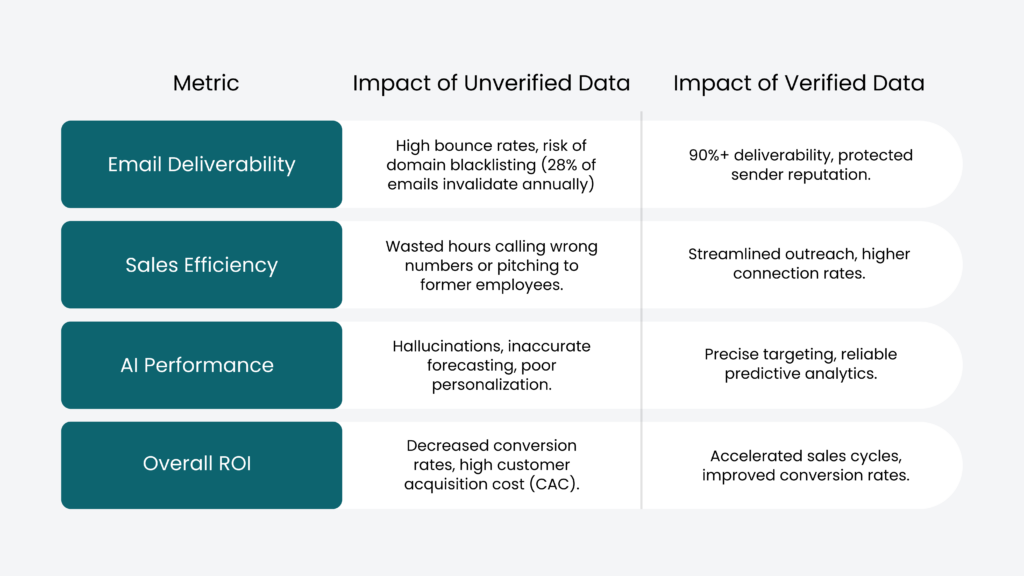
The table below illustrates the stark contrast between operating with unverified versus verified data:
Investing in data verification is not merely a cost-saving measure; it is a revenue-generating strategy. By utilizing tools like a built-in email verifier, companies can ensure their outreach efforts actually reach the intended inbox, maximizing the return on their marketing investments.
How to Implement a Verified Data Strategy in 2026
Transitioning to a verified data model requires a systematic approach. Here are the best practices for maintaining data hygiene and leveraging verified insights in 2026:
Conduct Regular Data Audits: Begin by assessing the current state of your CRM. Identify duplicate records, missing fields, and outdated contacts. Understanding the extent of your data decay is the first step toward remediation.
Prioritize Data Enrichment: Do not just clean your data; enhance it. Data enrichment involves appending missing information—such as technographics, firmographics, and social profiles—to existing records. This provides a comprehensive view of your prospects, enabling hyper-personalized outreach.
Leverage Data as a Service (DaaS): For enterprise-scale operations, managing data internally can be overwhelming. Utilizing Data as a Service (DaaS) platforms ensures a continuous flow of fresh, verified data directly into your systems, eliminating the manual burden of data maintenance.
Evaluate Your Vendors Carefully: Not all data providers are created equal. When selecting a partner, prioritize those who offer transparent verification processes and high accuracy guarantees. For guidance on this, refer to comprehensive resources on how to evaluate B2B data vendors.
Integrate Verification into Workflows: Make data verification a continuous process rather than a one-time event. Implement automated checks at the point of entry (e.g., form submissions) and schedule regular database scrubs.
Conclusion
In 2026, data is ubiquitous, but verified data is a premium asset. As AI continues to reshape the B2B landscape, the accuracy of the information fueling these technologies will determine the winners and losers. Companies that prioritize data verification will not only avoid the costly pitfalls of data decay but will also build stronger, more trusting relationships with their buyers.
To stay ahead of the curve and implement the most effective B2B growth hacking ideas for 2026, start by ensuring your foundation is solid. Embrace verified data as the core of your go-to-market strategy and watch your efficiency, AI performance, and ROI soar.
1. How do B2B contact data providers classify contacts by industry?
Providers typically use SIC codes, NAICS codes, or proprietary classification systems to tag companies and contacts by industry vertical.
2. How often should you refresh your industry-specific contact lists?
Quarterly at minimum. B2B data decays at 2-3% per month due to job changes, promotions, and company restructuring.
3. Can you filter B2B contacts by sub-industry or niche vertical?
Yes. Most advanced B2B contact database platforms allow filtering by sub-industry, department, seniority, technology stack, and company size.
4. Which industries have the best B2B contact data coverage?
Technology, finance, and healthcare typically have the deepest coverage. Niche manufacturing and local services may have gaps depending on the provider.
4. Are free B2B contact database tools reliable for sales prospecting?
Free tools work for initial testing, but typically offer limited credits, lower accuracy, and restricted filtering compared to paid plans.
Manohar Devdiga
Marketing professional with a Master’s degree in Marketing, specializing in SEO, content strategy, social media, performance marketing, prospecting, and demand generation.
Share
Table of Contents
Access 200M+ verified business emails and grow your sales pipeline effortlessly.