
Unlimited Data.
Infinite Possibilities.

Looking for B2B data? Download Unlimited data using our Chrome extension at just $79/month.
10 Best Clay Alternatives That Won't Break Your Budget in 2026

10 Best Clay Alternatives That Won't Break Your Budget

Best Tips on Lead Generation for Technology Companies

Clay’s credit-based pricing model can drain your budget faster than you’d expect—especially when enrichments fail and you’re still charged. For teams that just want verified emails and phone numbers without building complex workflow tables, the platform often feels like overkill.

This guide breaks down 10 Clay alternatives that deliver accurate B2B data at lower cost, compares pricing and features across each option, and helps you pick the right fit based on your team’s actual needs.

Clay alternatives at a glance

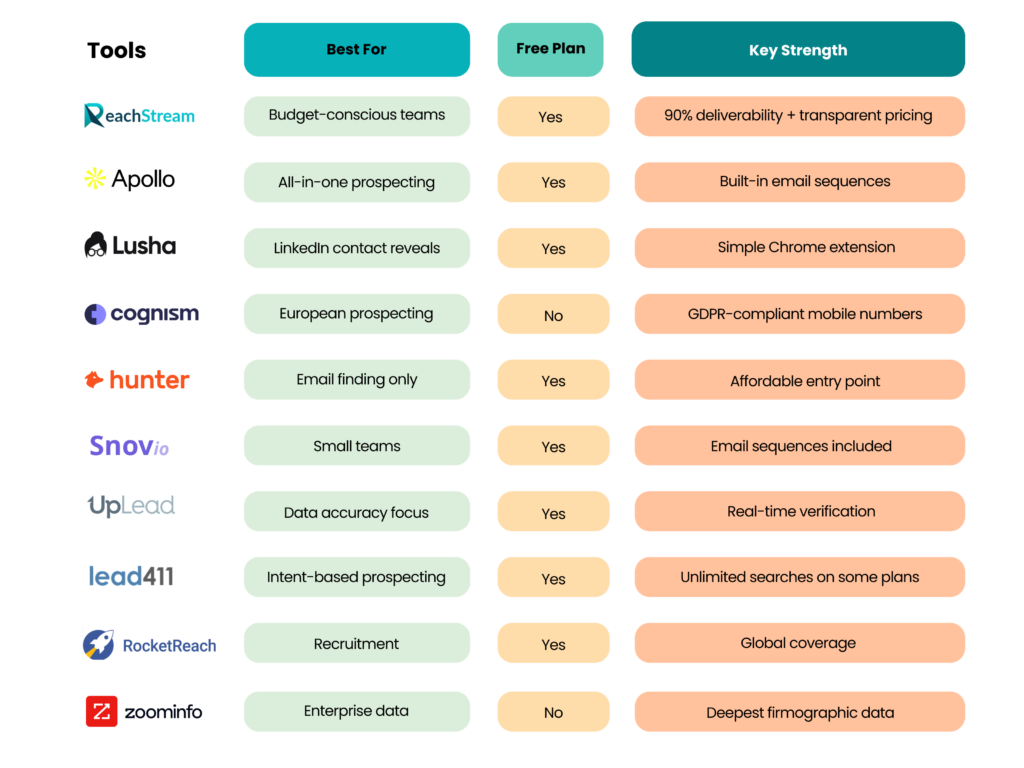
Top competitors to Clay for B2B data enrichment include Apollo.io for all-in-one prospecting, ZoomInfo for enterprise data, Lusha for quick contact reveals, and ReachStream for verified data with transparent pricing. Other notable alternatives are Cognism, Hunter, Snov.io, UpLead, Lead411, and RocketReach.

Clay alternatives

Why teams switch from Clay

Clay is a data enrichment and workflow automation platform that pulls contact and company data from multiple sources into customizable “tables.” Think of it as a spreadsheet that automatically fills itself with prospect information. While the concept is powerful, the execution comes with trade-offs.

Pricing adds up fast at scale

Clay uses a credit-based model where each enrichment action costs credits. Running a waterfall enrichment (trying multiple data sources until one returns a result) across a 5,000-person list can burn through credits quickly. The math gets uncomfortable when you’re testing different workflows or building large prospect lists.

Steep learning curve for non-technical users

Clay’s workflow builder offers real flexibility, but that flexibility requires technical knowledge. Sales reps and marketers often want to install a tool and start prospecting within minutes. Clay typically requires hours of setup and documentation reading before you see results.

Credits burn quickly on failed enrichments

Credits get consumed even when enrichments return incomplete or unusable data. You might run an enrichment expecting verified emails, only to receive partial results while your credit balance drops. That’s frustrating when you’re watching costs.

Overkill when you just need verified contact data

Here’s the thing: many teams don’t actually want complex automation. They want accurate emails and phone numbers, fast. If that describes your situation, simpler alternatives solve the problem without the overhead.

What to look for in a budget-friendly Clay alternative

Data accuracy and email deliverability

“Verified data” means the provider runs multi-step email verification, checking syntax, domain validity, and whether the mailbox actually exists. Deliverability rates above 90% indicate active data maintenance rather than stale records sitting in a database.

  • Email verification: Real-time validation catches bad addresses before they hit your outreach
  • Direct dials: Phone number accuracy matters for cold calling teams
  • Data freshness: B2B contact data decays at roughly 22.5% per year, so real-time updates beat quarterly database refreshes

Transparent pricing with free tiers

No-surprise billing matters when you’re watching costs. Free trials and freemium plans let you test data quality before committing budget. Look for clear credit structures where you know exactly what each action costs upfront.

CRM and B2B SaaS integrations

Native integrations with Salesforce, HubSpot, and Outreach eliminate manual data entry. API access opens possibilities for custom workflows. The goal is getting verified data into your existing tools without copy-pasting from spreadsheets.

Fast setup and time to value

Budget-conscious teams can’t afford weeks of onboarding. The best Clay alternatives work in minutes: install a Chrome extension, connect your CRM, start prospecting.

10 best Clay alternatives and competitors for B2B data enrichment

Not all Clay alternatives are built the same, and the cheapest option isn’t always the best value. Here’s what actually matters when evaluating a cost-effective replacement.

ReachStream

ReachStream is a B2B data platform with 200M+ verified contacts, 90% email deliverability, and 95% data accuracy. The platform serves sales, marketing, ABM, RevOps, and recruitment teams through a web app, Chrome extension, and API.

Best for: Teams wanting verified data without enterprise pricing

The IceBreaker free plan includes 100 export credits and 200 email credits with no credit card required. The Chrome Extension works directly in LinkedIn Sales Navigator for prospecting. ReachAPI handles automated enrichment and CRM integrations for teams building custom workflows.

One limitation: ReachStream has smaller brand recognition compared to ZoomInfo or Apollo. However, the data quality benchmarks and transparent pricing make it a strong fit for budget-conscious teams.

Apollo

Apollo combines a contact database with built-in email sequences and a dialer. It’s the go-to all-in-one platform for teams wanting data and outreach in one place.

Best for: Teams wanting prospecting and engagement without switching tools

The free tier includes 50 email credits monthly. Built-in sequences and call tracking reduce the number of tools in your stack. However, some users report inconsistent data quality and higher bounce rates compared to dedicated data providers.

Lusha

Lusha focuses on quick contact reveals directly from LinkedIn profiles. Click the extension, get contact info. That’s the entire workflow.

Best for: Reps who live in LinkedIn and want minimal complexity

The free tier offers 5 credits monthly. Paid plans start around $36/month. The limitation is depth: Lusha handles contact reveals well but doesn’t offer workflow automation or deep enrichment.

Cognism

Cognism stands out for European data coverage and GDPR compliance. If you’re prospecting in the EU, their Diamond Data® verified mobile numbers are particularly valuable.

Best for: International teams with European target accounts

The trade-off is price. Cognism sits in the mid-to-enterprise range with custom pricing, making it less accessible for small teams watching their budget.

Hunter

Hunter does one thing well: finding and verifying email addresses. Domain search, email finder, email verifier. That’s the product.

Best for: Teams that only want email finding on a tight budget

The free tier includes 25 searches monthly. Paid plans start at $49/month. The limitation is scope: no phone numbers, no firmographic data, no workflow automation.

Snov.io

Snov.io bundles email finding with outreach sequences at a budget-friendly price. Small teams get data and campaigns in one tool.

Best for: Small teams wanting data plus sequences affordably

Free trial available with paid plans from $39/month. The database is smaller than enterprise options, but the price-to-functionality ratio works well for early-stage teams.

UpLead

UpLead emphasizes data accuracy with real-time email verification. The platform offers a credit-back guarantee if an email bounces.

Best for: Teams prioritizing accuracy over volume

Free trial with 5 credits. Paid plans from $99/month. Limited workflow automation, but the accuracy focus appeals to teams tired of bounced emails.

Lead411

Lead411 includes Bombora intent data and offers unlimited searches on certain plans. It’s solid value for teams wanting buying signals without ZoomInfo pricing.

Best for: Signal-based prospecting on a mid-range budget

Free trial available with paid plans from $99/month. The interface feels dated compared to newer tools, but the intent data inclusion adds real value.

RocketReach

RocketReach offers global contact coverage with 700M+ professional profiles and strong API access. It’s popular for recruitment and talent sourcing.

Best for: Recruitment teams and global prospecting

Free tier available with paid plans from $53/month. Credit costs can add up with heavy usage, so watch your consumption.

ZoomInfo

ZoomInfo is the enterprise standard with the deepest firmographic and intent data available. It’s powerful, comprehensive, and expensive.

Best for: Large enterprises with substantial data budgets

Custom pricing typically starts at $15,000+ annually with required annual contracts. If you’re reading an article about budget-friendly alternatives, ZoomInfo probably isn’t the right fit.

Clay vs ZoomInfo for B2B data enrichment

Both Clay and ZoomInfo sit at the premium end of the market, though they solve different problems.

Clay vs ZoomInfo

Clay aggregates data from various providers through its workflow builder. ZoomInfo maintains its own proprietary database. If you want workflow flexibility, Clay offers more customization. If you want data depth, ZoomInfo goes deeper.

That said, budget-conscious teams often find that alternatives like ReachStream offer similar data quality at a fraction of the cost of either option.

Clay use cases and how alternatives handle them

While Clay is known for flexible data workflows, many teams use it for a handful of repeatable tasks. Understanding these core use cases makes it easier to evaluate whether simpler alternatives can achieve the same results.

Enrichment and lead scoring

Clay excels at enriching leads with multiple data points for scoring models. Lead scoring assigns point values to prospects based on attributes like company size, job title, and engagement signals.

Alternatives handle enrichment differently. ReachStream offers automated enrichment via API that feeds directly into your CRM. Apollo includes basic lead scoring in its platform. The workflow is simpler, even if the customization is less granular.

CRM data hygiene and lead routing

Teams use Clay to keep CRM records clean and route leads based on enriched attributes. A Validity survey found 44% of companies lose over 10% of revenue from poor CRM data, making this a high-stakes workflow. Native CRM integrations from tools like ReachStream and Lusha accomplish similar goals with simpler setup. No complex Clay tables required.

Free trial signups and Gmail enrichment

A common Clay use case: enriching free trial signups to identify company data from Gmail addresses. Someone signs up with a personal email, and you want to know where they work.

ReachStream’s API and bulk enrichment handle this workflow, turning anonymous signups into qualified leads with firmographic context like company size, industry, and revenue.

B2B SaaS integrations

Clay connects to dozens of tools through its workflow builder. Most alternatives offer native integrations with Salesforce, HubSpot, and Outreach, plus API access for custom connections. The integration depth varies by tool, so check compatibility with your specific stack.

Which Clay alternative to choose

Your best choice depends on your specific situation:

  • Choose ReachStream if: You want verified data with transparent pricing and a free plan to test quality first
  • Choose Apollo if: You want data plus outreach sequences in one platform
  • Choose Hunter if: You only want email finding on a tight budget
  • Choose Cognism if: European data coverage and GDPR compliance are priorities
  • Choose ZoomInfo if: You’re an enterprise with budget for premium data
Start with free credits and see the difference.

FAQs

What is the cheapest Clay alternative with verified contact data?

ReachStream’s IceBreaker plan, Apollo’s free tier, and Hunter all offer free access to verified contact data. ReachStream provides 100 export credits and 200 email credits at no cost with no credit card required.

Does Clay offer a free plan or free trial for new users?

Clay offers a free trial with limited credits. Alternatives like ReachStream and Apollo often provide more generous free tiers for ongoing use rather than time-limited trials.

Which Clay competitor works best for LinkedIn prospecting?

Tools with Chrome extensions work best for LinkedIn-heavy workflows. ReachStream’s extension works directly in LinkedIn Sales Navigator. Lusha and Kaspr also offer strong LinkedIn prospecting functionality.

Which Clay alternatives comply with GDPR and CCPA regulations?

ReachStream, Cognism, and ZoomInfo all maintain GDPR and CCPA compliance, which is critical with GDPR fines totaling €5.88 billion since 2018. ReachStream also adheres to CAN-SPAM, ACMA, and EDPS standards for global compliance coverage.

Can Clay alternatives be used for recruitment and talent sourcing?

Yes. ReachStream and RocketReach both support recruitment use cases with verified professional profiles, job titles, and direct contact details for candidate outreach.

What are the best Clay AI competitors for workflow automation?

Persana AI and Apollo offer AI-powered features for automated workflows. However, teams not wanting complex automation often find simpler tools like ReachStream more practical and cost-effective for day-to-day prospecting.

Table of Contents

Access 200M+ verified business emails and grow your sales pipeline effortlessly.

Claim Your 100 Free Export Credits Today!

Power Your Sales with Targeted Data

Don't forget to share this post!

Check out our other blogs!