


Best Tips on Lead Generation for Technology Companies
Cold email outreach is the practice of sending targeted, unsolicited emails to potential customers or partners to start a business conversation. When done right, it’s one of the most cost-effective ways to fill a B2B pipeline—but most campaigns fail because of poor data, weak personalization, or technical mistakes that land messages in spam.
This guide covers everything from building verified prospect lists and writing emails that get replies to setting up your sending infrastructure and avoiding common pitfalls that tank deliverability.
Cold email outreach means sending unsolicited messages to potential customers or partners to start a business conversation. The focus is on personalization, providing value upfront, and building trust before asking for anything in return. Unlike spam, cold email targets specific people with relevant messages based on research.
The goal isn’t an immediate sale. It’s opening a door. You’re reaching out to someone who fits your ideal customer profile with a message tailored to their situation.
A cold email goes to someone with no prior connection to you or your company. They haven’t opted in, visited your website, or engaged with your brand.
Here’s what a value-first cold email looks like:
Subject: Quick question about [Company]’s outbound process
Body: Hi [First Name], I noticed [Company] recently expanded into the enterprise segment—congrats on the growth. Many teams scaling outbound at this stage struggle with list quality eating into reply rates. We helped [Similar Company] cut their bounce rate by 40% while doubling qualified meetings. Would you be open to a quick chat about how you’re handling prospect data?
Notice the personalized opener, the relevant pain point, and the soft ask. No hard pitch, no meeting demand.
These terms get confused often, but they serve different purposes.
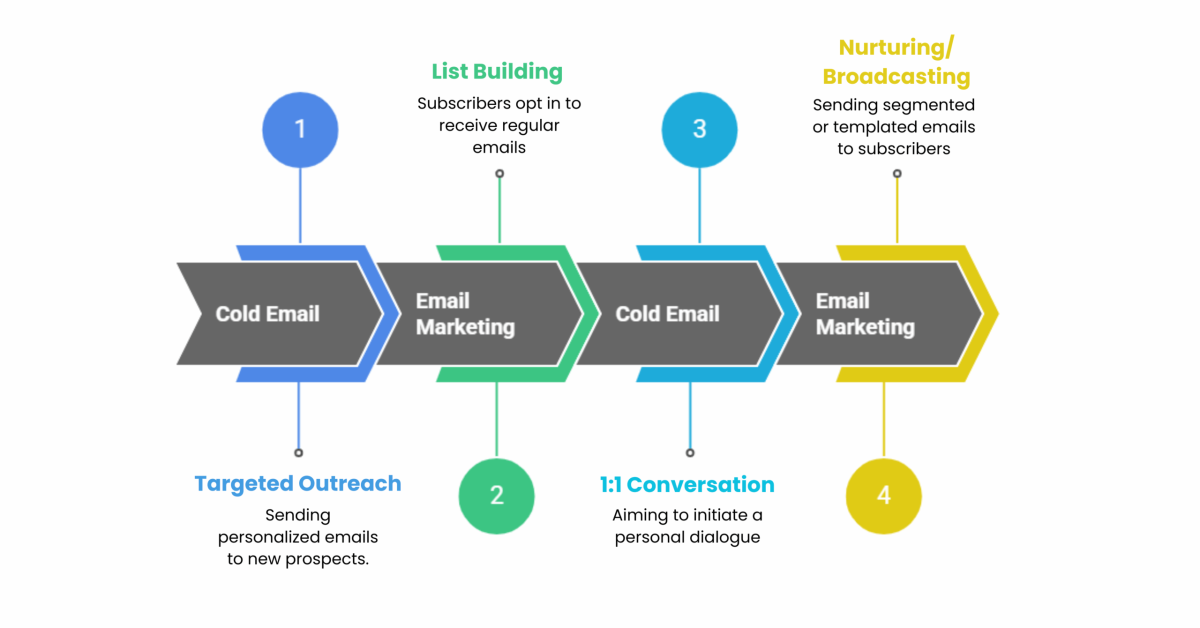
Cold email starts conversations. Email marketing nurtures relationships that already exist.
Yes, when done correctly. Cold emailing is legal in most places, though rules vary by region.
In the United States, the CAN-SPAM Act governs commercial email:
For EU recipients, GDPR applies. B2B cold outreach can qualify under “legitimate interest,” meaning the outreach relates to the recipient’s professional role.
Legal compliance is one thing. Actually reaching the inbox is another.
Platforms like ReachStream provide ESP-verified emails, so you’re only charged for valid contacts.
Why invest in cold outreach? Control, cost, and precision.
Cold email campaigns can reach hundreds of prospects while maintaining personalization through mail merge and sequencing tools. You’re not limited by ad budgets or algorithm changes.
Compared to paid ads or trade shows, cold email requires minimal financial investment. The primary costs are quality data and time spent crafting messages.
Cold email allows precise targeting by job title, industry, company size, and technographics. With platforms offering 50+ filters across firmographic and demographic attributes, you can build lists that match your exact ICP.
Modern cold email combines automation with personalization through merge fields, custom opening lines, and segmented messaging. The result feels 1:1 even when reaching hundreds of prospects.
Most failures trace back to a few common mistakes.
Blasting scraped or purchased lists with invalid emails tanks deliverability. If 20% of your emails bounce, your sender reputation suffers and future campaigns land in spam.
Generic templates get ignored. “I came across your profile and thought you’d be interested” fools no one. Personalization means showing you understand their specific situation.
Technical problems like no warmup period, poor authentication, or hitting spam traps prevent emails from reaching inboxes – 15% of emails never reach inboxes without proper optimization. You might have perfect copy that nobody ever sees.
58% of replies come from the first email, with follow-ups generating the remaining 42%. Sending one email and giving up leaves opportunity on the table.
Your list quality determines your campaign quality. This is where most teams either set themselves up for success or doom their efforts from the start.
Your ICP defines the companies and contacts most likely to buy:
Firmographics are company attributes like industry, revenue, and employee count. Demographics are contact attributes like job title and seniority. Combining both narrows your list to high-fit prospects.
Technographics reveal the technologies a company uses. If you’re selling a Salesforce integration, knowing which prospects already use Salesforce makes your outreach immediately relevant.
Sending to invalid emails damages your sender reputation. ESP verification checks whether an email address is deliverable before you send. ReachStream’s 95%+ accurate, ESP-verified emails mean you’re only charged credits on valid contacts.
Here’s a step-by-step framework for launching your first campaign.
Start with the criteria from your ICP. Which accounts fit best? Prioritize companies where you have a clear value proposition.
Use filters to build a list matching your ICP, then verify before export. ReachStream’s Chrome extension allows unlimited data downloads, with credits charged only on valid emails.
Use a dedicated sending domain, not your main company domain. Warm it up gradually over 2-4 weeks, starting with small volumes and increasing slowly. Configure SPF, DKIM, and DMARC authentication.
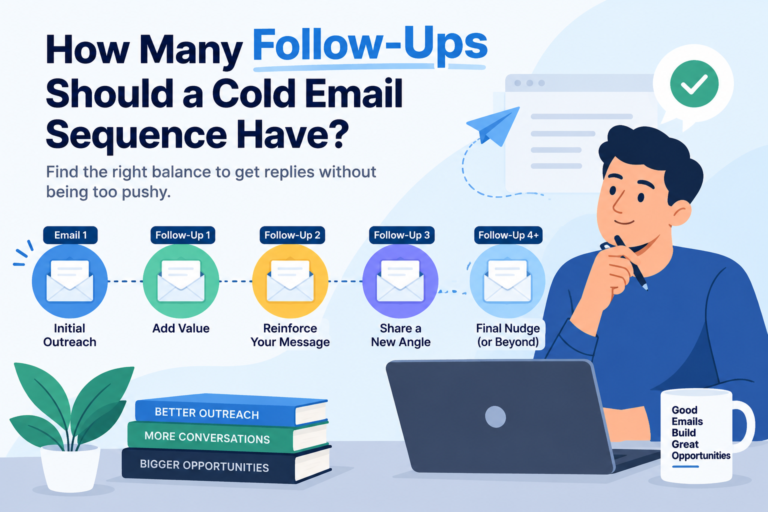
Plan an opener plus 2-3 follow-ups. Each email adds value rather than simply asking again.
Mid-week mornings (Tuesday through Thursday, 9-11 AM in your prospect’s timezone) tend to perform well. Throttle send speed to avoid triggering spam filters.
Writing effective cold emails comes down to personalization, value first, brevity, and a soft ask.
Your subject line determines whether the email gets opened – personalized subject lines are 26% more likely to be opened. Reference a business problem, not your product.
Your first sentence proves you’ve done research. Mention something specific like a recent announcement or a challenge common to their role. Avoid generic flattery.
Articulate the benefit to them, not your product features. “We helped [similar company] reduce bounce rates by 40%” beats “Our platform has advanced verification.”
For cold outreach, soft CTAs outperform hard meeting requests. Ask for feedback, a quick chat, or direction to the right person. “Would you be open to exploring this?” works better than “Let’s schedule a 30-minute call.”
Even great copy fails if it never reaches the inbox.
Your tech stack matters. Here’s what to evaluate when choosing tools.
Verification tools check email validity before sending. Some data platforms, like ReachStream, include built-in verification and free contact updates, reducing the need for separate tools.
For SDRs, AEs, and demand gen teams, cold email fits into a broader outbound motion.
Cold email outreach works when you combine quality data, personalization, a value-first approach, and strategic follow-ups. The foundation is your prospect list. Without accurate, targeted contacts, even perfect copy falls flat.
ReachStream provides ESP-verified B2B contacts with 95%+ accuracy, advanced filtering across 50+ attributes, and credits charged only on valid emails.
Sign Up for ReachStream to access verified B2B contacts and start building targeted prospect lists.
Response rates vary by industry and targeting quality. Well-executed cold email campaigns typically see reply rates between 1-5%. Focusing on list quality and personalization improves results more than volume., with an average of 3.43%. Focusing on list quality and personalization improves results more than volume.
Most successful sequences include 2-4 follow-up emails spaced 3-5 days apart. Each follow-up adds value rather than simply asking again.
Mid-week mornings (Tuesday through Thursday, 9-11 AM in your prospect’s timezone) tend to perform well. Optimal timing depends on your audience’s work patterns.
Signs include high bounce rates, emails landing in spam folders, and declining open rates. Google Postmaster Tools can help monitor domain health for Gmail recipients.
Cold email is primarily a B2B tactic. B2C contacts typically require explicit opt-in consent under most privacy regulations, making unsolicited outreach legally risky.
Spam complaints hurt your sender reputation and can lead to deliverability issues across all your campaigns. Keeping emails relevant, targeted, and easy to opt out of reduces complaint rates.

Author
Access 200M+ verified business emails and grow your sales pipeline effortlessly.
Claim Your 100 Free Export Credits Today!
Don't forget to share this post!















Check out our other blogs!
How Many Follow-Ups Should a Cold Email Sequence Have?

How a Medical Device Company Can Reach Hospital Decision-Makers
What Data Fields Should a Healthcare Marketing Database Include?
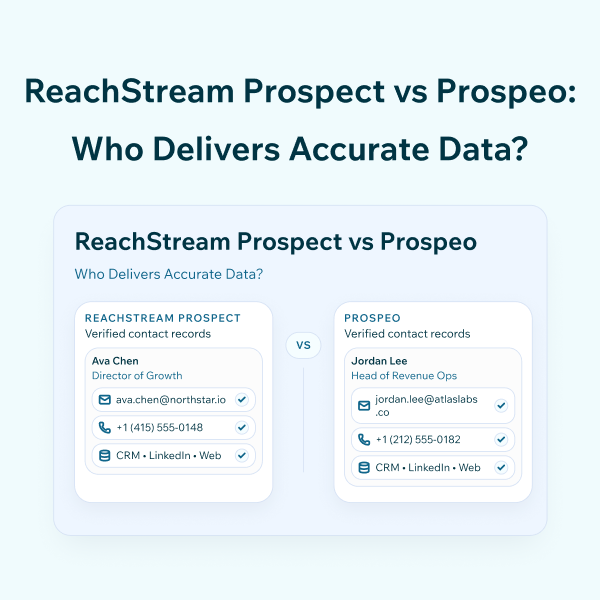
ReachStream Prospect vs Prospeo: Who Delivers Accurate Data?