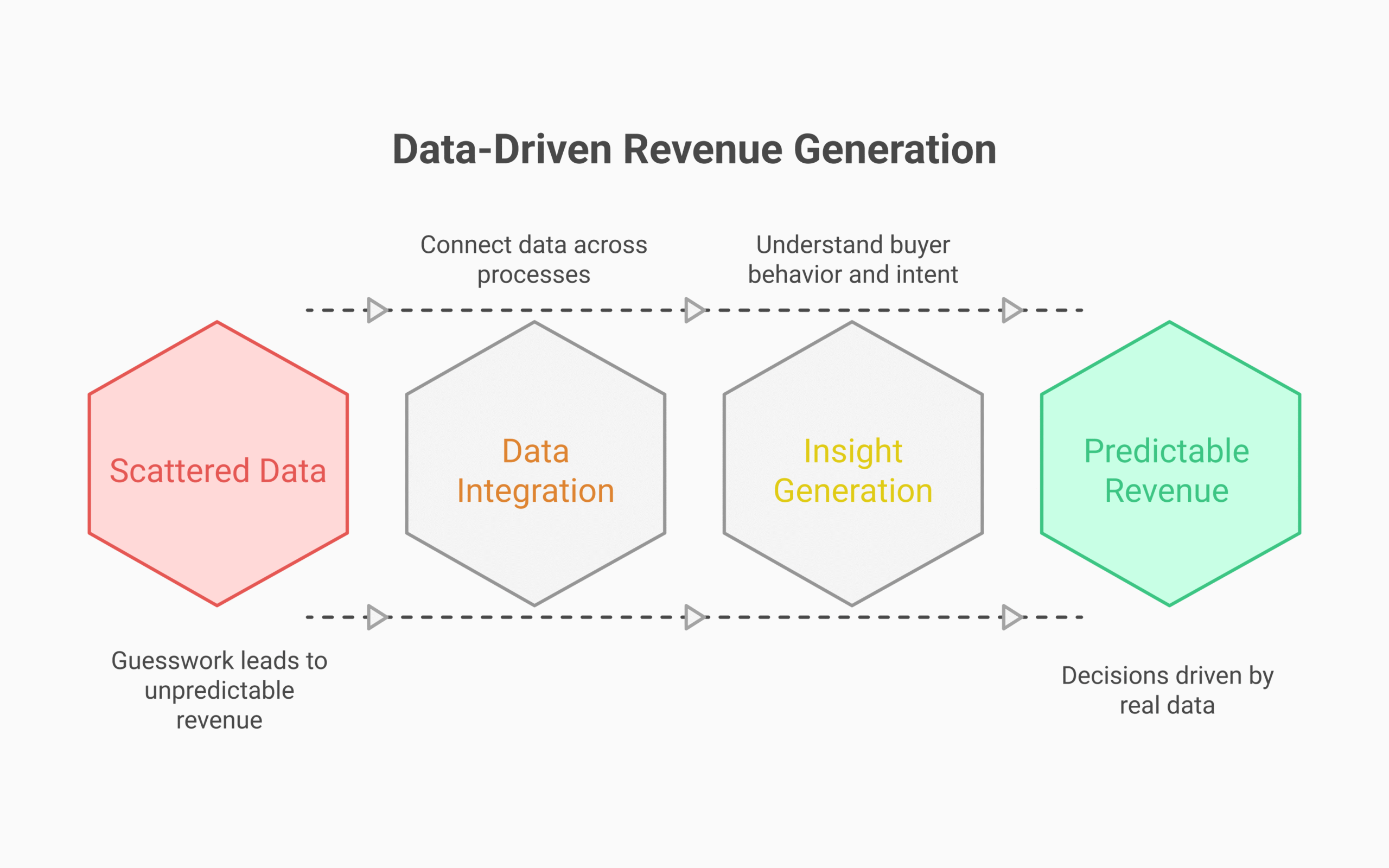
Revenue generation used to be treated as an outcome. In 2026, it’s treated as a system.
Companies no longer struggle because they lack effort or ambition. They struggle because revenue growth feels unpredictable even when teams are busy. Activity increases, but outcomes don’t scale at the same rate.
That gap is the result of outdated revenue thinking.
Where revenue was once an end result, in 2026, it’s an integrated system. The real problem isn’t ambition — it’s unpredictability: activity rises, but results don’t. That gap happens when old tactics meet modern buyers, and timing, targeting, and data aren’t connected.
Before going further, step back and consider the question that defines effective revenue leadership:
What’s currently holding revenue back?
Inconsistent pipeline
0%
Low conversion despite strong activity
0%
Poor data quality
0%
Weak expansion from existing customers
0%
The answer determines which revenue strategy matters most right now. Not every company needs everything at once.
What Is Revenue Generation?
Revenue generation combines processes, technology, and marketing strategies that help businesses earn and grow income sustainably. It includes a variety of activities, including selling physical and digital products, providing professional services through project-based or hourly pricing, monetizing owned channels with advertising, earning affiliate commissions via referrals, and leasing or selling assets.
Beyond individual transactions, revenue generation also involves digital, online, and data-driven marketing strategies that enhance demand consistency, support improved forecasting, and make cash flow more predictable over time.
Understanding Revenue Strategy
Revenue generation usually involves a range of interconnected responsibilities that guide how income is planned, executed, and expanded across the business. These nactivities come together to support lasting revenue growth, emphasizing sustainable success over quick wins.
Setting clear revenue targets for the year and breaking them down into manageable monthly or quarterly goals can really help guide your progress and keep you motivated along the way.
Aligning B2B sales and marketing strategies around shared revenue goals helps ensure that demand generation and deal closing efforts work seamlessly together, creating a unified and more effective approach.
Organizing teams and workflows to align perfectly with the revenue strategy helps ensure everyone in sales, marketing, and customer service is working together with clear accountability. This creates a cohesive environment where efforts are synchronized, and goals are more easily achieved.
Regularly reviewing sales and marketing processes helps ensure we’re consistently applying the best practices for increasing revenue. It keeps us aligned and ready to succeed!
Monitoring revenue performance through valuable metrics helps us understand how we’re doing. We can then gently adjust our revenue strategies, guided by the insights the data provides, to keep improving and growing.
Providing teams with the appropriate revenue operations tools, comprehensive training, and ongoing enablement helps ensure that every team function can contribute effectively to achieving revenue goals.
When we bring these elements together, they transform revenue generation into a smooth, well-coordinated system. This not only makes outcomes more predictable but also boosts our ability to execute plans effectively and nurtures steady, sustainable business growth.
How Do Companies Increase Revenue Today?
Most companies rely on a mix of proven revenue strategies. These strategies stay effective—but only when applied with accuracy and consistency.
Outbound prospecting continues to grow the pipeline when targeting is precise, and data is reliable. Inbound channels still convert when responding quickly to intent signals.
Expansion continues to drive growth when customer behavior is understood. The challenge isn’t choosing the right method but connecting them effectively.
Revenue Growth Through Outbound Precision
Outbound works best when relevance is prioritized.
Revenue teams achieve stronger results when outreach is connected to account fit, role clarity, and timing cues rather than generic lists. Conversely, poor contact data slows deal cycles and harms credibility before conversations even start.
Inbound That Supports Revenue, Not Just Traffic
Inbound generates revenue when leads are qualified based on genuine buying readiness.
High-performing teams route inbound demand using account context rather than form fills. This helps keep pipelines clean and ensures sales conversations happen at the right time.
Existing Customers as a Revenue Multiplier
Revenue growth increasingly stems from existing accounts.
Expansion, renewals, and cross-sell opportunities generate more stable income when teams monitor usage patterns and maturity signals. Companies that ignore this often pursue new acquisitions to cover avoidable losses.
Pricing That Evolves with Customer Value
Rigid pricing restricts growth potential.
Modern revenue models adapt to pricing as customers expand. Usage-based structures and expansion paths enable revenue to grow alongside adoption rather than remaining tied to initial assumptions.
Revenue Alignment Across Teams
Revenue grows when sales, marketing, and customer teams share the same account perspective.
Shared targeting, consistent qualification, and unified metrics reduce friction and speed up decision-making. Alignment doesn’t create extra work—it eliminates duplication.
Revenue Generation Strategies for 2026
Revenue growth in 2026 begins earlier. Teams succeed by acting on the right signals first. Accuracy is more important than volume. Clear ownership across the revenue cycle is more vital than speed alone. When data, timing, and execution align, growth becomes sustainable.
Align sales, marketing, and customer teams
Share account intent, qualification rules, and a unified account view, so marketing funnels convert into a pipeline. This alignment reduces handoff friction and improves conversions for content marketing and email marketing strategies.
Build data-driven revenue systems
Treat firmographics, technographics, and contact verification as the foundation of outreach. Verified data shortens cycles for online marketing and SEO strategies that rely on accurate targeting.
Focus on existing customers
Focus on onboarding, usage tracking, and expanding plays (cross-sell, upsell, renewals). Growth marketing and influencer strategies within accounts increase lifetime value without high acquisition costs.
Adopt flexible pricing models
Shift from static rates to usage-based, tiered, or outcome-driven pricing that increases with adoption. This method enhances branding and marketing credibility because prices align with customer value.
Strengthen outbound and inbound execution
Combine targeted outbound prospecting with intent-aware inbound routing. Digital marketing and social media strategies generate qualified demand; outbound precision helps convert the right accounts more quickly.
How ReachStream Supports Modern Revenue Generation
We’ve created our platform to give teams the confidence they need before taking action, making the process smoother and more reassuring.
Revenue growth stalls when targeting is based on assumptions. Our platform replaces guesses with verified insights—before outreach begins.
Account-Based List Builders Built for Real Revenue
Instead of broad filters, we enable precise account targeting based on firmographic and technographic data. This helps revenue teams concentrate on accounts that are truly ready to convert.
Chrome Extension for Real-Time Revenue Insight
The Chrome extension retrieves verified company and contact profiles directly from LinkedIn as you research and prospect. It reduces tab-switching and accelerates lead qualification without disrupting your workflow.
Data Enrichment That Makes Every Contact Action-Ready
We enhance every contact with verified emails, phone numbers, company attributes, technology details, and company size information such as name and address. This gives our teams a clear, reliable view before outreach—helping them prioritize the right contacts and engage companies with confidence.
ReachAPI That Keeps Revenue Data Current
ReachAPI allows your CRM, internal tools, or workflows to connect directly to ReachStream and automatically retrieve the data they need. No logging in. No filters needed. No downloading lists. Your systems simply request fresh contact or company data in the background and get it instantly.
100% ESP Verification That Protects Revenue Performance
Every bounced email affect revenue and sender credibility. We verify email addresses before campaigns go live, helping teams achieve over 90% email deliverability while safeguarding domain reputation. This ensures outreach reaches real inboxes and avoids long-term performance issues.
Make revenue predictable, not
noisy when data guides action.
Revenue generation no longer belongs to a single team or title. Instead, it involves the entire organization. Sales turns opportunities into results.
Marketing impacts the quality of demand entering the pipeline. Customer teams drive growth after closing the initial deal. Operations guarantee accuracy and continuity across systems. Leadership unites everything by setting priorities and ensuring alignment.
When each function assumes ownership and visibility is shared, revenue becomes more predictable. Decisions are made faster, handoffs are smoother, and growth is easier to scale. Going forward, revenue growth will favor teams that act deliberately rather than just focusing on volume. Loud execution will not succeed; clear, focused execution will.
The companies that succeed won’t chase after every deal but will spot the right opportunities early and act confidently backed by platforms using ReachStream, which make sure teams work from the same verified account and contact data.
This isn’t a prediction about the future; it’s how revenue already works.
Frequently asked questions
1. What is revenue generation in simple terms?
Revenue generation is how a business creates income by attracting the right customers, delivering value, and monetizing products or services through multiple channels. It spans marketing efforts, sales execution, subscriptions, and other income streams that support sustainable growth.
2. Who is responsible for revenue generation?
Revenue generation is a shared responsibility across sales, marketing, and customer success, with support from product, finance, and leadership. While the CEO sets overall targets, teams align acquisition, retention, and expansion using coordinated marketing strategies for businesses.
3. How is revenue generation different from sales?
Sales focus on closing deals, while revenue generation covers the broader system that produces income. It includes customer engagement, planning, and execution through digital and content marketing strategies, as well as long-term growth initiatives—making sales part of a larger process.
4. Why is data accuracy critical for revenue generation?
The most effective strategies in 2026 combine AI-led personalization, data-driven decision-making, and strong RevOps alignment. Businesses will also rely on growth marketing strategies, CLV optimization through upselling and cross-selling, and multi-channel execution aligned with the best marketing strategies for 2026.
5. What revenue generation strategies work best in 2026?
By 2026, leading revenue strategies will center on AI-driven personalization, data-driven marketing strategies for smarter decision-making, tighter sales and marketing integration through RevOps, and CLV optimization via upselling and cross-selling. Multi-channel, intent-focused execution, and flexible pricing models will further support alignment across teams and evolving customer needs.
6. How can companies make revenue more predictable?
Revenue becomes more predictable when businesses invest in consistent demand generation, technology-enabled sales processes, and recurring revenue models. Strong alignment across online marketing strategies, retention efforts, and customer expansion further improves stability.
7. How does ReachStream improve business marketing?
We help teams execute more precise digital and online marketing strategies by providing verified account and contact intelligence, enabling cleaner targeting, better-qualified campaigns, and more efficient marketing execution.
Table of Contents
Junaid Hussain Khan
Sales & Lead Generation Expert skilled in B2B Marketing, Prospecting, and Demand Generation with a Business Administration degree from Al-Ameen Institute of Management Studies.
Access 200M+ verified business emails and grow your sales pipeline effortlessly.
Junaid Hussain Khan is the Business Development Manager at ReachStream, adept at forging strategic partnerships and identifying new market opportunities to propel ReachStream's growth and strengthen its position in the B2B ecosystem.