


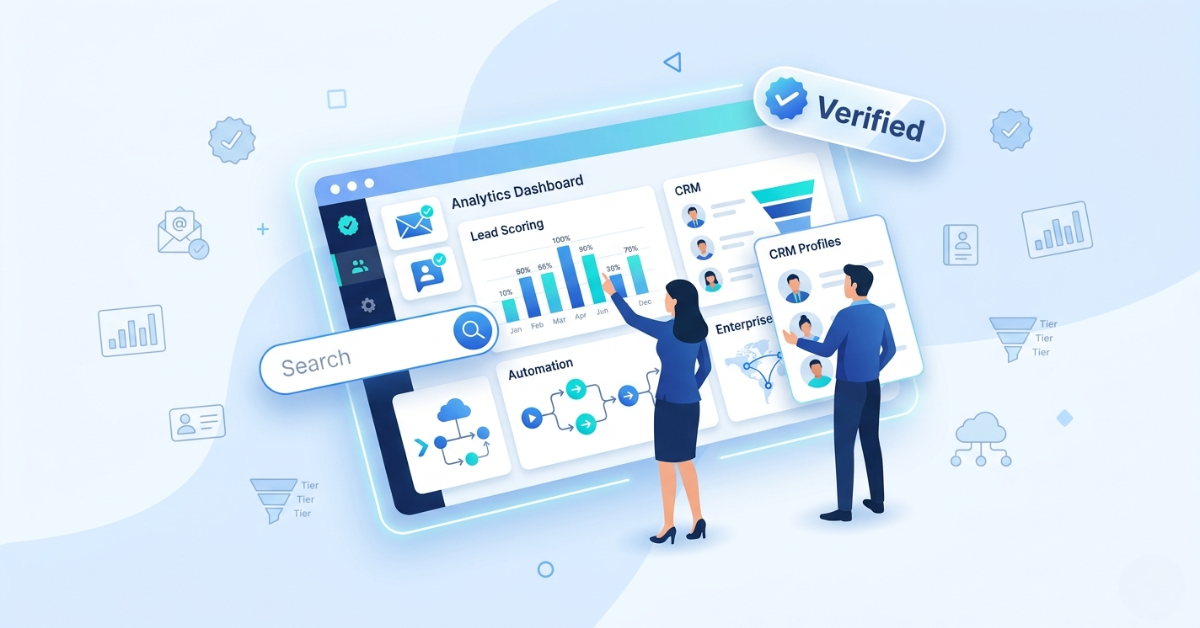
How to Evaluate B2B Data Vendors for Accuracy and Compliance
Your pipeline is only as strong as the data feeding it. When 30% of B2B contact data decays annually, the platform you choose for lead generation determines whether your outreach lands in inboxes or bounces into the void.
This guide breaks down what lead gen platforms actually do, which features matter most for enterprise teams, and how the top platforms with verified emails compare in 2026.
Lead gen platforms automate and optimize the process of attracting, capturing, and nurturing prospective customers. Instead of manually hunting for contact information or guessing which companies fit your target market, you use software that handles the research, validation, and organization for you.
The right tool depends on what you’re trying to accomplish. Some teams focus on outbound prospecting. Others prioritize inbound marketing. And some want to connect ad campaigns directly to their CRM.
Here’s how the main categories break down:
Most enterprise teams end up using a mix of approaches. The trick is finding platforms that play well with your existing tools while delivering data you can actually trust.
Here’s the thing about email accuracy: it affects everything downstream. When you send messages to invalid addresses, those hard bounces hurt your sender reputation. And once your domain reputation takes a hit, even your valid emails start landing in spam folders.
For teams sending thousands of emails each week, this becomes a real problem fast.
Verified data isn’t just a nice feature to have. It’s the foundation that makes high-volume outreach actually work.
Not every platform delivers the same value. When you’re comparing options, a few capabilities separate tools that scale well from those that create headaches.
Email verification checks whether an address is valid and deliverable before you hit send. The process typically includes syntax checks, domain verification, and mailbox confirmation.
Platforms often state their accuracy rates upfront. ReachStream, for example, claims 95% accuracy across its database. That number gives you a benchmark when comparing vendors.
People change jobs. Companies get acquired. Phone numbers go out of service. Without regular data updates, your CRM fills up with contacts who moved on months ago.
Data enrichment fills in missing fields and refreshes stale records. Platforms that update their databases every 45-90 days help you stay current, which matters when data decay affects thousands of records monthly.
Precise targeting starts with granular filters. You want to search by industry, role, company size, revenue, location, and technographics to define exactly who you’re trying to reach.
The more filter options available, the more precisely you can build lists matching your ideal customer profile. Look for platforms offering 20+ attributes as a baseline.
Seamless sync with your existing sales tools eliminates manual data entry. Whether you use Salesforce, HubSpot, or another CRM, native integrations save hours of administrative work each week.
API access becomes especially valuable for enterprise teams embedding data directly into custom workflows or proprietary applications.
Browser extensions surface verified contact details directly on LinkedIn profiles. You capture prospect information without switching between tabs or copying data manually.
For SDRs spending hours daily on LinkedIn research, this speeds up prospecting significantly.
Enterprise teams face regulatory scrutiny that smaller organizations might avoid. Built-in compliance features protect against risk and satisfy legal and procurement teams during vendor evaluation.
Now for the practical part. Here are the platforms that stand out for enterprise teams prioritizing verified email data and scalable prospecting.
ReachStream combines verified B2B contact data with data enrichment, a Chrome extension for LinkedIn, and API integration. The platform offers transparent pricing and emphasizes a simpler user experience while maintaining 95% stated accuracy across 200M+ contacts.
What makes it different is the combination of accessibility and enterprise capability. Teams from solopreneurs to large organizations use the same platform without unnecessary complexity. A 7-step verification process and 45-day data refresh cycle keep records current.
Apollo works as an all-in-one prospecting and engagement platform with built-in email sequences. If you want outreach automation bundled with your data, it’s a strong option.
The tradeoff is complexity. More features mean more to learn and configure, and costs can escalate at scale.
ZoomInfo offers enterprise-grade database coverage with deep firmographic and technographic data. Large organizations with significant budgets often default here.
Pricing reflects that enterprise positioning, which can be prohibitive for growing teams.
Cognism emphasizes GDPR compliance and strong European coverage. Teams prioritizing international prospecting with regulatory confidence find value here.
Coverage outside Europe may be less comprehensive than some competitors.
Lusha focuses on quick contact enrichment through a browser extension. Individual contributors and small teams benefit from fast lookups without platform overhead.
Enterprise features are more limited compared to full-scale platforms.
UpLead builds real-time email verification directly into the platform. Validation happens before export, so you don’t need separate verification tools.
The database size is smaller than some competitors, which may limit coverage in niche industries.
Clearbit positions itself as a real-time enrichment API for marketing and product teams. Companies embedding data into custom applications find strong value here.
It’s less suited for traditional sales prospecting workflows.
Seamless AI uses artificial intelligence to automate contact finding with CRM integration. Teams wanting automated list building with minimal manual effort appreciate this approach.
Data accuracy can be inconsistent compared to platforms with manual verification layers.
Snov.io combines email finding with outreach automation at accessible price points. Startups and small teams on tighter budgets often start here.
Enterprise features and support are more limited.
Hunter focuses specifically on domain-based email search and verification. For simple email lookup without full platform features, it’s efficient and straightforward.
It lacks the broader prospecting and enrichment capabilities of comprehensive platforms.
Selecting the right platform involves more than comparing feature lists. Here’s a practical framework.
Your ICP determines which filtering attributes matter most. Start by clarifying who you’re trying to reach: industry, company size, role, geography. Then evaluate which tools offer those specific filters.
Ask vendors directly about their verification process. How do they validate emails? Do they use AI, manual review, or both? How frequently do they refresh data? Stated accuracy rates give you a baseline for comparison.
List your current CRM, sales engagement, and marketing tools first. Then confirm native integrations or API support. Platforms that don’t connect to your stack create manual work that erodes efficiency gains.
Understand credit models, seat-based pricing, and volume tiers to project true cost as your team grows. Some platforms become significantly more expensive at scale, while others offer predictable pricing.
Pricing models vary significantly across platforms. The sticker price rarely tells the full story.
Watch for hidden costs like overages, add-on features, implementation fees, and premium support charges. Transparent pricing, where you can see exactly what you’re paying for, simplifies budgeting and avoids surprises.
The right lead gen platform changes how your team operates. Instead of chasing outdated contacts and managing bounced emails, you focus on conversations that convert.
When you start with verified emails, accurate firmographics, and current contact information, every downstream activity improves. Deliverability goes up. Response rates climb. And closed deals follow.
The best platform depends on your data accuracy requirements, integration setup, and budget. Enterprise teams typically prioritize verified emails, CRM sync, and scalable API access. Platforms like ReachStream, ZoomInfo, and Apollo serve this segment well, though pricing and complexity vary.
Most platforms use a combination of syntax checks, domain validation, and mailbox verification. Some add manual review layers or AI-powered validation. The goal is confirming an email is deliverable before you export or send, reducing bounces and protecting sender reputation.
AI assistants help with drafting outreach and researching companies, but they can’t access live contact databases or verify email deliverability. You still use dedicated lead gen platforms for accurate, current contact data. Think of AI as a complement, not a replacement.
A lead gen platform helps you find and verify new contacts. A CRM stores and manages existing relationships. Most teams use both together. The lead gen platform feeds qualified prospects into the CRM where sales teams nurture and close them.
Free tools often have limited data accuracy, smaller databases, and restricted export capabilities. For occasional lookups, they work fine. For enterprise-scale prospecting, the deliverability issues and data gaps typically cost more in wasted effort than a paid platform would.
Marketing professional with a Master’s degree in Marketing, specializing in SEO, content strategy, social media, performance marketing, prospecting, and demand generation.
Access 200M+ verified business emails and grow your sales pipeline effortlessly.
Don't forget to share this post!















Check out our other blogs!
What Is B2B Data and Why It Matters for Modern Sales Teams
A Buyer’s Checklist for Evaluating B2B Data Providers
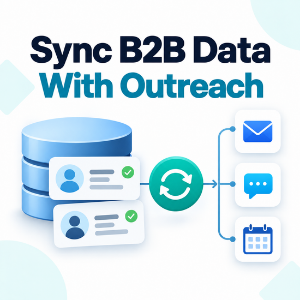
How to Sync B2B Data with Your Outreach Sequences